Friday, September 28, 2007

Towards an Icelandic Smelter (1)

(As background - Early Iron 4 was canceled due to lack of organization.
and I had already set aside time for it. So on short notice I decided to
run another smelt here at Wareham)

Dr Kevin Smith and I have been discussing the work he has been doing
excavating a Viking Age iron smelting site at Hals in Iceland. The
details can be found in his article 'Ore, Fire, Hammer, Sickle: Iron
Production in Viking Age and Early Medieval Iceland'.

A long range plan is to work towards a full reconstruction smelt using
the Hals excavations as the prototype. In brief the construction is a
conical stack of cut grass sod strips contained in a box frame of
timber. This whole construction is roughly 2 x 2 m and stands about 1 m
tall. The space between the cone and the box is leveled off with earth
for a working surface. The shaft of the furnace is cut down into the
sods, then lined with a relatively thin (3 cm) layer of clay like
material. The tuyere area is made up of stone slabs, with a 'blow hole'
method used to introduce the air. Evidence strongly suggests a top
extraction.

Taking some information provided by Skip Williams from his experiences
working (primarily) with Micheal Nissen (from Ribe) at the last European
Iron Symposium:

The blow hole has a thin plate of material used in those areas of the
furnace around the tuyere that are subjected to the greatest
temperatures. The thinner plate around and especially above the tuyere
opening allow the heat to bleed off the surface and keep the plate from
melting. (This opposed to our current thick walled furnaces that
withstand erosion every smelt.) The tuyere itself does not fit tightly
into the smelter - or protrude into the inside of the furnace. (Our
current method does both of these.)

This blow hole method has proved successful (Nissen and Williams) at lower air volumes - in
the range of 300 litres per minute.
As the bellows tube does not extend into the furnace, there is minimal
damage to the tube. (In essence there is no true tuyere - just the
nossel of the bellows).
The opening for this bellows tube is larger than the tube itself. In
practice Skip reports this produces a venturi effect to increase air
flow. It also allows the operators to see directly into the interior at
the developing bloom. Any surplus slag will flow off well before it
clogs up the air blast.

I have decided to run the Thanksgiving smelt as the first test towards
the full Hals prototype:

The main difference here from our last smelter is the construction of a
stone slab front and use of the blow hole method. The overall
construction will remain the proven thick walled clay cobb set as half
buried in the earth bank. The tuyere / bellows tube will again be the
ceramic tube with air via the current vacumn blower. This blower can be
throttled back to the lower air volume.
There is plenty of charcoal on hand, most likely using the pre sized
material that the Wareham Forge purchased in the spring (to save labour).
As the evidence from Hals suggests a high iron content bog ore was used
(very little slag produced) I'm suggesting use of the hematite grit as
the ore. Carbon control may be a problem, but the smaller particle size
may prove a good fit to a reduced air volume.

In truth this amounts to THREE changes to our process: Tuyere / Plate /
Air. I don't anticipate too many problems from the use of the stone
plate construction. Air can be quickly modified if required. The use of
the blow hole rather than our standard insert tuyere is the main
modification here.

Still there is a good chance (I'd say at least 50 / 50) that the smelt
may not result in a working bloom.

(Stay tuned!)

Monday, September 17, 2007

Viking Age Seax Two

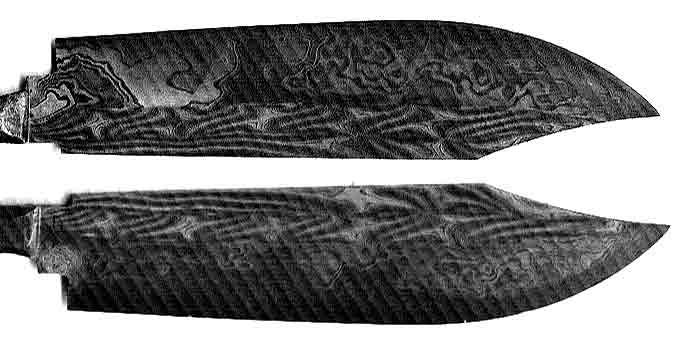
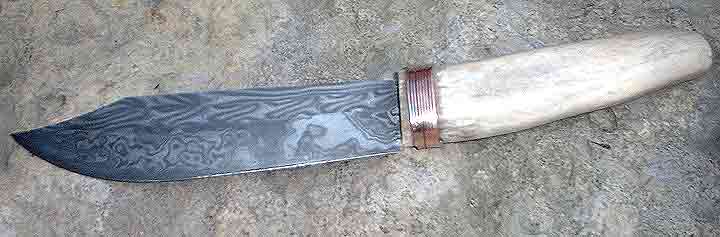
I may have talked about this blade earlier in the year - back in the forging process. The knife is completed and now off to the customer.

The blade is a heavy tool knife pattern - most typical of Norse men's knives. (Note that the customer is a woman - but one who specifically wanted the heavy tool style instead of the more typical long triangle kitchen blade.)

The overall length of the blade is a bit over six inches (these images roughly life sized - sorry that they are not the most crisp). At its widest (just back of the false edge) the blade is roughly 1 1/4 inch wide. The hilt is a natural piece of caribou antler. The wire wrap is a feature the customer requested. I drilled two small holes that the wire ends tuck into, then the strands were soldered together at top and bottom. (This was a high tin solder to avoid burning the underlaying antler.)

The blade is made up of 209 layers. The starting block was 13 layers :
M/LM/L/M/L/M/H/M/L/M/L/M/L/M
M = 1018 mild steel at 1/8"
L = L6 alloy (.5 nickel and .5 carbon) at 1/16"
H = 1095 carbon steel at 3/16"
The overall carbon content is lower, with the bulk of the material being supplied by the mild steel. The inclusion of L6 is to mimic meteoric iron.
This pile was welded and folded in three for a billet at 52 layers. That billet was drawn to a bar, with a third twisted right, a third twisted left. The last third was flattened and pulled out to twice that length, then welded to a second core of high carbon steel. The resulting bar was turned on its edge, and the two twisted segments welded into the final billet. This billet at 209 layers was forged out into the blade.

The finished blade is ground back at the edge to expose this high carbon steel cutting edge. This edge is hardened a bit more than normal for a plain mono block knife, as the layered back adds the required flexibility for the final blade.

Tuesday, August 28, 2007

Forging the Elements

To my loyal readers:

Those of you who have been following my work knowthat for the last two months (not counting a lot of August) I have been working on a set of front porch railings for a home renovation in the Riverdale Park area of Toronto.

Another long toiling project here has been getting a new digital video camera and learning how to use it.

In an effort to keep my clients informed, I have been making up a photo essay describing the 'work in progress' on the Riverdale House. Along with that, I had shot a short video segment showing the actual process of forging one of the hundreds of individual elements required for the project.

If all the retail shows I have been away at this last month are not enough insanity, just today I have had a satellite internet uplink system installed here in Wareham. (Less said about Bell Canada's 1 KPS "service" level the better.) So one of my first tests of te new uplink was to add that same video element - as Quicktime movie to the web site...

http://www.warehamforge.ca/work-in-progress/forging%20copy.mov

I'm pretty happy with the results

Friday, August 24, 2007

'Rivendale'

(sorry that these postings have been scant of late - August is show month and I've been away a lot...)

On Development of a Distinctive Style

As a high school student back in the early 70's I had been drawn to the sweeping curves in the distinctive art work of designer and illustrator Roger Dean. His work was seen on a large number of album covers of the times, most especially a large series of interlocked story images for the English group Yes. Dean's work featured a type of organic architectural design plus repeated use of a ribbon like 'reversal curve' rendered in bright colours. A lot of my earliest art work was in the mediums of large acrylic paintings and silk screen prints. Although I did attempt pieces in a wide range of materials and techniques, metalworking was not among these. I had barely managed a passing mark in grade 10 metal shop!

In college, I became increasingly interested in the art and artifacts of the Irish and Scandinavians. Through a widening of my exploration of historic styles, I began working back from contemporary artists to original sources. Dean it turned out had himself been influenced by the artists of the Art Nouveau period 100 years earlier. This movement in turn had been based on the unearthing of Celtic and Norse antiquities in the 1860's through 1880's. Objects like the Ardaugh Chalice and the Oseberg Ship Burial had electrified the designs of the times. Again it was the combination of sinuous curves and interlaced lines that I was drawn to. Further explorations revealed the bold patterns of 'La Tene' Celtic Iron Age bronze work, which was echoed by the lines of the Norse 'Urnes' style. I was also fascinated by the blending of artistic traditions and cultural influences seen on such objects as the St. Patrick's Bell Shrine - with its mix of Celtic and Norse, Pagan and Christian.
About the same time, I started my first working of forged metals. Frustration with my inability to touch weld had caused me to take a hammer and attempt to destroy the steel piece I was working with. In an Eureka moment, the process of deforming the hot metal grabbed my attention - and has never let it go! Working against discouragement from course instructors, I slowly began teaching myself the methods of the blacksmith.

From the very start, I had been drawn to the fluid lines of the Art Nouveau metalsmiths. At first it was the overall style of organic curves and sweeping asymmetrical designs that strongly influenced my own work. Because of my own long developing technical skill, and most importantly the physical limits of my own strength, much of these early pieces used lighter weight stocks. The stress was on line, with sculpting the mass of the material limited. Slowly I began to tie in my various influences into a personal style.
I had seen the Artist Blacksmith Roberta Elliot demonstrate working with heavy steel pipe at a conference, and had began exploring the possibilities myself. This lead to experimenting with forging other structural shapes - angle, channel and T section. Into the late 1990's, now with over 20 years at the forge to back me up, I took a fresh look at those individual Art Nouveau artists who's work I admired the most. Designers like Victor Guimard especially had blended work in stone, glass, wood and metal into their architectural designs. I now looked again at the work, but now in detail, with my own experience helping to clarify the picture, The 1870's to 1880's represented a unique combination of factors in forged metalwork, the like of which may never happen again. Ancient wrought iron material, with its excellent forging properties, was being replaced by the new cheaper mild steel. Blacksmiths had learned via the apprenticeship method a vast depth of traditional skills. At the same time, new tools and technologies were being introduced, the recently invented oxy-acetelyne torch for example. The new steel was being made into structural profiles that had never existed before. Of course the first thing the Artisan Blacksmith of that age did when presented with something like angle or channel was to cut back and explode the ends and explore all the possibilities of hot working the new materials.
In my own work I too started exploring the effect of aggressively forging structural shapes. The purchase of a small air hammer made it possible to work with larger stock sizes that would have proved far to physically demanding to hand hammer in the past. It was often said that 'A smith does his best work between 40 and 50'. I had reached that point where experience and skill could back up maturity in design.

I had developed a strong personal style, clearly visible through a body of past work. Like Art Nouveau, it was strongly influenced by historic European artifacts, and featured aggressively forged elements combined into flowing lines and often asymmetrical overall designs. I had forged a style - but one without a name.
In 2001 Peter Jackson's 'Fellowship of the Ring' was released. The films that made up his monumental 'Lord of the Rings' would have a huge impact. Most significant was the incredible detail in the conceptual designs at the hands of Allen Lee and Richard Howe. When I saw the film the first time, I found I was in such familiar ground - Howe and Lee had based so much of their cultural landscape for Middle Earth on those same Norse, Saxon and Celtic objects I knew so well. In the conceptual designs for the Elves of Rivendale especially, I saw the same blend of the Norse Urnes style blended through Art Nouveau lines which marked by own (long developed!) style.

So although I certainly had charted my own long progression to an artistic style entirely independent of Allen Lee, there is no doubt we had both been influenced by the same ancient sources. I have come to use the term 'Rivendale' to describe my metalwork style. Those striking images from Jackson's 'Lord of the Rings' are firmly rooted in present popular culture and the description creates an instant impression on the listener.

Like any artist, I expect that my work will shift and develop with time. The scope of the projects undertaken may (hopefully!) exand as a reputation for high quality original art metalwork increases into the future. My artistic vision is a result of all my past influences however, and I expect my RIVENDALE style to remain distinctive for years to come...

(formatted with images : www.warehamforge.ca/rivendale/rivendale.html)
 

February 15 - May 15, 2012 : Supported by a Crafts Projects - Creation and Development Grant

COPYRIGHT NOTICE - All posted text and images @ Darrell Markewitz.
No duplication, in whole or in part, is permitted without the author's expressed written permission.
For a detailed copyright statement : go HERE