Wednesday, January 28, 2009

'Will you take an Apprentice?'

I wanted to make a general commentary on this whole situation, if for no other reason than to save me repeating the same general reply over and over. (I refer readers to an earlier related piece 'Career as an Artisan Blacksmith? )I have been getting an increasing number of letters like the following:

" I have always had an interest in blacksmithing ... and after having attended a basic course I have had a great desire to learn more about blacksmithing and gain some experience at it .... even though it would mean a drastic cut in pay I would rather learn more about blacksmithing if it is at all feasible.

I started researching blacksmiths online (including the OABA website) looking for a potential employer I felt I could learn from and enjoy working with...

I do understand that as an apprentice I would be required to do the simple, repetitive and labour intensive tasks as befitting my level of experience. I also realize that it must be done at a rate of pay that is profitable to you. If you have sufficient work for me, or can acquire such work (i.e. making handles, hooks or simple fireplace tools and more as I gain experience and skill) I would be more than happy to come into your employment."
(much edited from the original - name removed )


The simple answer is, well, no.
And here is why...


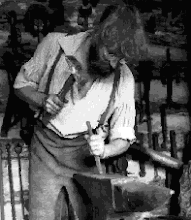
'Traditionally' (used in this case to refer to the Settlement Era) a young person (virtually always male) learned the 'art and mystery' of the blacksmith at the hands of an older, experienced smith, via the apprenticeship system. A typical arrangement started at age 9 to 11, and lasted anything from 5 - 7 years. A legal contract (indenture) defined the relationship. As with any contract, it cut both ways:
The Master was required to -
Supply food and housing
Supply clothing as required
Teach the student the trade
The Apprentice was required to -
Obey the Master
Work as instructed
Live with the Master
Refrain from specified behaviours (generally alcohol, gambling, women)
Depending on the time and place, there might be a 'signing fee' paid by the parents to the Master. In some cases there would be some limited 'pay' over the final years of the apprenticeship, typically paid to the parents, not the boy. The Master would be responsible (legally) for the conduct of the Apprentice, which included handing out discipline as he saw fit. The living conditions for the Apprentice varied considerably, anything from table scraps and sleeping in the forge to living like a member of the family. The Apprentice was bound, and subject to prison if he broke the contract.

The Master was trading off years of instruction against a possible assistant in the later years of the arrangement. A young apprentice was fit for not much more than sweeping up and simple labour at first. By the mid point of the indenture, the apprentice would be able to assume more and more complex tasks. It was expected by the last years he would be a hard working assistant, this labour 'paying back' the effect loss to the smith at the beginning.

At the end of the ideal indenture, the Apprentice left his former Master's shop, with a box of tools (made himself), a store of knowledge, and some store of direct experience. At this point he was considered a Journeyman - a trained blacksmith who moved to work for pay in other shops to accumulate experience and hopefully the funds to start his own business.


This traditional system rarely (if ever) can be applied to our modern world. Young people are in school until well into the age range that once was expected for journeymen (late teens). The only way the apprenticeship system works is with multi year commitments, trading labour against room and board.

So to be clear, what people have been asking me for is really a Journeyman position, but with no skills to bring to the arrangement. Undertaking repetitive tasks at a reduced wage for the opportunity of being gaining experience in more specialized skills as an assistant. I certainly see what advantage is in it for them. What advantage do I gain as the blacksmith? The only way I could envision such a relationship would be one framed much more like the traditional one: Straight out of high school, a multi year contract, room and board and no wages. Something you could arrange with a son or daughter, but not likely 'legal' in our modern world.

Right off the top, people forget that any working situation in our modern world is governed by strict provisions - the Labour Laws. Minimum Wages, Workman's Compensation Insurance, Unemployment Insurance, requirements for Occupational Health and Safety. These costs alone are going to amount to hundreds of dollars a month. As a 'sole proprietor' defined business, I can subject * myself * to extremes. Legally, I am not allowed to do this for any employee. (An example, there is no heat in the workshop, and its been -15 C most the last week, and why I'm inside writing this.)


A practical aspect is - just what kind of work goes on at the typical 'Artist Blacksmith' work shop? Can even a minimum wage level assistant fit into the pattern?

The honest truth is - this is a feast and famine lifestyle. And never confuse yourself that the artist blacksmith is an artist first, not a business man! Those who are interested in the business selling metal objects are not using the skilled labour intensive methods which these potential 'Apprentices' are so interested in learning. Certainly one can 'get by' supporting themselves as an artist, but you do this because you are compelled to the work, and chose the life that this creates. It absolutely is no comparison to working at GM - no weekly wages, no pension, no support if you can't work. If that is your hope, it is an empty dream.
Projects come and projects go. On a good year there will be large and interesting commissions, sometimes actually resulting in profits left over. A huge amount of time is spent in the raw mechanics of supporting the business. Forms, accounts, communication, promotion, design, maintenance, prototypes. If I manage one hour actually at the forge for every four hours spent on other stuff...

So for my own operation, and for most of the other Artist Blacksmiths I know, the only time I can * afford * to have an assistant is when a specific project requires specific help. This is almost always things like a couple of days painting, a couple of hours moving a large piece, a day helping install or deliver a finished piece. I no longer make 'handles, hooks or simple fireplace tools'. That is work too easily available off shore at slave wages, I leave that to the newcomers to compete over.


One last important consideration - Knowledge is hard won, and not casually given away. I personally are part of a generation of artisans who had to re-invent their skills from the ground up - working alone. I tell my (paid) students that they will learn more on a two day basic course than I did working two * years * on my own. I am amazed (and sometimes in awe of) the 'current generation' of artisan smiths coming up. They have had not had to spend years inventing simple skills, so they start working at such a higher level. How much knowledge should be given away to those who are fully intending on becoming my direct competition in an ever shrinking market place?
Skills can only be achieved through practice, the speed and fluidity that so many see in my own hands is only created through endless repetition. That skill has a high price that has been paid, if nothing else in mere years of practice with little money generated. There is also the cost in raw damage, for smithing is destructive to the body, and those endless hours take their toll.


So, in the end I must say, despite your honesty of intent, that I can not help you. You have much to gain, but the cost to me personally is much too high.

Advice, however, I am willing to give freely:
Get yourself even the most simple of forge and anvil. Practice. Learn slowly, but practice endlessly.

Tuesday, January 27, 2009

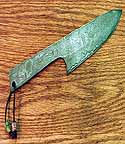
A known Meteor Iron Blade - from 1600!

Nathaniel had left a comment the post "Meteors in Forge and History" (edited):

While in D.C. at the freer we saw a meteoric iron knife from 13th century India where a meteorite was seen to hit, retrieved and made into a knife. So at least in India they got the sky metal connection.

quote from www.asia.si.edu (Simthsonian's Freer Museum)

Early pre-Mughal Sultanate period (ca. 1206-1526) works on view include ...
* Several Mughal luxury objects, including a knife made for the Emperor Jahangir out of meteoric iron and decorated with gold inlay...

(from the on line catalog - artifact entry)

1621 - Mughal dynasty
Meteoric iron, with gold inlay
H: 26.1 cm
India
Purchase, F1955.27a-b

(Image from the Museum web site)
"At dawn a tremendous noise arose in the east. It was so terrifying that it nearly frightened the inhabitants out of their skins. Then, in the midst of tumultuous noise, something bright fell to the earth from above...."

From the Jahangirnama (1605-24)

Thus did Emperor Jahangir describe a meteor that landed within his kingdom in April 1621. His fascination with unusual natural events—and his power to harness their aura—is revealed by this dagger's blade, forged from the glittering meteorite. Jahangir further noted that the blade "cut beautifully, as well as the very best swords."


In the original commentary, I had finished up by saying : "I should note that the whole 'streaks in the sky to rocks on the ground' connection was actually NOT made until the middle 1800's. The whole concept of a 'sky stone' would have been completely unknown (and unthinkable) to the Medieval mind. This is a fiction created by modern fantasy writers."
I should have been slightly more specific, in that I was referring directly to Western Europe and the Medieval (pre 1500's) period. I had not known about this ** Arabic ** object, and thank Nathaniel to pointing it out to the rest of us!

(Much later!)

See Aron's comment below.
My big error, that should read ** Indian **

Its nice to see that people still read the older posts!
I stand well corrected for not paying better attention to the reference. However, I will mention that I (try to) never attribute religion to any object, although I should not have attributed a cultural set from a (mistaken) geographic description. My use of 'Arabic' here would be like saying 'European' or 'African' - a sweeping locating generality only.
(And any object from the 1600's in Europe would in fact be as default described as 'Christian'...)

Thursday, January 22, 2009

Charcoal to Bar in Colonial Furnaces

This is a commentary edited from a posting to the 'Early Iron' discussion:

" ... Can anyone come up with a ballpark figure (SWAG) for how much charcoal it takes to make a ton of bar iron? There really aren't any good figures for the 17-18C, because they frequently measured by the basket-load, and very few of them wrote down consumption figures anyway..."
James


James is referring to Colonial Era (American) bloomery furnaces. These operate more or less the same way the Viking Age prototypes I have been working with. Most significantly, Colonial bloomeries are easily an order of magnitude larger, with bloom sizes into the multiple hundreds of pounds per smelt. Mike McCarthy has been especially interested in this type

This is my usual 'talk around the numbers' :

The raw machinery of the smelter takes a certain amount to operate in terms of heat budget. There is going to be a more or less fixed amount to get the furnace from cold to operating temperature. One of the biggest factors here is going to be raw volume and the furnace design. Numbers from small furnaces like we are using may not be the easiest to transpose, as there is a square to cube relationship between surface area (loss) and volume ( production space). My own furnaces tend to be pretty consistent, I think my smallest was 20 cm diameter and the largest about 35 cm. I'd bet most of those on Early Iron keep to the historic pattern of 'build one smelter, get it working, duplicate as required'.

With a small ore addition smelt, the ratio of fuel to iron is going to be the highest. I personally have found that (again in that standard 25 - 30 cm diameter by 65 cm tall furnace) that I need at least 8 kg ore (would vary by purity) to kick start the reaction. Looking back over my own notes, it looks like I'm using roughly 30 kg of charcoal to get the first 1 - 2 kg bloom. If the smelt keeps going, then at 60 kg the blooms produced are climbing up to the 10 kg range. At some point, the 'kick start' amounts would statistically disappear into the large bloom production numbers. (You want to find out from Lee and Mike what kind of raw material to iron production numbers they got from the huge bloom they worked on last Smeltfest.)

The size of the reaction volume in the furnace is dependent on air delivery. We have built furnaces up over 100 cm. Our usual air volumes are set by * diameter * (in the order 800 l/m +/-). What happens is that the reaction column (in our standard furnace) remains pretty consistent at about 40 cm or so above the tuyere. With a taller column, what seems to happen is that the exhaust gases in the upper area serve to preheat charcoal and ore. There can be no chemistry, as there is no free oxygen / carbon monoxide to drive it. What does seem to happen is that the burning efficiency improves, the furnace running hotter, so less fuel required to process the identical quantities of ore.

The dryness of the charcoal has shown to be a huge factor. Charcoal will absorb water from the air, and its amazing what even a little bit of dampness in the fuel can do to change consumption. We have been able to purchase fuel from a local fellow in Ontario who makes charcoal the same way we are making iron. This Black Diamond charcoal comes so fresh its almost still warm - and bone dry. It makes a big difference.

A couple of the others (on Early Iron) had mentioned a rough 1:1 ore to charcoal ratio.
In my own notes, I have recorded all the charcoal used, from first
addition (after wood pre-heat) through to initial compaction in the furnace. More typical is something closer to 2 : 1 (charcoal to ore) over the entire furnace cycle. Most of us over here are getting yields in the range of 25 % (ore to bloom) . For myself I have seen in our larger ore smelts (45 kg ore) giving returns closer to 40 percent. So taking the lower yield, that means 50 kg charcoal is being consumed for a 12.5 kg bloom (more or less). Of course the 'Colonial' era furnaces that you were referring too might be basically be 'kept hot' through a continuing working series, which would significantly reduce overall consumption.

The original question also specifically mentioned 'bar iron'. All of the above just applies to the ore to bloom phase. I think Lee Sauder has kept some notes on this second stage of the process, bloom to billet. Peter Crew had reported ore to working bar conversion at roughly 10 %. (And I've got to admit, that seems pretty low to a lot of us.) I personally have not worked enough raw blooms into bars to say much useful (those blooms are like our children!) I think Lee had figured that his own ore to billet conversion was on the order of 25 %. What about billet (block) to actual long rods? Most of us are undertaking the bloom to billet phase in coal (or in some cases propane) forges. I personally don't have enough time with charcoal forges to estimate the fuel requirements. (And my charcoal work has been with a much smaller Viking Age forge at that.) On a real, real rough guess, I would not be surprised to find that you might consume as much charcoal taking a bloom to rods as you did taking ore to bloom.

I would expect the overall requirement for charcoal - from lighting the smelter through to pulling off those final working rods, to be quite high.

Lee Sauder later made the following comment:
" For a long time we seemed to burn 8 to 10 lbs of charcoal to produce 1 lb of bloom. It's only over the last few years that we've gotten that down to 5:1, ... The best I found was 3.2 lbs charcoal per lb of bloom, for the second smelt in a furnace that was already hot.

Good blooms give us a bar that is 60% to 75% of the bloom weight."


PS - For those truly interested:
The Early Iron Experimental Group was formed after Mike organized the first Early Iron Symposium in 2004. This Yahoo based discussion is confined to "individuals who have a keen interest in the smelting of iron from ore". It is an invitational group, and I am the moderator. Any of my readers with a serious interest in experimental iron smelting who might wish to join and participate should contact me directly.

Wednesday, January 21, 2009

2009 Course Dates Posted

http://www.warehamforge.ca/TRAINING/train.html

Along with new details and revised pricing. Remember to Book Early for your choice of dates and programs!
 

February 15 - May 15, 2012 : Supported by a Crafts Projects - Creation and Development Grant

COPYRIGHT NOTICE - All posted text and images @ Darrell Markewitz.
No duplication, in whole or in part, is permitted without the author's expressed written permission.
For a detailed copyright statement : go HERE