(from their web site)
The Steel
The Daimyo Tamahagane blades are made using high-carbon Tamahagane iron sand, the traditional ingredient of the true Japanese sword. This sets our swords apart, as it is very rare for blades to be made outside Japan with this material. By sourcing our Tamahagane from China, we can create a superior product at a fair price. The iron sand, through a low-temperature smelting process, combines with carbon to form fairly crude high-carbon ore. The resulting material is broken into smaller pieces that are sorted by carbon content. As much as half of the extracted material contains insufficient carbon for sword-making.
Tamahagane/Jade Steel
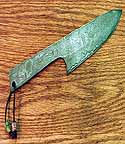
Our Tamahagane/Jade steel is smelted by our craftsmen in the traditional process that pre-dates modern steel producing technology. Starting from iron-sand and charcoal,the raw materials are heated in a clay smelter, producing a solid steel bloom that is smashed into smaller pieces and hand-sorted by our smiths for carbon content. These fragments are then forged and folded into a solid billet from which a blade is meticulously shaped. This traditional process produces an inherently impure steel, and it is these very impurities that give the steel a complex and organic grain.
Looking over their site , you will see that the stress is on 'traditional' Japanese blades and processes. Little is actually said or illustrated on the physical methods used. Surprisingly, virtually nothing on the tamahagane smelting method. Nothing on exactly the forging methods either. Although the term 'hand forged' is used repeatedly, I suspect massive use of power hammers (with shaped dies) is the actual case.
I find the pricing irregular. It appears the blades seen on the company web site are the higher end - with considerably more care on the furniture and scabbards. The range seems to be $2500 US +. Comparing to their other blades, it appears they are charging roughly double for the smelted iron material.
Surprisingly, Relics in London Ontario is offering one of the simpler 'production line' blades from Dynasty for roughly $2200 $US+
Now - of course the Dynasty product are for finished swords. Their normal high end work looks pretty well finished (sorry I could not poach an image to show)
But notice that they charge $500 for carbon steel, $1300 for layered steel, and $2500 for smelted steel. Note that a finished katana is in the range of 2 - 3 lbs. I would expect you to start with maybe double that material to create a layered blade, perhaps three or four times the finished weight with bloom iron.
For comparison, Lee Sauder (by far the most experienced iron smelt master in North America) has pegged the cost for raw blooms (per pound as produced) at $22 USD and consolidated to billets at $32. (Note that I personally think this is not near enough! Although our smelts here at Wareham generally tend to smaller blooms, its still roughly $300 plus in consumed materials for each smelt event. With our typical yields at 8-12 lbs, at Lee's prices we would not be recovering the raw cost!)*
The reason I am commenting on all this - there is a FALSE 'mystery' being placed on bloomery iron in the blade making and collecting circles. The process is not as controlled as many individuals are making out that they can achieve. No one now working (certainly in North America, and I suggest anywhere in the world) can state: I need carbon content XX - and I can get that result inside a smelter. Worst, those few who pioneered and reserrected the ancient techniques are quickly being lost in the dust of those rushing to cash in.
Historically, the smelting process was ALWAYS a random one. Predictable results could only be ROUGHLY achieved by exact duplication of both method and most important, materials. After the smelt, the resulting bloom would be typically fractured, and then carefully examined and sorted. This is where specific carbon content material could be selected and set aside.
(Looking back over this post, it seems random and rambling, even for me. There are clearly at least three or four individual topic areas could be expanded here?)
* Thanks to Karen for pointing out my error on not specifying 'per pound'







 Posts
Posts


