Sunday, April 29, 2012

Working the Press 2

 (slightly modified from the post on Bloom 2 Bar)
Something I saw at the  Corning Glass Museum (on the combined Smeltfest / Research trip in March).


F- 'Split Fire Riser'
R- 'Solar Riser LH4'
Thomas Patti - 1943
(Sorry - its a horrible image)

When I saw these glass objects by Patti at the Corning Glass Museum, I immediately thought of how the hydraulic press could alter the shape of a block of steel in a similar way.

So this is what became of the concept (Very, very, first renditions)


The left corner is the result of the very first experimenting with the press day I did with David Robertson. (David had consulted heavily with me on the construction of the press before this OAC project begain.)
The tool was originally produced for potential use with my small air hammer. I never use secondary tools that much with the air hammer, primarily because of the small die surface (as repeatedly mentioned, only 1 1/2 " wide by 4 " long). Although it is true that lack of practice is part of that problem! It has a slightly tapered shaft forged from 1 1/4 ' round stock, so the working end is roughly 1 inch diameter. The shaft length is roughly 3 inches, made of mild steel. The handle is piece of flat stock, wrapped around and MIG welded on the top surface, then ground flush.

The starting block was a piece of 1/2 thick by  roughly 2 inch square.
The resulting shape was made by setting the tool on the orange hot block, then driving it downwards. I used the full power of the press (to 3000 psi), primarily to see how far through I could push the tool.
As you can see, what happened is that the tool 'bottomed out' at about 3/16 thickness. At that point the metal below the tool had most of its heat pulled off through contact with the tool and bed of the press. The increasing pressure then simply started to bend the shaft itself.


Obviously not the way to go. Interesting potential however.


The second test , at the upper right, (done April 17) started with modifying a tool. This small (cheap) ball peen hammer had been used for a different impression test initially. Result was that the pressure collapsed the walls of the eye around the original wooden handle. First I used a drift to re-open the eye and straighten the bent head. The hammer face side was forged down to approximately the same shape and size as a standard 3/4 inch taper base candle.  Last I forged down a piece of solid 5/8 " round to fit, then drove that into the eye hot to seat it.
The starting block this time was a piece of 1 inch square, about three inches long.
First the hot block was collapsed downwards into itself. With a second heat, the tool was pressed down into the block.
One unexpected result was that the ball top end actually left an impression into the mild steel top flat plate die set in the press. Not good. 


But the finished object? Closer, but still not quite.


Both tool and object prototyping continues...


Thursday, April 26, 2012

WORKING the Hydraulic Press

['Mark Green' ,21 April 2012 - 02:56 PM' - Don Fogg's Blade Forum]

I hope all is well with you. Jesus told me you were setting up a log splitter press for bloom compaction.
I was just wondering if you have that going yet, and how it is working?

This is an edit of the reply I sent to Mark, as I expect some of the rest of you will be interested as well.

My purpose for building a hydraulic press was to allow me to work up a huge pile of iron blooms (from a decade of smelting!). I currently have a 50 lb home built air hammer, but the dies are only 1 1/2 x 4. Not near big enough to work a bloom on.

I had taken a lot of images while I was working up the hydraulic press. My intent was to put together an e-book (pamphlet) on the topic. Never got past the information collecting - at least for this year!

That being said, I did write some pieces seen earlier on this blog :

http://warehamforgeb...ulic-press.html

http://warehamforgeb...-continues.html

http://warehamforgeb...ulic-press.html


The overview is this:
I took a look at a couple of presses others had built. Both in person and via various web sites.
I'm not the 'machine' guy - but my friend David Robertson certainly is. Hydraulics represents a level of complexity (and potential disaster) that I was uncomfortable with.
I had looked at several layouts - single or double cylinder, cylinder on top or bottom, C or H frame.

Anyway, I had already bought a used hydraulic pump and electric combination, from a guy I do trust. Question was 'how much and how fast'. A long session at a local shop did not answer that. I considered buying some valves, hoses and a high pressure gauge to test this. Was going to cost me at least $100 for those parts - even more if I bought long enough lengths to incorporate into a functional press later.

David and I went back to his local TSC to get those parts. As we walked back to the parts section, we passed through a display of log splitters. The manager spotted us and asked 'Are you thinking about one of those? If so, have I got a deal for you..."
Turned out the Champion 30 ton was going on sale for 1/3 off starting the next day. That put the cost of a *pre-engineered* system (with self contained power) at only $1300. The unit was already designed to work in the horizontal position.

David went off to do the math. The cost of purchasing all the components (2 hp electric, cylinder, pump, valves, hoses) was going to be at least as much. I would have to build a frame in either case, the difference being that if I scratch built, that frame would need to be considerably heavier (enough to manage the full 30 ton thrust). The alternative was simply holding the existing machine up off the floor to working height.
Most importantly, I would not be *changing* any of the actual working machine.

The final design moves the gas engine from its original mount to the opposite side of the machine (to allow the operating controls of that to be accessable to the front side. This did require adding an extra 24 inch piece to two of the hoses, only one a high pressure line. I did this via a T mount, which allowed me to mount a high pressure gauge - which turns out to be very handy in opperation.

The biggest problem I had with the conversion was venting the exhaust from the gas engine.

In operation the actual pump and cylinder are very quiet. You do *not* get that shriek that Jesus's machine produces. Balance that against the noise coming from the 5 HP gas engine.
Given my shop layout, I could in fact add another 6 feet of hose to all the lines, and just mount the engine outside the shop altogether. I did not want to do that at first, as I was concerned about slowing the action time of the cylinder.

In use the machine is wonderful.
The ram moves 'about as fast as you would want' - with 2 inches clearance on any given piece of metal, to full compression (at 3000 psi on the gauge) takes about 5 seconds. Fast enough to preserve the heat, slow enough that you can stop it if things start to go off.
I can compress a piece of 1/2 thick by 2 inch down to 3/4 thick in a single shot. The maximum compression under the full 2 inch width of the rectangular block die is effectively down to about 3/8 thick. The full plate die I made up is roughly 5 x 7 inches (used for compacting blooms, or using smaller handled dies or tools).

The fiddliest part of the conversion was setting up a replacement ram head. I just replaced the existing log splitting head, which had a step diagonal to it. I had to figure out how to make for easily switching top dies. You can see the solution in the blog postings. This proved most certainly worth the extra trouble. With the slot and single pin system I worked up, I can swap a top die out in about 5 seconds.

If there is any major disadvantage (other than the noise) it is that the press has a C shaped frame. The maximum depth is about 6 inches, only a problem if I was to attempt working with plate.

With EVERYTHING included, my total cost to get the machine up and running was $2100 (CDN).
That included the block steel to make three dies , a large flat plate, a rectangular compression head and a heavy cutting head.

Images:
First is a view of the completed log splitter to hydraulic press conversion
Second are some of the test pieces worked up on my first session. The rectangular bar is 1/2 x 2 mild steel. All the compressions are single strokes.

  • Attached Image
  • Attached Image

Sunday, April 22, 2012

"the people we were - the people we are"

 Check this post by Jim Wright at his Stonekettle Station :

http://www.stonekettle.com/2012/04/people-we-were-people-we-are.html

It side swiped me considerably. I thought it was going one way (and broke my heart) and then suddenly shifted gears and hit me from another direction.

We all have those ancient friends. The ones that for some reasons that truly defy any rational explanation have slipped out of contact. The ones who chance (as much as anything) throws you back together with.
And its like the time and distance have never existed.

To them (and you know who you are) I suggest this piece by Jim.
I suspect Jim is most certainly a kindred spirit, and would fill any empty place at our table well and effortlessly.

Over the years of my own life, I have always valued *consistency* far more than *agreement*. Anyone around me most certainly can hold differing opinions. My interest is most often held by those who disagree, especially those who can offer measured and passionate discussion. What I have never had patience for are those who are inconsistent. If I can figure out how you are going to twitch, usually I can work with you. 'Say what you mean and mean what you say' and you and I will be able to come to some accommodation.

Always remember 'what goes down, comes round'.
*Responsibility* is more important than *Rights*.
Make a choice, but do so with clear eyes, head up - and be prepared to pay the butcher's bill when it comes due.


Friday, April 20, 2012

Building a PRODUCTION Iron Smelting Furnace

(a duplicate of the post at Bloom to Bar)

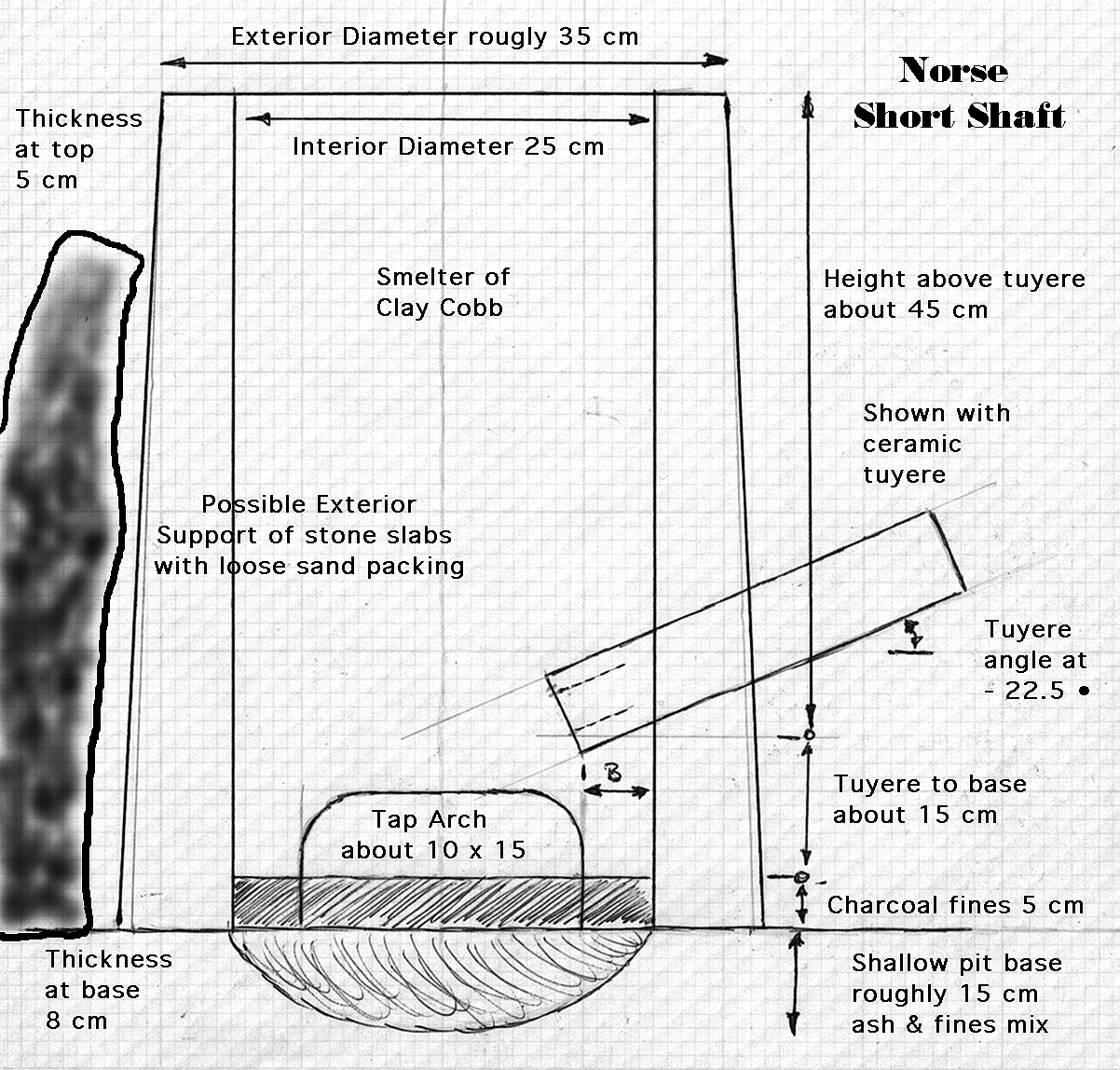
Making a bloom requires an iron smelting furnace. I have built dozens over the years, most on the 'Norse Short Shaft' model. The work on the actual smelting end (creation of the iron blooms) has been a combination of a learning process extended into experimental archaeology. Furnaces are often purpose built to test a specific variable, and commonly only used one or two times.

I have decided to take the opportunity offered by the OAC project grant to build a more durable 'production' version furnace.

The first day's work consisted of gathering the available supplies and possible pieces, plus cleaning up and preparing the site. The furnace built for last year's 'slag pit' experiments was examined to see if it could be simply repaired. 

Damage to top of Fall 2011 furnace
The nature of recording the slag pit experiments had meant picking up and moving the furnace itself after each smelt. The furnace had been returned to a prepared base and covered over with a plastic drum for the winter. The combination of all that shifting, and the winter weather, had resulted in a fair amount of damage. This certainly could have been repaired, but I decided to build a brand new furnace.

There would be a number major elements used for the production furnace which should combine to greatly increased durability :
use of a copper tuyere 
base area built of fire brick
metal sheathing over the shaft
use of sand / horse manure / clay mix
Part way through construction, with measurements
One of the things kicking around the shop was an old metal trash barrel, with the bottom pretty much rusted out. It was roughly 60 cm tall and about 35 cm diameter at the small end. Almost exactly the same size as the exterior of a short shaft furnace. I decided to use this as a combination form and protective shell for the upper shaft. The base area would be built from a circle of dense fire brick, both for durability and stability.
Firebrick base as laid out
 The furnace was constructed on the shelf that makes up one edge of the Wareham smelting area. This places the bottom base of the furnace up about 25 cm above the working floor. To create a hard bottom and stable surface, a (broken) concrete paving slab was placed first. The furnace is being constructed with a large tap arch - large enough to allow for possible bottom extraction of the bloom (although my normal method is a top extraction). The location of the tuyere will be to the left hand side as seen above. The placement of the fire bricks on edge creates a heavy and flat surface for the shaft of the furnace to rest on. The circle of standard construction bricks defines the boarder between the furnace and the natural earth surface.
Brick layer with clay fill 

The first layer of clay was a mix of 50 / 50 rough sand and standard ball clay (mixes by volume). This was used as a mortar to fill the wedge shaped gaps between individual bricks. Next the space between the firebrick circle and the outer retaining bricks was filled. Finally a sloped shoulder was created from clay to the top of the fire brick layer. A full bag of clay was required here.


Next, the bottom of the metal barrel was cut out. A slot was cut on one side, roughly 7.5 x 7.5 cm. This would be the hole allowing for the insertion of the tuyere later. The measurement from the top of this hole to the top of the barrel was 40 cm. (When positioned, the angle of the tuyere will place its tip even lower, so there should be a good 50 cm of stack height.)


Dry measures for the clay mixture
The furnace walls were composed of a mixture of course sand, shredded dry horse manure and clay. The clay used was 'New Foundry' - a higher firing temperature clay (which I had gotten from Lee Sauder). The ratio is roughly 25 / 25 / 50. This is mixed dry by hand before the water is added. (I took considerable care to make sure the mixture was fairly stiff, particularly with the first layer.) The material was kneaded up to an even consistancey, then hand wedged into balls and left to stand for about an hour before applying. (Note that Lee recommends letting the clay stand overnight to even out the moisture content. Yes - I did rush this a bit!)
First wall layer applied (tap arch at bottom right)
The individual balls were broken in half, with the individual pieces blended in carefully as the walls were built up. The metal form allowed to exert good pressure, but still keeps the overall shape consistent (and under control!) The thickness of the walls was kept to roughly 6 cm at the bottom, thinning slightly to closer to 5 cm at the top. You can see how the interior diameter is matched to the ring of fire bricks.
Because the metal barrel tapers, the interior diameter of the furnace will taper slightly as well. This is actually ideal, as it moves the tuyere tip slightly off the direct line of ore falling inside the furnace. (We have seen this arrangement reduces the amount of slag that collects on the tuyere tip.)

I finished up a long working day just as the sun was getting close to the horizon and the black flies were starting to come out. Expect some images of the final construction, once the clay has had a couple of days to stiffen up and I mount the tuyere.


February 15 - May 15, 2012 : Supported by a Crafts Projects - Creation and Development Grant

COPYRIGHT NOTICE - All posted text and images @ Darrell Markewitz.
No duplication, in whole or in part, is permitted without the author's expressed written permission.
For a detailed copyright statement : go HERE