Thursday, January 31, 2013

'Global Warming Ain't Happening...'

First thing : BULLSHIT

Second thing : Repeat after me - CLIMATE CHANGE

Third thing : Get your nose out of your bible, or stuck on Fox News, an look out your WINDOW


This is the situation at Wareham Ontario, Canada, North 44.5 degrees. (For the science challenged out there, that almost exactly half the way from the Equator to the North Pole.)

Current temperature (January 30, 2013 - 11:00 AM) is 9 Celsius (thats 48 Fahrenheit for the Tea Party)

And this is what it looks like:

The creek that runs behind my property, seen from across the road towards the west.( Corner of my yard is the trees on the upper left.)

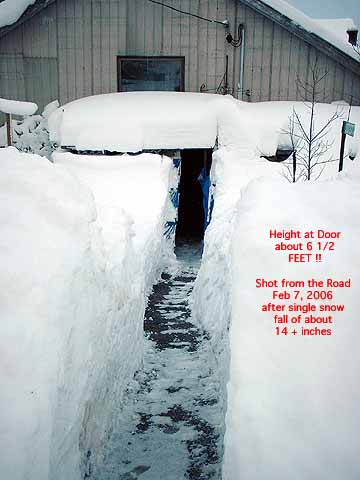
Almost exactly SIX YEARS ago - My front shop entrance from the road.

Now that I have pissed off the Fundimentalists.


For the rest of you
Close up of the Ice Dam
The pieces of ice that were covering the creek up till a couple of days back have created a damn against the mouth of the bridge (at the NE corner of my property). The individual pieces range from maybe the size of paving slabs up to as big as two sheets of plywood. These are mostly about three fingers thick. The water has risen about a hand span higher to the down stream side - and higher in that area across the road from us than it has ever been since the winter of 1990 (when I came here).
There is virtually no snow left most places around. I expect with the warm temperatures and the rain today it will most all be gone come nightfall.

Remains of the Boat - inside the Ship Shape
We celebrate the turn of the Sun by burning a model Viking Boat the last Saturday of January. Our version of (the Victorian) Up Helly Aa. So only 4 days ago - the ice covering what is open water above was more or less thick enough to stand on.

But you know - its all just Liberal Hysteria..


Readers : This piece was written for Monday January 30. It got trapped as a draft and missed its correct and timely publication. Over the 12 hours following, the temperatures at Wareham dropped over 15 C (!!) and back to the -5 to -10 C 'seasonal' range. 

Wednesday, January 30, 2013

*How* big? Imagining details


A recently recovered artifact is all the buzz in the Norse re-enactor's community.
It is a three dimensional depiction of a woman, cast in silver. The bottom of the figure has been broken off (thought to be plow damage from working the field it was discovered in).

The Harby 'Valkyre' - click to see the published image size (!)


(Metal) Detectorist Morten Skovsby found the ... figurine late last year at Hårby on Funen, (Central Denmark)

Go to the report

 Pulling a couple of the starting comments from the Norsefolk2 discussion group:
On 09/01/2013 04:24, Hilde wrote:
Hopefully, a high quality scan will be available some time in the future.

On Tue Jan 8, 2013 6:15 Charles wrote:
This is where the fun starts, now begins the search for archaeology to back up the outfit worn by the figure.
The need is there to make this more than an artistic representation.
The first rush was divided into to main topics:
1) Depiction of female with sword and shield - 'proof' of women in combat.
2) Deciphering details of the clothing.

There is a gap between the falling hair and the back of the neck. Much was being made of this : A pendant? Hung as a ritual object* ?
( Of course since the bottom of the dress line is broken, we can not tell if the piece was flat based to sit on a table, or might have once had details of the feet.)

But before we go too far - Look at another object from the Viking Age which has also been examined and argued about in minute detail:


'Odin fra Lejre '
by Tom Christensen

1,75 cm høj, 1,98 cm bred og 1,25 cm dyb,
(high / wide/ deep ?)
(images and quote from Christensen's report) 

The recent 'discussion' has centred around the sex of the figure. One camp sees a female, based on the length of the garment and seeing the dotted bands on the chest as four rows of beads. The other camp sees the figure as male, based on the band around the mouth seen as a moustache, and the iconography of the thrown of O∂in.  

Now - a reality check. Take a look at this image:
'Warrior' - click for detail
 Look at all that detail on the figure's costume (or lack thereof)!

This is actually one of those 30 mm cast tin alloy miniatures so many of us used for war game / Dungeons & Dragons playing 'back in the day' (and still may do, for I know).

But before you start to attempt to determine all those fine details - Let's try something first:


All objects reduced to LIFE scale in these images.

It has been my overwelming experience that no matter how much you work with artifacts, you never really understand then until you see them in life, actually before you. Reading the measurements does not really impact you. Almost everything is either way SMALLER, or way LARGER in actual truth, than what you imagine it is. 

This is absolutely critical. 
I have gotten into the habit now, for any object I have never actually seen before me, to take the source image, scan / open it into Photoshop (or the like). Then convert the image best as I can to the *actual* size given for the object. I will often put a piece of blank graph paper into my printer and print the life sized image on to that. This makes for very easy conversions of details into physical measurements. 

People have been going a bit overboard (in my opinion, not so humble), attempting to derive the finest detail from the published images of the objects. Yes, it can be a wonderful tool to take a very high resolution photograph, then look at that expanded version.

But what about the ancient artist who made the original object in the first place?
How small a thing was he really making?
What limits on detail were imposed by the medium he was working in?
Or by the tools he had available to work with?
Are you really looking at intended details of a reality? 
Or is all this combined through an artistic style? 
Let me tell you, as someone who has actually worked with lost wax casting techniques, there is very much a limit on just how much detail you can physically place on any object that is as small as these pieces are!

* "Ritual Object'
Archaeological short hand for : 'We don't know what the heck this is for'


Later Addition:

The following is a comment by Cathy Raymond. I have come to know Cathy as a measured and intelligent voice on the Norsefolk descussion :
I agree with your basic point that it's hard to derive such detail from these tiny figures.

However, our other sources of information about Viking and Vendel era costume are so limited that there's no option but to try. Surviving textiles from graves and other sources are tiny and sparse, and surviving garments almost vanishingly rare (I can think of only three or four that are complete or close to it--a shirt, a sock, a cap, and a scarf with human head hair found in it).
What Cathy says is in fact quite true. I did want to expand a bit, and mention the work of another friend, Dr. Michele Hayeur Smith :

An expert on Icelandic and Scandanavian textiles, Michele Hayeur Smith will explore current research on archaeological textile collections from ten Viking Age (AD 874-1100) mortuary sites and eleven settlements from the medieval period (AD 1100-1600), as well as medieval records, to shed new light on age-old associations between female embodiment and power in Norse culture and their transformations through time. Her interdisciplinary work integrates art, narrative, textile production, gender, power, and fertility.

Co-sponsored by the Women's and Gender Studies Program

Anthropology Distinguished Lecture
Bridgewater State University 

Michele has spent many trips over the last several years looking through what she jokingly describes as 'filthy brown rags' - pieces of Icelandic textiles. Largely not assessed, she has discovered a large number of these fragmentary textiles are much older than previously thought. 

Sunday, January 27, 2013

Hammers - Weights, Styles - and Rounding Type

The core here started from a series of postings on 'Iron Smelters of the World' on Facebook
Eric Campbell wrote :
If you watch people with heavier hammer tend to grab the handle closer to the head of the hammer. Moving steel is all about the equation Kinetic energy = 1/2 mass times velocity squared what this boils down to is that if I double the mass I double the kinetic energy. If I double the velocity I can quadruple the kinetic energy. Many of the smiths that come from the Yellin line use lighter hammers that measure in length from the crook of their arm with the head of the hammer resting on the tips of their fingers. I've tried it and I can generate an astounding amount of kinetic energy that way however I like a bit more control so I tend to have my handles about 2-3 three inches shorter than that and I like having one of my faces being ground to be like a rounding hammer when I am doing long draws. (Brian) Brazeal tends towards a short handle and a rounding hammer this video is worth a watch if you do a lot of long tapers.

... I became aware that the hammer weight conversation is missing 4 variables. Face geometry, handle length. grip, and swing style.
1) Eric is echoing my own experience. Less mass, moved further and faster, equals more impact energy. I have seen Brian Brazeal working - massive hammer, moved very slow, short strokes. I suggest that a lighter hammer allows for more precise control, not only of target, but also of entry angle of the face, more importantly the edges.

2) Never forget the physical dynamics of body build! Personally, I have extremely long arms, and still after over 30 years of smithing, still only weigh 160 lbs over my 5 foot 11 frame. Brazeal is heavy through the chest, with much shorter arms and is very powerful in build. Not a surprise he would work in close, short, heavy, and pretty much punch - rather than swing the hammer as I do.

3) Something to direct this back to our topic of forging blooms: A lighter hammer, moving fast, does have more impact energy. But that energy will tend to be concentrated to the surface of the metal. For bloom welding (or thick bars) a heavier hammer moving slower will *penetrate* the force through the mass of the bloom. Remember that this is effect desired to compact or weld a bloom
Replica Viking Age hammers - Lower left based on Mastermyr at 800 gms
4) We all have to remember as well our bloom iron and antique wrought iron *does* move differently under the hammer stroke than modern steel alloys, often very differently. Those ancient smiths were not fools, and would be building hammers suited to their metal, anvils, and objects to be formed. It may suggest something that the kind of heavy sledges typical in contemporary blacksmith shops are absent from the early historical artifacts?

ON THE VIDEO:

Why Use a Rounding Hammer
Brian Brazeal demonstrates and explains why a rounding hammer is the most versatile hammer to forge with.

1) Note that this is work with COPPER - not STEEL.
Copper moves like butter when hot, and even cold, moves about the same as mild steel would if it was at forging temperature. This gives a false impression of the effectiveness of the hammer technique. Copper, unlike iron, can be effectively cold worked (for a good while before work hardening).

2) A short stroke with a heavy hammer?
Note that Brazeal is noticeably out of breath, even after the first hammer sequence. This despite how slow the pace of the individual strokes is (also an effect of the use of a very heavy hammer.) Perhaps not the ideal method if you intend on any actual production work?  (Of course, you might be younger and more fit!) This method suits a physical build with a barrel chest and massive chest muscles, short arms with 'Popeye'  chunky arm muscles - all suited for power.
Definately not a weight or style for those with lighter builds, longer arms, and more slender 'dancers' muscles - suited for speed.
Note also how he is choking up on the handle, gripping the hammer just barely back of the head. There is no swing involved here at all - he virtually is punching up and down in a straight line.

3) Entry Angle?
Note that Brazeal is working his strokes at 90 degrees to the length of the bar. This puts the line of force *across* the desired direction of the taper - not *down* it. Although care is being used to keep the hammer flat and straight, the natural dynamic of your body will cause some of the material being forged to be pushed sideways if you work as shown. If you are

3) Cheating on the Edges!
Note that the effects attributed to the rounding hammer are as much because of the use of both the curved base of the horn - and the use of the front and back edges. Although the slight curve of the rounding hammer *does* increase the speed, this is secondary to the much more aggressive pinching by curved horn and especially the edge radius.

4) Straightening with a Round face?
No, Use the FLAT side of the hammer for straightening! That *is* what the second face on the hammer is for after all.
Note he specifically says : "I think stems look a bit better rough than they would perfect." This then is a *design choice* not a technical method. Using the rounding face when finishing the taper into round will certainly leave the surface facetted.

Near the end of the video, he talks about 'not hitting square' with a flat face. Sorry, I see this as a flaw in basic technique. How could you be so aware of the entry angles available to the crowned surface, but at the same time so sloppy with the flat?

5) The true advantage of the Rounding Hammer?
Is seen over the second part of the forming - the pulling out of the tip into the leaf shape.
Again, this will *not* be so dramatic an effect if forging steel. In steel, as the material thins, it will loose heat faster and faster - to the point where it will prove almost impossible to work the material before it cools in contact with the anvil - and becomes brittle.

OABA had flown Brian Brazeal up at considerable expense for a two day workshop. There was an afternoon demonstration session, which I attended. My apprentice Kelly Probyn-Smith, who stands all of about 4 foot 8, found the methods demonstrated completely outside of her physical abilities. Despite my lifetime of blacksmithing, I also would not be able to utilize the physical methods illustrated.

Remember blacksmithing is a *physical* activity. The way any individual should chose to work should be first determined by the safest, most comfortable and most effective system as defined by their individual body dynamics.

Saturday, January 26, 2013

Bloomery Smelting - Variations on ... Everything!

Jur de Stoute said :

Quote
When you are working with the hand bellows there is another variable coming into play and that is weight of ore charge. About 250-500 grams/charge works about best. If you charge more/charge pumpinng will be ALOT harder, because it chockes the column more. Just drop on the weight per charge and after a while things start to work just fine again.

My usual is to distribute the ore as evenly as possible through each addition of a 'standard bucket' of charcoal.

DD 2 ore analog with the 'standard scoop' - Vinland 1, May 2009
The tool we use for the ore additions is shown in the image above. It holds a bit more material than you could hold in a single cupped hand.

One of the problems we all face in these kind of conversations is that I'm sure our experiences all roughly match - but we are all using slightly different measurements. Both in terms of tools and how we keep track / records.  This goes back to the thing I mentioned about 'kg charcoal per hour' being one thing most of us can record (or calculate from our methods).

On charcoal, we have a 'standard galvenized bucket' sold through hardware stores all over N. America.
Dave Cox adding charcoal in our 'standard bucket' - June 2006
Now, the charcoal does vary in density based on wood species. The most commonly used types here in N A are oak, hickory or maple (or some combination). There is some research to be considered here (??)
The charcoal does also vary in weight per volume due to how dry it is. When my team noticed this, we started trying to measure the weight of our 'standard bucket' at each smelt. The variation is easily 10 - 15%.
Of course another wrinkle there is that we certainly do not weigh each individual bucket, and there is certain to be variations in how full any given bucket might be. On a guess - another 5 - 10 % at least.

On the ore, we originally just counted 'scoops'. We would measure and weight three, take that average, then multiply number of scoops against that calculated weight to get our ore total.
We again realized there was considerable variation there. Now we measure out the ore by full kg (or 500 gm multiples) into cans, then use the cans into the scoop to make it easier to add to the top of the furnace.

The density of the specific ore types we use can vary considerably. The same 'scoop ful' can vary from the DD analogs in the range of 275 - 300 gm - to as much as 600 + gm when the ore type is taconite or hematite grit.

The stack height of the furnace will come into play here too. As the charcoal burns, individual pieces will turn, tumble, and change size. This all will result in the ore particles all falling at slightly different rates. In effect they should start to distribute themselves fairly evenly though the entire volume.
The size of the particles, and the relationship between ore size and charcoal size, will certainly effect this as well.


That being said - I think you may be on to something Jur!
We are always careful to spread the ore in a given charge as equally as possible through an individual charcoal addition. So we never lay all the ore as a single 'slug'. (And yes, many earlier published illustrations suggest this as the method, which I do agree is NOT the correct way to proceed!)
We very rarely charge more than 3 kg of ore into a single charcoal measure (for us the average 'bucket' is about 1800 gm). In method, we would be splitting that ore amount into four roughly equal applications, covering each with a 1/4 bucket of the charcoal.  More typical is charging at 2 kg to one bucket (so roughly 1 to 1)

One consideration on that advise may be the surface area of the furnace as well. I think we all can see that 500 gms ore over a 20 cm diameter results in more of a 'plug' than with a 30 cm furnace. (Our standard here is between 25 - 30 cm interior diameter at the top.)

I think this all just re-enforces what Mark said : Bloomery Smelting is an ART.

Something for those not familiar with historic artifacts:
It is common to find a number of slightly different furnace layouts at a larger 'industrial' ancient iron smelting sites. Usually showing signs of a single firing only. Then there will be one version built over and over again. Obviously the ancient masters would take their generalized knowledge of the iron smelting process, then tweak the furnace design to account for the local clay, ore type, maybe even the charcoal available. Once an 'ideal' combination of design and method was determined - they just repeated that combination over and over.

We do all need to remember that this same problem of matching our furnace and method to our individual local ore does confront us all!

(again taken from a post to Don Fogg's Bladesmith Forum )
 

February 15 - May 15, 2012 : Supported by a Crafts Projects - Creation and Development Grant

COPYRIGHT NOTICE - All posted text and images @ Darrell Markewitz.
No duplication, in whole or in part, is permitted without the author's expressed written permission.
For a detailed copyright statement : go HERE