Readers:
I have most certainly gone over these details here in the past - as well as covering these points at various spots on the web site:
On 30/09/14 4:04 AM, Peter wrote:
I am looking for a knife for a while now and have not yet found one which met my requirements for a price I’m willing to pay.
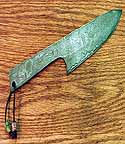
 |
| "Layered Drop Point" - 1997 : This is the blade Peter referenced. It has a 3 1/2 inch long blade and a specifically shortened handle and one piece construction |
A true statement is always 'you get what you pay for'
This cuts both ways - as you *should* expect higher quality at a higher price.
I need a knife which
will cut my fire wood as well chops 1 tot 2 inch branches which wont turn blunt in 2 days. I only need 4 inch length of blade.
These three requirements may work against each other.
At 4 inches, the blade would have to be considerably thick to create the
kind of impact you would need for this kind of heavy hacking task. This
not necessarily a problem, as a blade with 5mm or more in thickness
along the back, and a relatively wide blade can certainly be forged.
A larger concern is balancing your requirement for edge holding against the requirement for excessive durability.
The problem is that a harder metal is required to produce a cutting edge
that retains sharpness. However, harder metal is also more brittle -
more prone to breaking if subjected to extreme use. (Consider a scalpel
or box cutter blade = extremely sharp, holds that edge, but also
extremely fragile.)
Generally 'heavy hacking blades' are created from a middle carbon steel, to balance edge holding with shock resistance.
One solution is to create a sandwich with a high carbon core (edge
holding) layered between two pieces of mild steel (shock resistant).
Be aware that a blade formed of * just * layered steel will * not * have the edge holding ability of a plain high carbon one.
Because the layered block alternates hard and softer metal, the cutting
edge created will actually alternate (in fine detail) between areas of
hard and soft. This in fact creates a cutting edge that will wear
unevenly.
The true value of layered steel is not in its edge holding - but in
greatly increasing shock resistance. This effect most functional in very
large blades (read sword sized).
My current method of creating layered steel blades (cross section)
XXX
XXX
XXX
FVF
FVF
V
X = layered and twisted
F = flat stack layered
V = high carbon slab
You can see that in effect, the back area of the blade is composed of
the more flexible (and highly decorative) twisted 'pattern welded'
material.
The blade area is composed of a slab of hard carbon steel, protected by two blocks of layered material
On sharpening, the hard carbon steel is exposed to form the actual cutting edge.
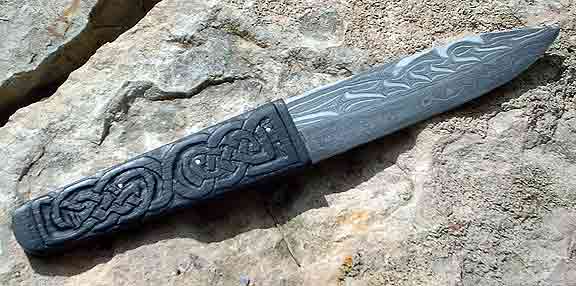
 |
"Pattern Welded Sgian Dubh" -
2006 : This blade is constructed in the method described above.
|
An alternate solution to these functional requirements would be to use
some exotic alloy steel. I personally do * not * work with those kind of
materials. Most require specialized forming and most especially heat
treating steps or equipment that I just to not have access too. (This is
the approach used by most 'commercial' knife producers, with ground
blades from stock bars, which are then industrially heat treated.)
I like to know how much it
costs to make a Layered drop point knife of layered steel, could you
give me a estimation of the costs?
Specific quote will be determined by the exact details of a specific design.
Typically, it will take me three working days to forge up the starting
billet of layered material as described - enough to then forge out two
knives (depending on blade size). The process of forging, then grinding and polishing a single
knife takes another two and a half days.
Hilting adds both more time and materials costs, so needs to be quoted separately.
The current rough estimates (blade only) is posted on the web site :
Flat stack 'Damascus' = $200 / 4 inches plus $40 per inch larger
Twisted core 'Pattern Weld' = $250 / 4 inches plus $50 per inch larger
http://www.warehamforge.ca/knife.html
Note that for the one piece knives seen on the web site - the price is calculated for the * entire * length (blade plus handle)
(You might notice that this is a stupid small amount - considering the
amount of time expended on each knife - in a seven day 'shop week' I can
basically only produce TWO blades.)
And the final question do I understand correctly that you charge in
Canadian dollars?
Yes - prices quoted in CDN funds.
If paying in alternate currency, there will be a conversion fee added (cover bank losses)
50 % deposit required on order 'non refundable against work undertaken'
balance due in full before shipping
Shipping costs added on top as required your destination
(HST added within Canada)
Any Customs Duties remain customers responsibility
Production time dependant on current commissions
One of the continuing problems any artisan maker has is sorting the
serious from the casual.
I do normally treat every initial request as if
it was serious and going to lead to an actual commission. In actual
fact at best only one in ten leads to actual paid work.









 Posts
Posts


