Friday, January 29, 2016

'And Age Shall Not Tarnish Them'

A design submission for the Ypres 1916-2016 Cenotaph project.

Ypres 2016 web site

Ypres Cenotaph Project

I have been working on the concept end of this potential design for some weeks now. This has included watching a lot of documentaries, researching the Ypres WW1 battles, and searching for original reference photographs.

Unique to this project is the level of group involvement.
Monument Design
British artist-blacksmith Terrence Clark is behind the overall design and concept.

What is missing from the concept design seen above is the mass of individual hand forged poppies, some 2000 in all. These will be massed over the base area at the foot of the slab. The individual flowers are being forged by blacksmiths, and the general public under their guidance, from all over the world.  The intent is to allow as many people as possible to be involved and make a personal contribution to the memorial.

The individual railing panels bounding the space are being produced by teams of working blacksmiths, largely as a public event over September 1 to 6, 2016, held at the central market square in Ypres itself. The overall design uses a total of 24 individual railing segments. Each uses a standard framing layout.
There are 12 longer panels. A select group of Master Smiths have been recruited to undertake the design and lead teams producing these pieces. 
There are 12 shorter panels (roughly 28 inches long by 26 inches tall). For these there is an open competition for design and team production.

Here is my submission:

'And Age Shall Not Tarnish Them'

Concept :

Mud, Wire and Gas. The intent is to capture a soldier’s view, from the ground, of these overwhelming elements of the battlefields of Ypres.

Three silhouettes represent the major combatants, one for each of Belgian/French, Allied/English, and German troops. Each is represented by their distinctive helmet and gas mask types, roughly life sized. Both sides in the the extended conflict would both undertake extensive poison gas attacks (first seen at Ypres), and issue troops with various protective masks. (The designs of the individual masks have been chosen for their distinctive appearance.) Almost featureless otherwise in their obscuring masks, individuals become anonymous, any single one standing for all. Any of them may have originally been driven to the armies at Ypres by national pride, seeking ‘adventure’, or fear of appearing cowardly to their peers. Quickly for all, the endless sea of mud, personal suffering, and too often useless struggling would wipe those ideals away. In the end, this left all the soldiers involved - ‘faceless’.
The soldier’s images are cut from heavy stainless steel sheet. This material endures with time - symbolic of the idea that in death all of their hopes and potential was frozen.  After a century, all that remains now is our vague concepts of the men from both sides, sure to be brighter than their personal realities.
The wide eye cut outs invite viewers to hunker down and peer through. The uncomfortable height is intended to transmit some appreciation of a soldier’s daily hardship. The low perspective and partially obscured view transmits different perspective of the battlefield.

Dividing the opposing sides is a line of barbed wire. The individual strands are supported on versions of the ‘screw picket’ uprights used by both sides. One has the slightly longer terminal post favoured by the English troops, the other the sorter cut top used by the Germans.
Placing the national identities on opposite sides of the wire is intended to remind that ‘On each of the end of the rifle, we are all the same’. For the soldiers at Ypres, death and hardship were identical, and the accident of geography would place them to one side of a barrier of wire or the other. The pickets are staggered slighly, intending to suggest the randomness and chaos of the battlefields. For the same reason, the three strands are warped and bowed, the placement of the individual barbs also random.

The wide lower bar is rippled and distorted. This to represent the sea of mud churned by the constant and massive artillery strikes. It would bear a line of dimples across its surface, representing scars from some blind machine gun fire.


It would be ideal to know the final placement of the completed panel, in terms of how it would relate to troop positions at the actual site. Ideally the final arrangement of cut out nationalities / picket styles would reflect the real situation on the ground.

At this point I have produced my scaled drawings for the design, and written the overall concept description above.

I still need to complete the submission : Technical Description / Artist Statement / Biography.

Deadline (original) is January 31. Because the time is so short, I though it possible to post the design openly.
I will certainly be interested in your comments / honest (!!) critiques. 

Sunday, January 17, 2016

About a FROE...

A request came in a couple of weeks back via e-mail, concerning the possibility I could make a custom Froe.
I have taken Martin's original messages and cut it up a bit - to fit to a commentary here. I have also underlined a few aspects that I will be addressing below :

... I have a project in mind which is based on several videos I have seen on youtube.  The inspiration for the project came from several videos in which a small froe was use to split kindling.  The froe's featured has a blade length of less than 6 inches, and appeared to be somewhat older pieces, possibly reclaimed and repurposed.

Froes are typically not sharpened and so normally will not spit wood with ease.  However the ones I saw in the videos mentioned split wood quite easily.  This suggested to me they may have been slightly sharpened so as to allow the split to be started and completed with only a froe.  However I would be reluctant to sharpen a froe as it might render it useless for its intended purpose.  I recently bought a larger froe from Lee Valley Tools.  It works nicely when used as intended to extend a split.  However it will not start a split, and it's generally to big for making kindling from smaller stock.

After doing some research I discovered a blacksmith who hand forged a small froe from a railroad spike.  The finished piece did not have an eye, but rather had a metal handle drawn out from the main blade.  I have since found other videos featuring people making custom froes for various purposes.

Since seeing these videos I've started looking for a blacksmith who could make such a custom froe for me.  The object of the design would be to make something which is purpose built for making kindling from firewood of 6 inches or smaller.  Obviously I'd want something which had enough of a sharp edge to bite into the wood to being the split.  The edge profile would them be more typical of a traditional froe, widening out with a slight convex bevel.

As a point of reference here's links to the video's I referenced
 (Added)
The first video consists primarily of the good trick of using a rubber bicycle tire to hold the splitted wood together. Do note that he is in England - and is using some very clear grained (willow?) for the splitting. Not going to work as well with the kind of pine or spruce you would get here in Ontario!
The second video?
That guy is not making a froe at all.
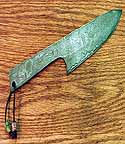
It is a simple heavy rail spike knife being used like a small froe. Honestly, I don't think it belongs in this conversation at all.

When I worked at Black Creek Pioneer Village (and other historic sites) I have had opportunity to examine and use a number of artifact tools. Over the years I have also made a few froes myself.

For the reader - a FROE is a tool used primarily for splitting thin planks off a prepared block of timber. It has a heavy, straight blade, ending with a loop on one end. A wooden handle is set into this loop, so the handle runs at right angles to the blade. In use the blade normally extends past the wood block to be cut, allowing the top of the thick blade to be struck with a wooden mallet (typically). This forces the blade down through the wood, splitting off the plank. Some direction to the cutting can be provided by levering the handle, but primarily the lever action simply splits along the existing grain. The most common use of the tool in Settlement Era is for making wood shingles (cedar normally here in Ontario). To that end, the more typical size is a blade running more like 12 - 16 inches long. Usually the bar is quite heavy, 2 inches plus wide by 3/8 thick. I have seen 'miniature' froes, in the size range of 6 inch blade, used for splitting out arrow shafts.

the Froe offered by Gransfors *
Hand Forged by Gransfors - from their product description

The Lee Valley Froe - from their web site
 The full description of the Lee Valley Froe


Some comments related to the original e-mail:

- A froe should be *sharp*. This not only to allow the start of the cut, but also to allow it to potentially slice through the grain when making longer cuts to control direction and depth. (I once saw a guy at Colonial Williamsburg make 12 inch wide by 8 foot long clap boards - just with a froe!)
- Commercial tools are not normally shipped sharp. This for safety and packaging. The user should be putting a final sharpening to the 'mill' edge. This also goes for any antique tools purchased almost always.

- A 'hollow ground' / concave grind would be incorrect for a working froe. As you certainly know, a froe is designed with one side flat, the other side having the diagonal slope to the cutting edge. This means the tool is set up for either right or left handed use(or cut from the front of a block / cut from the back of a block). Ideally the back of the blade is kept quite thick, I'd suggest 1/4 inch as a bare minimum, perhaps thicker depending on other measurements. The length of the bevel from bar thickness to cutting edge is relatively short (a pronounced chisel edge). This allows a sharp edge, with strength to leaver the split provided by the thick back part of the tool.
The inexpensive Lee Valley tool actually has the bevel in the *centre* of the blade. Likely this has been done to allow for left or right hand use. The down side is that this certainly effects the overall performance of the tool. It is reasonably effective for a simple split - but not able to cut across the developing grain to control depth and direction of the cut. (So fine for making simple shingles - if you have dead straight and even grain in your wood block.)
I actually have one of these here in my shop - purchased from Lee Valley.

- Using a rail spike is (at best) a kind of a blacksmith trick. It would simply not provide enough mass to make a really effective tool of any size (unless you were making arrows or something like that diameter). The metal is not really hard enough (1035 carbon typically) to hold an edge, only being slightly harder than plain mild steel stock.

- The simplest (most likely) construction for an effective froe is using a 1045 middle carbon spring steel. Larger froes (for shingles for example) are best made of a length of leaf spring material.
- You could consider using a simple layered construction (high carbon core with mild steel sides to support), but given how the tool is used, this complexity is not required.
- The traditional design has one end of the flat bar looped over and forge welded to itself to form the eye. On some antique tools you also see a simple rivet securing the loop, this is not as strong as a properly executed forge weld (although certainly  faster, less skill involved).
The Lee Valley version uses an even faster modern method - an inert gas weld the cutting bar on to a pipe fitting. A one piece blade to handle would certainly be possible, this is not done traditionally due to the expense (then) of the metal itself. (Wood handles are cheap - and replaceable)

Do note that I can not possibly compete with the cost of the Lee Valley tool, made offshore and using modern industrial mass production techniques. 
Note that this is not a criticism of this specific tool.
'You get what you pay for' - and at the cost of roughly $60 CDN, this is actually a fair balance of cost against quality. (Remember I said that I had actually bought one of these myself.)


* I consider Gransfors-Bruk of Sweden the best single point of reference for anyone inquiring about hand forged quality tools. This company makes exceptional quality (I have purchased tools from their product line in the past). They are using forged techniques, although I would quibble a bit about 'hand' in the description. Primarily they have set up for power hammers using specially shaped and designed pattern dies. Hand work is only in the final finishing. This investment allows them huge time savings and also excellent consistency.
Their cost for the specific tool seen above is roughly $160 US (reference)

Sunday, January 03, 2016

Recent look at Older Work

I used to wonder how / why so many artists with a long practice ended up with 'Sculpture Gardens'...
The truth is that any new work has a very limited 'display time'. If you haul them to shows / exhibits, they most always get damaged, even if it is only the paint getting scratched. The larger and more complex the piece, the more mere loading and traveling will impact on the object.
The other factor is that the public wants to see 'What's New?'. Repeated showing of even the best work leads people to believe that you have stagnated. My own practice is never to show the same object two years in a row.
Storage can lead to its own problem. I will attempt to 'rotate' works, packing them away for two or three years before exhibiting them again. Face it, anyone's storage space is limited. I face the additional problem that many objects are large, hard to fit into exisiting spaces. The workshop is a dirty place, and simple storage can also end up requiring objects be at least re-painted.
 And there are of course objects that you may think are good, but for a large combination of reasons, never attract the attention (or the buyer!) the artist hopes for.

Put all together - you end up giving up on exhibiting a lot of work produced over years of effort. Rather than hiding or destroying, eventually your home ends up with surprises spotted around.

"Copper Rushes - 2004"

"Copper Rushes" - December 2015

'Copper Rushes' was one of larger pond mounted fountains I had created in the earlier 2000+ period. The piece stands over 5 feet tall, and was very difficult to pack for transport to shows. Eventually I removed the pump and installed it as a free standing sculpture in the shallow end of the pond here at Wareham. Ice over the years has largely collapsed and damaged the copper 'leaves' at the base. The forged rushes still stand proud above the water surface.

'Stone Forest' - 2013
'Stone Forest' represents a slightly different problem. Sometimes you get too much work in storage, you forget what you have! This piece *should* have been exhibited at SummerFolk in 2015, when my overall theme was 'Earth'. I honestly just forgot I still had it, and came across the stone components when I was finishing up the construction and re-organization this Fall.
This is another tall piece (individual uprights from 4 to over 5 feet tall). In this case it does all come apart, allowing for easy transport. As I don't suspect I will have a suitable venue to display it in the near future, I have just mounted at the front edge of the workshop for now.

Saturday, December 26, 2015

Pressure in a Bloomery Furnace?

 (I had made a detailed response to a question on the Bladesmith Forum - 'Bloomers and Button's'. This is edited from that conversation...)

What I haven't seen though is any talk about the internal pressure of the furnace and what effect it has on a bloom. I was thinking of modifying one of the Rockbridge furnaces to increase the internal pressure as a way of increasing the temperature.

Has anyone tried doing this? If so, was it helpful? Hurtful? Aside from a different way to regulate temperature, I'm speculating that the rate of reactions inside the furnace would increase at a higher pressure, so I wanted to try it to get a better yield.

Byan
(link to complete thread)

My team here has made some input pressure readings. Honestly using fairly cobbled together instruments. This primarily to counter criticisms (largely from theoretical academic commentators) that all the current work is not 'scientifically rigorous' enough.
(But like Lee Sauder says : 'If you don't get any iron - whatever you have done *has* to be wrong'.)

The first thing we tried (cheap and only a relative measure) was a simple U tube with water in it attached to the tuyere side. This gave us some rough ideas - at least between individual smelts.
Eventually I got a small guage (off E-bay) that measured 0 - 30 psi range. (The trouble I had was finding something in the right range, at a price I could manage.)
Some of the individual smelts in our series here have the input pressures measured. You would have to check through the individual 'smelt data' records one by one - there is no centralized table with all the variables charted from all the experiments. (Neil and I am working on that however - with plus 60 smelts, and so many measurement points, its pretty ugly.)

Overall, the average we recorded for input pressure at the tuyere was 3 - 5 PSI.*

We also were using a rough guage for input volume. This consisted (budget again) of a wind surfer's speed guage placed across the input pipe. The volumes were calculated mathmaticaly from the flow speed. Again not the ideal, and it turned out fatigue in the vanes at the high speeds measured really effected instrument performance with time.

gage185.jpg

I have been using a different method than Lee uses for controlling the input air from the electric blower. (I've managed to purchase one of the same high end blowers he uses by the way). You can see the sliding plate gate (from a dust collection system) located just at the exit from the blower. So I'm limiting the amount of air into the entire downstream system. (Lee uses a moveable plate just in front of the tuyere set up, venting off excess air.) Both of us have some rough calibrations on these valves that let us have some rough approximation of the air we are providing to the overall system. Mine is marked (very rough approximations!) of 100's of litres / minute (based on earlier measurements). Lee's (was) marked in fractions of total possible (1/4 - 1/2 ...)

My smelting partner, Neil Peterson, is driving an experimental series investigating Viking Age glass bead making furnaces. (Even *less* archaeology than for iron smelting furnaces!). He has deeper pockets than I certainly do (!) and has recently invested in a multi input data recorder system. Along with high temperature probes, he has purchased some modules that will record pressure, and a better quality vane type air speed (so volume) instrument. We still have to assemble the fittings and run some tests, but we have good hopes for better (more consistent) measurements into the future.

You may have gathered from all that - my thrust here has been to researching possible historic *process* - with less concentration on *product*.
I have to agree with what Mark Green has said : That historic air delivery systems may not result in the most efficient utilization of ore = not the best quality blooms. You most certainly can *make* iron in lower air systems (and this most certainly was the method for much of human made iron production). What many researchers miss is the second stage - of bloom to bar. What you may gain in simplicity from ore to bloom is competely lost by the extra labour / materials converting a lacy bloom into a working bar.
Lee has much better experience / notes / observations about this aspect.

Ok

Lee and Skip experimented and documented and then introduced to all the concept of high volume air = better ore to bloom conversion, both in terms of size and density. (Historic note, look at the impact of water powered systems circa 800 - 1100 AD in Europe  - pretty much the same thing!)

Although some experimenters have produced measurements of input air pressures, I am uncertain that anyone has attempted to measure pressures inside the actual furnace itself.

As Mark as mentioned, delivery air needs to be considered in terms of not only *volume* but also in terms of *pressure*.
This is why people attempting to use rotory blacksmith's forge blowers as air sources often have less than the best results. Those equipments produce a large volume - but at virtually no pressure. The air simply does not penetrate through the tuyere diameter into the charcoal mass. Increasing the diameter of the tuyere might assist this. Using multiple tuyeres would certainly help (and both methods are seen in historic systems.)

But in actual fact, none of us need to really worry so much about absolute pressure measurements, or even with measuring air volume. The best 'working' measurement is via charcoal consumption. Rate of charcoal consumption is also the effect of internal temperature and size of the effective heat zone. Bigger and hotter = faster charcoal burning.

Most of us are working on some variation of the 'Sauder System', what historically I would call the 'short shaft' furnace. Most typically our working furnaces have an internal diameter of closer to 10 - 12 inches.
This is quite important when discussing measurements and working methods.
As you have seen, there is a dance between ore / charcoal / furnace  / air. My own experience is that there is no *absolute* 'perfect' furnace. Any basic design will have to be modified based on changes to those four primary elements. Hematite will not produce the same results, even in identical furnaces and method, as the bog iron ore analog I typically use here.

I'm (educated?) guessing that any attempt to modify the internal gas pressure in what is a very rough and simple furnace will prove far more effort than effective in result.
Past experience has proved the simplest way to effect the reaction ability of a furnace is just to increase the total stack height. (Nice example there, Mark gave 40 inches as his ideal stack height - I usually build for closer to 24 - 30 inches. My standard furnace diameter is larger, rarely below 10 inches, to his reported 8 inch minimum. I know we are working with quite different ore types, and maybe charcoal as well.)
There are just too many other variables for a 'one size fits all' design. (So many things that can, and often do, go wrong!)
 

February 15 - May 15, 2012 : Supported by a Crafts Projects - Creation and Development Grant

COPYRIGHT NOTICE - All posted text and images @ Darrell Markewitz.
No duplication, in whole or in part, is permitted without the author's expressed written permission.
For a detailed copyright statement : go HERE