Wednesday, September 28, 2016

TtT2 - Considerations towards an object (2)

Second Flow Chart from Turf to Tools Two
Chart One


This is a continuation of an earlier post on the same topic. This flow would lead off the lower right corner of chart one.

Critical (for me) is that all those elements / conciderations are coming first. You might notice that the small space in black type in the lower left is where the actual object under creation actually starts to be considered in detail.

My work here on TtT2 got jammed at the block to the upper right 'Gap here at Bloom to Bar'.
In the end the one day allotted for 'forge prep' (day 5 / Sept 20) actually turned into a total of three full days spent. We ended up having severe problems with fuel, to the point were yet another half day of equipment modification (actually undertaken by Eden) and ideally another half day of physical testing (needed - general forge work by me) is required before I would want to risk working up any of our valuable bloom iron.  The problem of a workable forge welding flux still has not been solved in addition.

For those counting, by this point I am now 'officially' into the two week period for 'personal project' as covered by my OAC Project Grant.

(Hey Nuno! Does this mean I have to come back to Scotland and SSW for a third working session??)

Iron Smelt in Poland (two)

This posting a bit out of current order, coming from the iron smelting event at the Museum of Ancient Mazovian Metallurgy, Pruszkow Poland, Sept 7 - 12, 2016.

Second Iron Smelt
Sunday Sept 11

I had hopes of re-using the upper portions of the furnace from the first smelt, which despite having been lifted off to expose the bloom, was still in fairly good condition.
Well...

I had told event organizer Kamilia Brodowska that for the second smelt, I would be happy to work with a group of three younger volunteers who where keen to take part.
Ok, 14 years old, semi keen, proved not used to actual hard work, but all in all they did stick it out for two days and eventually sorted out into tasks that suited their abilities and interests.
Early on build day (Saturday), while starting to mix clay, one of the lads tripped up (somehow) and fell on the existing furnace.
Guess what boys? This means you get to experience mixing even * more * clay, then building an  entire  new furnace!

Furnace 2 - during pre-heat Sunday morning.
I decided to build this furnace raised on a plinth. In this case made of the raw clay brick that had been supplied in large amounts for the various builds.
Unlike the first furnace, this one was slightly tapered towards the top. With 22 cm internal diameter at the top and about 30 cm at the base.
It had a wider tap / extraction arch than number one, at 28 wide by 20 cm tall.
Typical height, at 54 cm above tuyere.
Again the copper tuyere, set 5 cm proud of the interior wall, roughly 20 degrees down.
Charcoal fines base set at about 15 cm below tuyere centre.
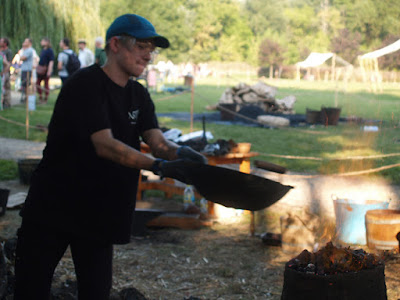
One of the boys on Charcoal
Ore used was the Harres from Denmark (thanks to Niessen & Olessen), total 41 kg.
It took the two boys working Charcoal and Ore to get a co-ordinated addition system sorted out, but once they had it figured they did a very good job. (The third member proved very good at public interface, so he undertood explaining - in Polish - to the many people watching.)

I used a method that had been illustrated by Micheal Niessen, earlier during his first smelt.
Micheal makes his first charges not of ore, but of 2 - 4 kg of iron rich tap slag. He suggests that doing this will create the needed slag bowl at the bottom of the furnace much faster. This in turn means that metallic particles being reduced will start too collect sooner, with the end result of more effective bloom production. Both his direct experience and our use of this method at the workshop certainly prove this to be the case. 
Bloom from smelt two
The end result was an extremely nice 8.2 soft iron bloom.
This would prove one of the largest created, out of a total of some 15 + individual smelt attempts by the various teams.  Most certainly this bloom showed the single best return, with a yield of 20%.

 Again, on comparison with the Norse artifact bloom, you can see the shapping is almost identical.
(On a suggestion by Lee Sauder, we intentionally left the cut to about the same depth to illustrate this.)

Plans are to add this specific bloom to the Museum's display as a sample of what historic blooms would have looked like!

Great work by all.

Monday, September 26, 2016

TOCCA FERRO


 TOCCA FERRO
A collabrative project between :
Katriona Gillespie
Darrell Markewitz
Kelly Probyn-Smith

Initial concept Sept 21, 2016
First proof of concept test = Sept 25, 2016

details to come...

Friday, September 23, 2016

Scottish Coal - the Bad, the Ugly (where is the good?)


One of the tasks for the central week of Turf to Tools 2 was to get a basic equipment set up for basic blacksmithing operations at the Scottish Sculpture Workshop.

After way too much time expended attempting to source equipment, and manage excessive shipping costs, Eden Jolly at SSW ended up using measurements I supplied and simply casting a new forge fire pot. Cast Iron pours is one of the features of the facilities at SSW!
Eden's fire pot, set in place and ready for the fuel.
As it turned out, two critical elements remained to create an effective forge.

The first problem has proved providing suitable air flow. As built above, there is a choke point at the lower 'chip breaker'. This was fabricated out of scrap materials available around the workshop, forming the 'slotted cylinder' type seen above. Problem ended up being that the available air opening was effectively a rectangle about 1/2 wide by about 1 3/4 inch long. Too small to easily pass the required air for ideal combustion. After trying three separate blower / gate combinations, we did manage something that if a bit loud, would at least allow for a reasonable sized fire.

We used up the last bag of (more or less) acceptable coal on hand - remaining from the 2014 project.

Eden went to the local coal merchant.
He asked for blacksmithing coal
He was sold what they call 'Smithy Nuggets'.
The bags are actually labled 'Best Home Heating Coal'
What we got.
Sorry - this is Anthrocite - hard coal.
Not Bituminous or soft coal.
Hard coal is fine for steam engines or heating stoves. It is not the type of coal needed for small scale (ie normal) blacksmithing forges.
See the yellow crystals on the surfaces? That is sulpur.

This is what happens when you try to burn this quality fuel in the forge.
After about 10 minutes of a full air blast.
Eden still struggling after 20 minutes of blast.
This level of dense sulphur ladden smoke is toxic to the worker. I've already gotten lungs damaged from working with high sulphur coal at a museum in the late 1980's. By the point that the second photo was taken - I would not get any closer to that fire or smoke.

The sulphur also damages the metal itself, making forge welding particularly almost impossible. (Maybe more on that later.)
Since the next phase of Turf to Tools is to compress and repeatedly forge weld up the blooms into solid bars - I was not willing to subject our hard gained bloom iron to contact with this fuel.

We have hopes that we may be able to get some better quality (workable) coal from the near by Transport Museum in Alford.  (later today)

At this point the Bloom to Bar part of the project is three days behind. It will have to be laid aside to ensure all is ready for the second iron smelt experiment (fuelling with Peat) taking place TOMORROW.
 

February 15 - May 15, 2012 : Supported by a Crafts Projects - Creation and Development Grant

COPYRIGHT NOTICE - All posted text and images @ Darrell Markewitz.
No duplication, in whole or in part, is permitted without the author's expressed written permission.
For a detailed copyright statement : go HERE