Thursday, October 05, 2023

On Click Bait - and going to the Source

I had been presented with this ...

" Archaeologists stunned by 2,900-year-old steel tools in Portugal

Steel tools were believed to have only become widespread in Europe during the Roman Empire, but a recent study challenges this assumption. The study shows that steel tools were already in use in Europe around 2,900 years ago, during the Final Bronze Age. " (1)

https://www.zmescience.com/science/archaeology/2900-year-old-steel-tools-portugal/
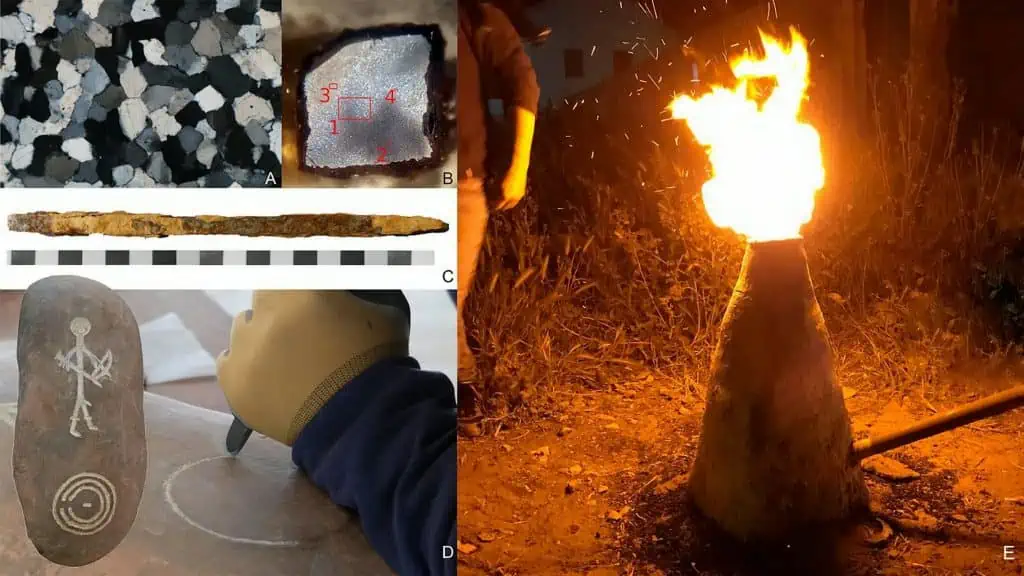
Image linked from the original article (2)

" Photos: Rafael Ferreiro Mählmann (A), Bastian Asmus (B), Ralph Araque Gonzalez (C-E) " (1)

Go and read the article and come back...


Before I get into this, did you see the link to the actual report on the Experimental Archaeology? Very last line in the article :

" The findings appeared in the Journal of Archaeological Science. " (1)

Ideally you should read that as well...


Ok.

Do you see any significant differences between the two? 

I sure did!

I took a look at the fluff piece first, then used the link to the actual formal paper.
Two different animals.   

The article substituted 'temper' for 'harden'. Any blacksmith would tell you that these are not even vaguely the same. Hardening iron metals involves high temperature and then quenching in some liquid, attempting to create a controlled hard material, where the initial carbon alloy content of the iron is critical to both method and result. Tempering is another process entirely, done as the last step, carefully and at much lower temperatures, which effectively removes hardness to a desired area and amount.


Going to the actual report

First thing that needs to be understood that the archaeological report is centred primarily on the question of how detailed carvings were made in specifically a hard quartz-sandstone type. The experiment included test carvings with replica stone, bronze and specifically several different copies of an iron alloy artifact tool.

The object itself, on detailed examination, shows no proof of hardening at the point sampled, which was the top of the chisel, not the cutting tip. As would be expected, that part of the artifact tool was annealed. Annealing is the first of the three heat treating steps for carbon alloys in tool making, involving first high temperature and then slow cooling. This effectively removes any hardness and importantly stresses from the initial forging process.

" Fig. 9. The chisel from Rocha do Vigio, length ca. 18 cm (Photos: Ralph Araque Gonzalez) ".(3)

The tool in question is a very basic straight edged chisel with a square cross section of about 1 cm, total is 18 cm long. A bit narrow, but otherwise a pretty standard tool shape for detailed stone carving. (4)


The conclusion about hardening being used on the artifact is based on their making of a replica made of 0.60 % carbon modern steel, and its use effects on the same stone as was used historically. The experimental tests suggested that to carve that stone, the tools used required some type of carbon alloy, with hardening of to some state (importantly, not analysis of the artifact itself). A reasonable comparison, but not proof.

The artifact shows considerable variation in carbon through the cross section, to be expected with processing a single bloom by folding, with the bloom material varying from 0.17 % to as much as 0.83 % carbon, four places were tested over a 1 cm cross section. Visually the polished and etched section looking like four separate areas of a bloom forge welded together to create the bar. 

This is important to understanding exactly what the material in this tool represents. Having made more that a few iron blooms, I can state that bloomery iron is not homogeneous, with contained carbon varying between top and bottom surfaces of the same raw bloom. The process of consolidating and purifying any bloom will require repeated flattening, folding and forge welding together. (The more dense the starting bloom, the fewer of those steps needed).


Worth noting that this is NOT a sign of either an attempt to case harden or specifically place harder carbon metal at one edge. (To be fair, the report does not claim either of these methods are visible). Than any blacksmith could tell the relative hardness of an iron bar as it was being forged is certain. (Ask any contemporary blacksmith!) The quality and carbon content of individual working bars from blooms (even areas within the same stock bar) was well known right up to the introduction of Bessemer steels in the 1850's. That an ancient smith might save 'hard iron' specifically for tool making can hardly be questioned.


So - typical distortion of a limited report through limited understanding into bad description and mis-use of technical terms - for impact via the popular press. 


1) Tibi Puiu, September 21, 2023,

ZME Science, Archaeology, News

2) Worth noting that I think the furnace depicted here is a very bad design. The extremely large difference between top opening and base diameter is certain to have a negative impact on the fall of added ore through the reduction zone, and bloom formation. 

3) Gonzalez, R. A., 2023, "Stone-working and the earliest steel in Iberia: Scientific analyses and experimental replications of final bronze age stelae and tools" in Journal of Archaeological Science, Volume 152,

https://www.sciencedirect.com/science/article/pii/S0305440323000201?via%3Dihub

4) I have made a number of similar stone chisels for modern artisans over the years. Most typically of a middle carbon / 0.45 alloy, hardened by oil quenching and tempered to a 'red'. With good results reported, admittedly mostly used on limestone types.


Monday, September 11, 2023

Women Become Wise…

 So here is a thing.

Looking to Old Norse culture ( a place I spend a lot of time ) you see a pattern (?). Old men are still expected to keep up with the young wolves, their declining physical abilities are considered more detrimental than the value of any accumulated experience. First out into the snow should times get tragically hard. (As my gang in DARK are often to remind me.)


Older Women on the other hand…

Continue to be valued and preserved for their accumulated * wisdom *.

Ok, this is most certainly a sweeping generalization and mis interpretation. But those reading here ‘of an age’ have also likely seen a pattern emerging that has struck me more and more of late, especially with my own personal increasing decrepitude. I have many male friends who are skilled, experienced and knowledgeable (all different qualities, of which I have expanded on here and other places). But it is my female friends who constantly impress me with their accumulated wisdom. Which most certainly exceeds my own. 

Thank you, those Wise Women who may read this. (You likely know who you are, so naming of names is not needed.) I’m often smart enough to vaguely frame a pattern, but so often quite unable to grasp any solutions. 


(Apologies to the original photographer and model of the image used above, scammed randomly off the internet.)

Thursday, September 07, 2023

Trapped on the Tide


Isle of Skye

I had always thought of  crabs as little organic tanks, just needing a gun sticking from below their eyes. I had messed with the concept back in art school, at least to the point of making drawings and collecting plastic model parts and a large carapace on my first trip to the Atlantic coast (about 1978).

But not all explorations to the landward side work well for intrepid explorers. Especially if there is a mis-understanding of scale.


I can imagine my old friend and semi-surreal painter Steve Strang more better suited to this imagining. Thinking of his submarine in a bog, floating fishing boats and ‘universal protection suit’ series.

(Sorry about the small size of the image - please view at full size! This my first attempt to add a piece using my iPad, while on travels.)

Saturday, August 19, 2023

Ireland and Scotland

I have a major trip planned to Ireland and Scotland coming up.

This has been in the (seemingly endless) works since the start of 2023. The major purpose initially was to finally attend the Caherconnell Furnace Festival (originally Woodford) which I have missed every year since it started in 2018. I had been considering attending in 2019, but the aborted Iceland iron smelting project overlapped, and I had already committed to that. Then my involvement there was cancelled virtually at the last minute (like 7 days before departure), so I ended up missing both. 

Then COVID hit...

The 2020 Festival was done as a virtual international smelting day, with boxes of Irish bog ore shipped out to various locations. (DARC had contemplated undertaking a smelt using this material and our standard furnace, but the cost of shipping 30 kg to Canada was beyond our reach.) I had supplied a video presentation, but with the everyone still not too familiar at that point in remote access, this never got included in the program. 

In 2022 the Festival returned, moving to the Caherconnell Stone Fort site, but between my major effort for Parks Canada at L'Anse aux Meadows early summer and lingering concerns still over COVID, I decided not to make the trip. Significant for that year was the development of both a furnace design (short shaft with bellows plate and blow hole) and working method (multiple top extraction of smaller blooms in a continuous sequence), that ideally suited the extremely rich bog iron ore available locally in Ireland.

Caherconnell Furance, 2022 - image by Jens Olesen

Between my uncertainty of the working situation at Caherconnell, and more significantly my own recent decline in physical ability, my direct involvement is expected to have shifted for me personally from a chance for further experimentation to more limited participation, some observation, and generally just hanging out. There may be some chance to work with Irish blacksmiths on the bloom to bar phase, but given the expected (normal) limitations of field equipment I'm not sure how much I will be able to contribute. I had initially suggested a prototype for testing slag pit furnaces (known for early Irish at other locations) but there was less interest in that build, largely because of local surface conditions (bed rock) and limited materials supply. I certainly hope to help out my old friend Jens Olesen from Denmark, who will be taking on a teaching element over Thursday and Friday. Likely also 'working the rope line' explaining the combined undertakings to the visiting public (something I do have significant ability and experience with!)


Another major element of this trip was the potential to present at the European Archaeology Association annual conference EAA23, which was happening immediately after Caherconnell - in Belfast. I had submitted an abstract early on, and was quite pleased that the paper / presentation was accepted. Originally I did not think I would be able to physically attend, as the lodging costs in Belfast were simply astronomical (even the cheapest hotel rooms were running $300 a night, or significantly more!)

Late in organizing, I did manage to get lucky on affordable lodgings for at least two nights in Belfast, so will be able to attend part of the EAA-23 conference, including the day of my own presentation there. This being :

SESSION - 729 : Friday Sept 1
Session title
EXARC: Reconstructing Past Narratives Through Experimental Archaeology
4. People of the Present – Peopling the Past
Presentation : #2296 (set later morning)
Title :
Experiment, Archaeology & Art - The Turf to Tools Project
ABSTRACT
Turf to Tools (2014, 2016) was originally conceived as “ ... an ongoing investigation in to landscape, material and craft, inspired by local archeological investigations in Rhynie, Aberdeenshire.” The archaeological foundations centred on the work of Dr. Gordon Noble’s investigations of Pictish sites, notably the ‘Rhynie Man’ stone, and later the excavations by Ross Murray at the ‘Iron Age Craft Working Site’ of Culduthel, nearby. To date, a total of nine bloomery iron smelts have been undertaken for T2T, the two main series at the Scottish Sculpture Workshop at Lumsden (close to Rhynie). These included tests of the unique local Macaulayite ore and peat as a potential fuel. Local materials would be utilized using prototypes established by the archaeology, through methods refined by experimentation, with an aim to replicating a specific object, being the axe depicted with Rhynie Man.
Taken together, this project illustrates an interface between archaeological research and practical experiment, extended into artistic vision.

This all does mean a lot more moving from one side of Ireland to the other, so I guess most of what we will see will be through bus windows.


For those who may not of caught it via Facebook, the Scottish side project work on this trip has completely fallen apart. The original intent was to mount a public demo of iron smelting, but I could not find a hosting organization to even offer up a location. (I was going to cover all the supplies and my lodgings - Guess I am not the draw I thought I was). So the third project component, Turf to Tools Phase 3, has been reduced to only a personal deposit of a replica axe into a bog, now on Skye. (This provided I can get the consolidated from blooms made during earlier phases into the replica Rhynie Man axe in the two working days left me before departure!) Taken together, this is overall very disappointing and demoralizing. 


With no institutional support (and my applied for Canada Council grant unknown until we return in September) this trip is quite expensive, taking a big chunk of my personal savings (especially now I am on OAS income here). Between the costs involved and my own increasing physical decrepitude, this was likely going to be my last major and working trip. 


PS - Note to regular readers. 

Sorry for the general decline in additions here. In the past I had attempted one contribution here each week, lately one every month has been more the case. A number of major writing projects, preparing for helping at the Gallery for CanIRON 13, (finally) a railing commission, the time with my co-op student in the spring - and what seemed endless fooling around trying to organize this trip. 

Will try to get better into the Fall...


February 15 - May 15, 2012 : Supported by a Crafts Projects - Creation and Development Grant

COPYRIGHT NOTICE - All posted text and images @ Darrell Markewitz.
No duplication, in whole or in part, is permitted without the author's expressed written permission.
For a detailed copyright statement : go HERE