I had been presented with this ...
" Archaeologists stunned by 2,900-year-old steel tools in Portugal
Steel tools were believed to have only become widespread in Europe
during the Roman Empire, but a recent study challenges this assumption.
The study shows that steel tools were already in use in Europe around
2,900 years ago, during the Final Bronze Age. " (1)
https://www.zmescience.com/science/archaeology/2900-year-old-steel-tools-portugal/
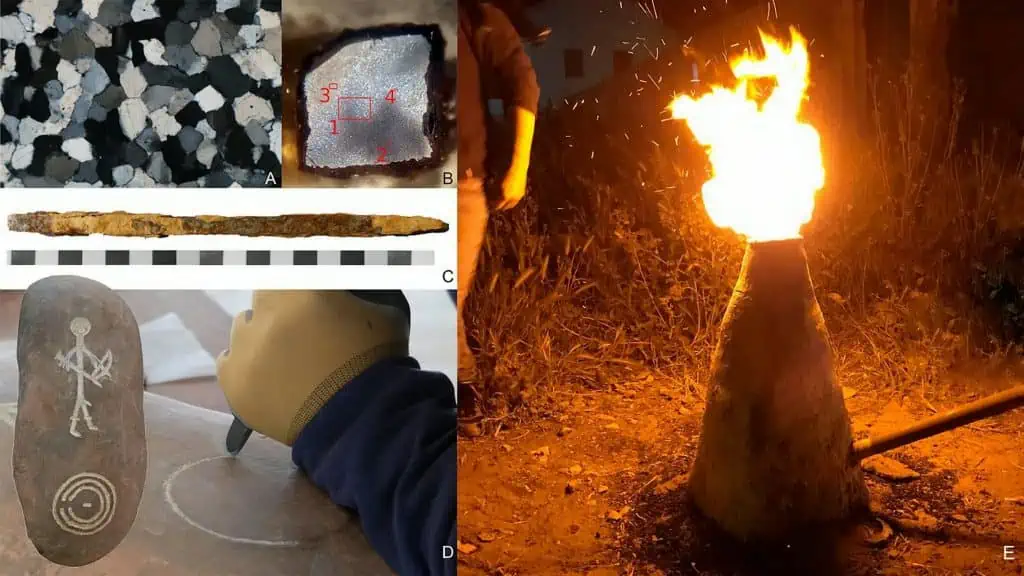
Image linked from the original article (2)
" Photos: Rafael Ferreiro Mählmann (A), Bastian Asmus (B), Ralph Araque Gonzalez (C-E) " (1)
Go and read the article and come back...
Before I get into this, did you see the link to the actual report on the Experimental Archaeology? Very last line in the article :
" The findings appeared in the Journal of Archaeological Science. " (1)
Ideally you should read that as well...
Ok.
Do you see any significant differences between the two?
I sure did!
I took a look at the fluff piece first, then used the link to the actual
formal paper.
Two different animals.
The article substituted 'temper' for 'harden'. Any blacksmith would tell you that these are not even vaguely the same. Hardening iron metals involves high temperature and then quenching in some liquid, attempting to create a controlled hard material, where the initial carbon alloy content of the iron is critical to both method and result. Tempering is another process entirely, done as the last step, carefully and at much lower temperatures, which effectively removes hardness to a desired area and amount.
Going to the actual report:
First thing that needs to be understood that the archaeological report is centred primarily on the question of how detailed carvings were made in specifically a hard quartz-sandstone type. The experiment included test carvings with replica stone, bronze and specifically several different copies of an iron alloy artifact tool.
The object itself, on detailed examination, shows no proof of hardening
at the point sampled, which was the top of the chisel, not the cutting
tip. As would be expected, that part of the artifact tool was annealed.
Annealing is the first of the three heat treating steps for carbon alloys in tool making, involving first high temperature and then slow cooling. This effectively removes any hardness and importantly stresses from the initial forging process.
 |
| " Fig. 9. The chisel from Rocha do Vigio, length ca. 18 cm (Photos: Ralph Araque Gonzalez) ". | (3)
|
The tool in question is a very basic straight edged chisel with a square cross section of about 1 cm, total is 18 cm long. A bit narrow, but otherwise a pretty standard tool shape for detailed stone carving. (4)
The conclusion about hardening being used on the artifact is based on
their making of a replica made of 0.60 % carbon modern steel, and its use
effects on the same stone as was used historically. The experimental tests suggested that to carve that stone, the tools used required some type of carbon alloy, with hardening
of to some state (importantly, not analysis of the artifact itself). A reasonable
comparison, but not proof.
The artifact shows considerable variation in carbon through the cross
section, to be expected with processing a single bloom by folding, with
the bloom material varying from 0.17 % to as much as 0.83 % carbon, four
places were tested over a 1 cm cross section. Visually the polished and etched section looking like four
separate areas of a bloom forge welded together to create the bar.
This is important to understanding exactly what the material in this tool represents. Having made more that a few iron blooms, I can state that bloomery iron is not homogeneous, with contained carbon varying between top and bottom surfaces of the same raw bloom. The process of consolidating and purifying any bloom will require repeated flattening, folding and forge welding together. (The more dense the starting bloom, the fewer of those steps needed).
Worth noting that this is NOT a sign of either an attempt to case harden
or specifically place harder carbon metal at one edge. (To be fair, the report does
not claim either of these methods are visible).
Than any blacksmith could tell the relative hardness of an iron bar as it was being forged is certain. (Ask any contemporary blacksmith!) The quality and carbon content of individual working bars from blooms (even areas within the same stock bar) was well known right up to the introduction of Bessemer steels in the 1850's. That an ancient smith might save 'hard iron' specifically for tool making can hardly be questioned.
So - typical distortion of a limited report through limited understanding into bad description and
mis-use of technical terms - for impact via the popular press.
1) Tibi Puiu, September 21, 2023,
ZME Science, Archaeology, News
2) Worth noting that I think the furnace depicted here is a very bad design. The extremely large difference between top opening and base diameter is certain to have a negative impact on the fall of added ore through the reduction zone, and bloom formation.
3) Gonzalez, R. A., 2023, "Stone-working
and the earliest steel in Iberia: Scientific analyses and experimental
replications of final bronze age stelae and tools" in Journal of Archaeological Science, Volume 152,
4) I have made a number of similar stone chisels for modern artisans over the years. Most typically of a middle carbon / 0.45 alloy, hardened by oil quenching and tempered to a 'red'. With good results reported, admittedly mostly used on limestone types.







 Posts
Posts


