Wednesday, November 30, 2011

What is True - or what they want?

'Wrought Iron Work'
What it really is - what it really means...

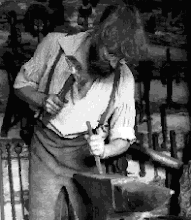
Wrought Iron was the metal of the ancient smith :
• It is a specific type of material, both chemically and physically much different than modern mild steels. Wrought Iron is typically forged (hot worked) at different temperatures, when finished is softer and more flexible than our modern day steels, and is more resistant to basic oxidation (rusting).
• The truth is that real wrought iron has not been produced in commercial quantities since the late 1970's. It is basically NOT AVAILABLE anywhere in the Western world, save as re-cycled antique material.
• Despite what may be claimed by some, all modern smiths work with industrially produced mild steel bars.
• Today, most self described "wrought iron workers" are in fact using machine formed, cold twisted, mild steel elements which have been mass produced over standard forms - then arc welded together. Typically these shops employ not blacksmiths, but welders and production fabricators. Most often the poor design, and frequent duplication, of the objects they manufacture clearly reflects these limitations.


A truism among actual artisan blacksmiths :
When some one says they are producing 'wrought iron work' - the first question should always be -
"Where did you get the iron?"
 Opening segment from 'Wrought Iron Work' - new commentary / description on the Wareham Forge

So - how does this relate back to the title?

I have been concerned of late about the way the internet is shaping information. Increasingly, useful content is becoming buried under the dross - the noise. *

I was early involved in the developing internet - my first service provider was back in the days of bulletin boards (although they call that kind of thing 'chat' these days). I started working up the original Wareham Forge web site in the mid 1990's (some point about 96 - 98)/ Over the years I have been able to maintain a Google ranking 'above the fold' (top 10, often the top 5), based on longevity, lots of content - and I hope accurate (or at lest interesting) information.

But more and more, I see other sites with far less to offer (on so many levels) edging me out. I see individuals catering to the whims of an increasingly trend driven population.
'Sure, I *know* I don't actually work with wrought iron - but its what people want to find...'


Might just be me.
Expecting to be able to shape the world to what is true - rather than just giving people what they *think* they want...


*Sturgeon's Rule : 95 % of EVERYTHING - is garbage.

Saturday, November 26, 2011

Forging the BIG Time (again!)

...more on the Peterson House Project.

 In the last post, I described the creation process leading to the final design.
Now, that looks great on paper, or even as a sample piece, there are some practical realities that need to be considered.
'Expand the diameter to six inches for visual weight' :

Calculating pipe sizes against desired bundle width. Locating the tendril wrap locations.

This is a 'size as' drawing I used to visualize / convert my available stock sizes into the layout. I'm working with standard schedule 40 mild steel pipe (most typically used for water lines). One ongoing problem for me is that the material is defined by its *interior* diameter, but as an artist, I'm more interested in its *exterior* measurement. Of course all the specifications are in thousandths of an inch, which messes me up even more. (Additionally, something I just found out - and should have known - is that as the diameters increase, so does the individual wall thickness increases!)
So what I ended up with is using 2 inch (2 3/8 OD) for the central support. To evenly distribute a bundle of tubes around this circle, I have a total of four at 1/2 inch ( 3/4 OD) and four at 3/4 inch (1 inch OD).

Physical strength was NOT going to be a problem here! Physical WEIGHT on the other hand...


I've got a handy little booklet (from Canada Steel) which lists the weight per foot of many standard industrial steel stocks.
On my scratch notes, you can see the unit weight for the various pipe sizes.
Now, bare in mind that I will be working with pieces roughly 10 feet long. The central support pieces (that 2 inch) may not seem like much, at roughly 58 lbs total, but when you make that 10 feet long...
Try forging one end while your are holding (balancing) the other *with one hand*. And consider moving that length, part of it orange hot, around the shop.

My new 3 burner gas forge (rebuilt largely for this project) with the two main support tubes heating.
A larger view, giving some idea of how long those tubes really are!
Anvil? Using my heavy layout table (3/8 plate steel top) as a forging surface. Working with a 5 lb hammer.
Detail of the finished profiling. The surfaces more deformed than aggressively shaped.
Just to put the work into perspective (for those that don't know me).
Those 58 lb tubes represent over 1/3 of my own body weight!

The surfaces are deformed with slightly flattened and spiral shaped grooves. Because it is important to retain the load baring strength of the main tubes, the circular cross sections are not 'pinched' too much.

The next step was to work up the smaller sized pipe. Because this material was not really adding (much) to the structural strength, it could be much more aggressively flattened and folded. The smaller cross section also means that even as a flattened oval cross section, it was possible to twist sections.

Showing one end of the 3/4 ID pipe as forging was completed.
One last note:
On the calculation of weights is also seen the costing for the materials. For *small* objects, normally the cost of the steel is minimal next to the contribution for labour. Not so for architectural work, especially for pieces as massive as these structural uprights. Each finished support, roughly 8 1/2 feet long, will consume almost 200 feet of the various pipe diameters. The cost of this material is approximately $400. (An indication of the relative price for the finished project.)


Oh - one last thing. With the tendril wraps, and some vine work at top and bottom, each completed support unit is estimated to weigh roughly 150 lbs. (And yes, there is a 'large object tax'!)

Where DO Ideas Come From (3) - Peterson House

My current commission is for a replacement set of supports under a front porch at Peterson House in St Agatha.
The house is late 1800's, a nice 'short two story' brick, what could be considered an affluent farm house of the period. The front porch covers the entry for the original entry door, with a small balcony above off the master bedroom. The original sculpted wooden pillars have rotted out. Part of the project has included replacing some of the timber support beams underneath.
 
Peterson House - This image altered to 'remove' existing structure


As with any project of this nature, there is a structural component, plus an artistic consideration. I had done some work earlier in the year for the clients, in that case an extension to the existing fence. (To the left side of the house.) The first possibility was to continue working in that theme - a design based on the natural lines of vines with large leaf end terminals. As usual, I sat down with the clients and had them pour over a number of book collections of contemporary work by other artisan smiths. We marked things they liked, with me making notes on their specific comments. Later, I took a more careful look at those pieces, narrowing down the general outlines from all the specific illustrations.

From this I was able to generate a number of rough layouts. One specific structural requirement was going to come to dominate the possibilities - that there had to be a strong vertical line of metal to support the weight of the heavy porch roof and its upper deck. In most cases, this reduced the visual aspect of the potential designs to look too much like 'a beam with stuff stuck on to it'.

In the end, I was struck by the potential from something else entirely:
Runnels of slag - Slag Pit Smelt 1 - October 2011
 Neil has become my enthusiastic right hand for the ongoing experimental iron smelts here in Wareham. The massive slag block produced in our 'slag pit' smelt in October was composed of individual runnels of slag, running downwards through a bundle of willow sticks. Even at the time, we both remarked on the artistic possibilities.
So I was struck by a potential design - using a bundle of individual tubes, instead of one major structural elements. In fact, a bundle of smaller tubes would be *stronger*, with the many side wall cross sections combining to the load carrying capability. Inspired by the folding and bulging of the slag, individual tubes could be partially flattened, twisted, folded or surface deformed. The bundle would be both welded and then wrapped with tendrils of round rod. This would both massively reinforce the welds, but also add an additional decorative feature.

Of course - I couldn't really draw this concept effectively!
Faster to make a sample piece :


This is the original sample, composed of a total of five individual pieces of pipe. The central core is larger diameter (roughly 1 1/4 OD) and the outer pieces of smaller (thus more flexible!) pipe (roughly 7/8 OD). The sample is about two feet long, and has tendril wraps of 3/8 round at either end.  A number of different forging techniques have been used on the individual pieces.
The competed sample bundle is roughly four inches wide.

At this point, I played some hoo-doo with Photoshop.
- First I photographed the sample piece from a number of different sides.
- I then spliced the images together to create an impression of what a full sized support would look like.
- I then scaled that image to fit the proportions of the modified image of the front of the house (with the existing structure removed digitally).


The problem here is the at the four inch width, the bundle just looks too small in proportion to the rest of the structure. Note that there is no problem with physical strength! The original pillars were roughly 6 x 6 inches, but turned into cylinders (which reduces the apparent visual 'weight').

Next I played some games with scale - and this is what the result was :


Here you see the bundle increased in size so it 'looks right'. Measuring from the known dimensions, the bundles should be closer to six inches wide.  (The total height of each is roughly 8 1/2 feet.)
Also in this last illustration is a very rough concept for the lower hand rail. This element is not required by code, with the concrete porch only 18 inches above grade. The landscaping plan is to place a large plant into the current central gap. So the rail is more about  a 'leaning' support. (The clients actually rarely even use the front entrance to the house.)To that end, the hand rail will be a simple arch shape, further supported by some organic and asymetrical curved elements on either end.


Next : Forging the BIG Time - converting design to reality

Friday, November 25, 2011

Bill Short on VIking Age Weapons & Combat

 My readers will be interested in this note from Bill Short, researcher, author and fellow Viking Age re-enactor. Bill is associated with the Higgins Armoury Musueum, and we of DARC have worked along side him on several occasions.

Generally, his Hurstwic web site is an excellent overview of many aspects of Norse archaeology, live and that group's ongoing experiments and research.

(The following was scooped from a recent Facebook posting from Bill) 

William Short
I've been updating some of the Hurstwic web articles with additional and updated text, and with many dozens of new photos. A lot of the photos were shot for my next book and illustrate our current interpretation of Viking fighting moves from the sagas. The new material is interspersed with the old, but most of it is in the arms and armor articles:
http://www.hurstwic.org/history/articles/manufacturing/text/arms.htm
and in the turfhouse article:
http://www.hurstwic.org/history/articles/daily_living/text/Turf_Houses.htm


www.hurstwic.org
Comparatively little is known about Viking age weapons, and even less is known about how the weapons were used. This limited knowledge is due to the limited sources we have available for the study of Viking age weapons and their use. This series of interlinked articles summarizes what is known ...


February 15 - May 15, 2012 : Supported by a Crafts Projects - Creation and Development Grant

COPYRIGHT NOTICE - All posted text and images @ Darrell Markewitz.
No duplication, in whole or in part, is permitted without the author's expressed written permission.
For a detailed copyright statement : go HERE