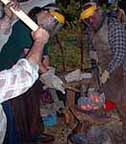
...while I'm out of the country at Smeltfest.


 This is the same shot, with the bed of the furnace established. A thin mat of broken straw covers over the stick ends, topped with a thin layer (about 1 cm) of charcoal fines. Its fully expected that the ignited charcoal will establish its own working level. The layers seen function to keep smaller pieces of burning charcoal from falling straight down between the sticks into the pit.*At this point the first layer of clay tuyeres have been installed into the open arch. The initial spit wood fire has been started. Next the remaining gap will be filled with a loose high sand and rough clay mix to seal the base of the furnace completely.
 The heat created operated the furnace like a big charcoal retort at this phase, resulting in considerable smoke from the stack. This certainly indicated that the tuyeres were in fact drawing enough air to produce a significant natural draft. Jeff figured it was more than time enough to ignited the exhaust gasses, touching these off with burning paper at the lower charge door. The effect was quite dramatic...(The handle for this can be seen in the bottom of the pipe in the image above.)
 Once that wood fuel was obviously fully ignited, rough charcoal was added to fill the lower chamber. Of course some of the wood had burned away by that point. It took about two 40 lb sacks of charcoal to fill to the ‘neck’ where the shaft starts. Jake Keen, the smelt master for this experiment, is seen adding charcoal via the charge door in the image above
 The furnace would settle down to a fairly uniform consumption rate of 5 ore plus 5 charcoal roughly every 10 - 15 minutes. Of course there would be variations on this! Twice the furnace almost stalled out, with internal temperatures obviously dropping and consumption greatly increasing. With a total of 200 lbs of prepared ore on hand, many long hours of furnace tending were expected. The initial fire had started about 2 pm on Tuesday, it was fully expected to take 24 - 36 hours to run the complete smelting cycle.

 The construction of the furnace is clay cobb, mixed with chopped local plants (a wild variant of broom straw). Jake is inserting a layer of straw between the frame and the applied clay mix. This is to allow the clay to shrink without cracking (we hope) as it dries. My job at this point was applying a further 4 inch layer of clay like soil, another line of straw, then revetting with stone and back filling with earth. This is to support and keep the bottom 18 inches or slow from slumping.
" I'm trying to process bronze (10%Sn) specimens for my master thesis. I have purchased the adequate metal and my trying to find information regarding forging and annealing (temperature and time) at the roman times."
I Am (Not Stephen Harper's) Canadian | 15650 Signatures  |


Tweet this petition: |
 |  |  |


 Showing completed group of three *. The bar has increased from 40 inches to roughly 46 inches long.


 * Now, I found that the ideal arrangement was to have three bars in the forge at any given time. By the time I had worked over three pieces as one step, the first bar I had worked had gotten back up to correct forging temperature. I did use my two burner propane forge for this part of the project: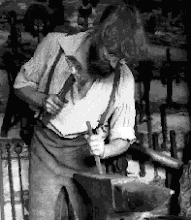


 Posts
All Comments
Posts
All Comments