Showing posts with label contemporary arts. Show all posts

Monday, August 10, 2026

Blacksmith's Gloves for a Museum?


this came to me recently :
"The Canadian Glove Museum in Point Leamington, Newfoundland recently contacted OABA requesting a set of bona-fide blacksmith gloves to add to their collection as they are expanding the collection to include more gloves connected to traditional
trades and skilled craftsmanship. They are requesting "a retired pair connected to a Canadian blacksmith, demonstration, major commission, long career, or teaching story.
A well-used pair with visible wear and a short explanation of how the gloves were used would be especially meaningful."
(This is my response to this request)
 
 I have a pair of gauntlet style gloves, retired due to left hand wear and shrinking, which might well fit your description - and although I am based in Ontario, these have a direct connection to Newfoundland.
 

I had added a few short sections, as direct responses to the details requested :

A Canadian Blacksmith...
Scope of Work...
As a Teacher...
As a Demonstrator...


A Commission - in Newfoundland...
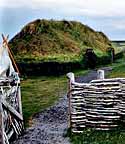
From the mid 1990's I have had a direct association with Parks Canada at L'Anse aux Meadows NHSC. I would be commissioned by Parks to design, construct and implement the 'Norse Encampment' living history program now seen at the site. This would include both the initial staff training and many follow up visits over the years (the most recent in 2023). The original presentation required the creation of roughly 150 detailed objects, and dozens more have been made by myself since. 
In 2000 year I designed and delivered the college level program 'Interpreting the Viking Age' in association with the College of the North Atlantic and the Viking Trails Tourism Assn. at St Anthony. This six week course for adult students would provide the background training for the 'Norstead' attraction.

In 2008 I was commissioned by Parks Canada to create a set of working replica Viking Age ship building tools, This included axes, adzes, chisels, a saw and drills. As research, I would travel to Denmark to the Viking Ship Museum in Roskilde and the Nation Museum in Copenhagen to view artifact prototypes. 
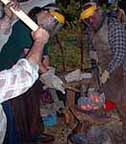
As part of that trip, I would be the only North American invited to participate in the 'Iron Making at Thy' symposium, a practical workshop in bloomery iron smelting. These specific gloves were purchased originally for the needed hand protection working with these furnaces.
Back in Canada, the creation of the axes for this commission would require repeated forge / hammer welding. This process, often seen in images for the dramatic sparks produced, again requires hand protection, particularly for the left, holding, hand. Again this pair of gloves was used. 

 In 2010, I would return again to L'Anse aux Meadows, this time to undertake a full re-creation iron smelt (meaning using all Norse equipment and clothing). Working with the local staff interpreters, it is worth noting that this was the first time iron had been successfully made at L'Anse aux Meadows in 1000 years! This pair of gloves was again employed, not being that much different from a potential Viking Age type.


Looking at the Wear...
Normal practice (for me at least) is to leave the right hand bare, to ensure proper control of the hammer. For that reason there is often more wear to the left, as it is more frequently used, and this is seen in this pair. A split seam on the left thumb was covered with a loop of common hockey tape while welding axes (and yes - I discovered this hole when I got a burn!). A second spit (not covered) is seen on the left index finger. 
As the left hand can be exposed to the extreme heat of the forge - especially during forge welding, this will both harden and shrink the leather. Eventually this will result in a lack of flexibility in the grip which becomes a problem while working. Comparing the two gloves, this shows as both discolouration and the condition of the leather on the left hand.
I would 'retire' this pair of gloves from normal working after the 2010 smelting event. I've kept them to have an additional pair available, even if not in perfect condition, for workshop events. As I have fairly small hands, getting gloves that fit correctly is sometimes a problem. Typically I replace my working gloves about every two / three years - normally due to damage to the left side. (Meaning a lot of mis-matched right hands kicking around the workshop!)
It might be of some interest that right glove has the original price sticker still in place = $33.99. That would have been in 2008 for comparison. I had considered these gloves, which had a good fit for me, well worth the price.
The cuff of each has my 'three lines & three dots' maker's mark inside. This primarily from wanting to keep them sorted at the Danish smelting event.

I appreciate that this pair of blacksmith's used gloves may not show the most extremes of wear. Honestly (and speaking from 45 years experience), a pair of gloves that are over worn may actually not perform the function they are intended for - protection of the hand. I normally only wear gloves when undertaking techniques using the most extremes of heat; forge welding, casting, smelting. Experience has shown that people are too quick to pick up a bar at 'black' heat, (still up too 600+ C) in a gloved hand. This effectively sets the glove on fire, they drop the bar but it is the hot leather than is burning them! Because you can feel the radiant heat with bare skin, merely slowing done before touching generally will keep the experienced smith safe. This combines with the fact that any work in gloves is more clumsy than manipulation with your bare hands.
The main exception here is when forge welding. Proper grip with tongs will leave the triangle between thumb and index finger sitting upwards - and flat. As correct forge welding modern steels requires use of a flux (those sparks seen), not only will extremely hot debris potentially land on that flat surface - it will (painfully!) stick there.


I'm hoping you will consider this pair of gloves, not as much for damage, but as the clear history of use that links directly back to Newfoundland.

(Message to the Canadian Glove Museum was sent on August 10, 2026 - too early yet to know what the response may be.)

Monday, June 03, 2024

'History in the Wind' : Installed at Paisley

    Those who have been following my work for some time are aware that I have both submitted and been selected to contribute pieces for several small town 'sculpture walk' collections over the last decade. 

    This year I was extremely pleased to be one of two pieces selected for the Paisley Street Sculpture Project. This is a new presentation only in it's third year. A collaborative effort with Kelly Probyn-Smith of Elfworks Studios entitled 'Wave Action' had been chosen for the inaugural presentation. 


    'History in the Wind' was originally designed for a public artwork competition at Elora in 2017, intended to mark the 150'th anniversary of Canadian Confederation. The concept was to represent the contributions of major groups in the history of our country, portrayed as a series of weather vanes mounted to a central shaft. There is an earlier description of the design and the meaning of the individual elements :

The original 2017 design

The submission for Paisley was similar, but in the creation some modifications were made, and detailed here with images of the completed work.

'History in the Wind' as installed'

   Beneath it all - the Land : The original layout suggested the use of larger granite stone for the lowest element. On more rational consideration, the simple logistics of moving such a huge stone was simply beyond my abilities. This coupled with the difficulties of boring a hole through such a large and hard material. As I did have a big pile of thinner limestone slabs (gathered off locally off the Niagara Escarpment), I decided to use one of these pieces instead. This was set on to the top of the steel plate base mount. The base was then hidden by a number of pieces of differently coloured granite stones and one of quartz, all found as glaciated field stones, intended to represent the Canadian Shield.

    Turtle Island : The original layout had the figure of a turtle to represent the First Nations. On a bit more research, I could not find any reference to those Peoples using directional weather vanes. ('You want to know the weather? Just look up...') I was also having some trouble thinking how to build an elegant and functional element out of the intended wood. Thinking deeper into the concept of 'Turtle Island' I decided to take that more literally, and make a very large flat depiction of a turtle as the base element for the whole sculpture, at 36 x 30 inches. The outline carving of the shell plates are those from the common painted turtle, painted black and outlined in red. The paints used are red and black ocher, mixed with linseed oil. The turtle has head, tail, and feet made of hammered copper, the metal employed before the intervention of Europeans. The body is positioned so it faces north.


    The Norse : Although a very brief episode in terms of the overall human occupation of this land, my own long association with Vinland lead me to include this element. There are a number of depictions of D shaped 'weather boards' mounted fixed to ship's masts, as well as surviving artifacts that had been retrofitted as weather vanes and put up on Christian churches. This element is made of brass sheet, with a surface punched depiction of the World Serpent from Norse mythology. The lower text is first in runes and Old Norse 'Kettil made me' (the character name I use in Viking Age living history demonstrations). The second text us in rune like modern English, 'Wareham Forge 2024 (the date in Roman numerals). In place of what would have been weighted ribbons are bronze wires ending in large hand made glass beads.

    Europeans : I had originally chosen to use 1605, Champlain's founding of Port Royal in Nova Scotia, to mark the beginning of the European settlement in Canada, (not withstanding seasonal settlements like in Red Bay Labrador, some 75 years earlier). I considered actually forging this element out of antique wrought iron, but in the end used modern mild steel bars. The numbers are highlighted with a copper coloured paint. Although a modern type, the feather of the arrow is made of cut and slightly twisted galvanized sheet steel. This is the physically heaviest of the elements, and in proportion has the least amount of fin surface.

Lower Canada / Quebec : Rooster shaped weather cocks where a common shape seen in Catholic Quebec, a reference to the 'before the cock crows' reference in the New Testament. This one is made out of sheet copper, the body as two clam shell pieces. Again detailing is rendered by punch work.

Upper Canada / Ontario : In more secular times, roughly a century later, for Ontario the most common figure found on weathervanes was the running horse. This specific outline is based on an object in the collection of the Royal Ontario Museum. As the artifact, this is made of tin plate, the material chosen already slightly weathered. 

Into the Modern Age : The top element is a rotor like variation on an anemometer. This made of stainless steel sheet. Individual arms have central rotating disks to create a further impression of wind driven motion. Additionally the disks are covered with holograph film, with the hope this will catch the sun and increase the visual component. 


    The finished sculpture is large, including the 4 x 4 foot stone base, standing a closer to ten feet tall. The individual elements vary in size, but all fit into the four foot diameter of the base.

Ken Cormack beside the completed sculpture

    'History in the Wind' is located in downtown Paisley, on central Queen Street North, along the west wall of the Paisley Arena. It will remain in place until mid - later October.


    Both the entire sculpture as seen, or any of the individual elements, are also available for purchase, after the public presentation of the work. Overall price has not been calculated yet. Cost of individual elements will vary, and a separate mount will need to be created for any of these purchased individually. (Contact Darrell at the Wareham Forge


    I would especially like to thank Ken Cormack of the Paisley Street Sculpture project for his patient assistance in installing the sculpture. Individual positioning nuts had to be tediously hand threaded down the length of the main supporting spar from the top. (Some of those down as much as 7 1/2 feet of threaded rod!)


Monday, March 25, 2024

'History in the Wind' - past work as prototypes

 The last posting showed my design rough for 'History in the Wind', but was thin on details of what the individual weather vane units would actually look like!

I have always been interested in wind motion objects, and have made a great number of both conventional weather vanes and what I call 'sculptural windbiles' in the past.

For the actual submission to the Paisley Street Sculpture Project, I had included images of past works, most replicas or interpretations of historic objects from the spread of history represented :


3) The Norse - ...Bronze Weather Boards like this element were fixed to the ship’s prow, with weighted ribbons moving to indicate wind direction and speed. 

Copper Weatherboard - one of a set of four, early 1990's

5) Quebec - The most common early Canadian weather vane is the rooster or cock.

Copper Weathercock, lightly sculpted, mid 1990's

6) Upper Canada - As settlement moved westward into what is now Ontario, ... the Horse becoming one of the most popular.

Galvanized sheet steel, mid 1990's

7) Into the Future - ... the spinning cups of the Anemometer, to measure wind speed. 

'La Tene Rotor', stainless steel, 2012


For other examples of past work see :

Weathervanes - http://www.warehamforge.ca/WEATHERVANES/wvane.html

Sculptural Windbiles - http://www.warehamforge.ca/DECORATIVE/windbiles/windbiles.html


Saturday, March 23, 2024

'History in the Wind' - selected for Paisley Street Sculpture Project


" On behalf of the Paisley Artscape Society, thank you so much for your submission for the 2024 edition of the Paisley Street Sculpture Project.
I am pleased to tell you that the Artscape Board chose your submission "History In The Wind" as one of the 2 sculptures to be displayed in Paisley this year.  The Board really appreciated the concept of time as captured by your design and the way it connected to the celebration of Paisley's 150th anniversary as a village."
 

 “History in the Wind’

What is the weather? One of the defining characteristics of Canadians everywhere has been our discussion (often complaints) about the weather. Through Canada’s long history, weather vanes have had symbolic meaning, with specific cultural / regional styles.  
Over the decades, with my connection to museums throughout Canada, weathervanes have been a area of both interest and work. This has included reproductions of specific artifacts, new work inside historic design traditions, and extension into my own ‘windbile’ series of sculptural objects.

History in the Wind’, overall, consists of a series of individual elements, representing various historical and cultural traditions, stacked chronologically one above another on a central support. In this the rough form also echoes First Nations ‘totem pole’ memorials.

1) The Land - As Canadians, again almost universally, we are strongly tied to place. Since the Canadian Shield runs under almost all our country - and almost links the whole country side to side, a block of granite forms the base of the sculpture. I have proposed random piece of glacier dragged and smoothed stone - here representing the Land before the advent of humans.
2) First Nations - Obviously the First Nations Peoples inhabited the Land for thousands of years before the recent history of Canada. For at least Eastern Peoples, the Turtle is important in traditions about the creation of the world. Here the figure of Turtle is rendered in a thick slab of simply surface carved wood. This element, although mobile, is not balanced to shift under anything but the most harsh of winds. This is intentional, representing the long duration of First Nation’s traditional beliefs.
3) The Norse - The Scandinavians of the late Viking Age were the first Europeans to travel to our East Coast, although admittedly only with a brief stay. Bronze Weather Boards like this element were fixed to the ship’s prow, with weighted ribbons moving to indicate wind direction and speed. The figure punched into the metal surface is the World Serpent, thought to entwine the World.
4) Early Europeans - The first European voyages to their ‘New World’ start in the early 1500’s, what is really the end of the Medieval period. At this time, the ‘Banner’ design was common. The element was created out of individually hand forged bars, the whole riveted together - the construction method chosen here. The date of 1605 represents the founding Champlain’s original settlement at Port Royal in Nova Scotia.
5) Quebec - The most common early Canadian weather vane is the rooster or cock. With its ties to Christian symbolism, this remained especially true in Quebec. The historic samples range from simple sheet iron cut outs, carved wood, and hammered tin plate and elaborate copper sheet. The Weathercock seen here, executed in copper, is based one from Saint Georges.
6) Upper Canada - As settlement moved westward into what is now Ontario, the taste of the English speaking immigrants effected choice of design, with the Horse becoming one of the most popular. These were often made of tin plate, thin iron sheets with a bright white tin coating (now worn to black with time). The pattern here is loosely based on a number of vanes from Central Ontario.
7) Into the Future - As time progressed, commercial stamped weathervanes, sized as decoration rather than function, started to replace the larger often self made figures. With the shift (in my own life time) of Canada from primarily a rural to primarily urban dwellers, people are increasingly cut off from even being able to feel the wind at all. Increasingly, suburban home owners were able to install simple weather forecasting instruments. This includes the spinning cups of the Anemometer, to measure wind speed. For the top element the form of this functional instrument is warped to create an element as much eye catching as useful. It incorporates six spiral shaped individual arms, each with a inserted moving ball element

Technical Details:

This sculpture was originally designed for the 2017 ‘Canada 150’ competition, but was not selected.

- The installed sculpture will stand roughly 9 feet about the base mount.
- The individual elements all shift with the wind, the widest being the Banner, at roughly 5 feet above ground level and sweeping out roughly a five foot diameter circle (so 2 1/2 feet each direction from the base). Note that this element has the least amount of ‘fin’ so will require the most wind to push it.
- In keeping with the requirement  for long term durability, many of the structural elements will be created from stainless steel. Primarily this relates to the central support, which will be composed of a single length if 3/4 inch diameter threaded rod.  The individual elements are secured via nuts with washers also of stainless. The individual bearings will be of a weather proof type.
- The base flanges and central upright will all be permanently welded together. The remainder of the elements plus their hardware will be threaded onto the upright at the installation site.
 

Asking Price for ‘History in the Wind’ can only be estimated at this point.
This primarily because of the unknown cost of sourcing some of the major components.

I have undertaken considerable work creating individual weather vanes over the years :
http://www.warehamforge.ca/WEATHERVANES/wvane.html

G
M
T
Y
Text-to-speech function is limited to 200 characters

Friday, January 19, 2024

Elora Sculpture Project 2023 - 'What Comes Next'


‘What Comes Next’

Elora Sculpture Project - 2024


Average global temperatures for 2023 became the hottest on record, rising to 1.46 ° C above ‘pre-industrial’ average (1850). With warming will come sea level rise.

The form of this sculpture is suggested by deep undersea hydrothermal vents.
In keeping with the concept of ‘humans once lived here’, sometime in the distant future coloured limestone formations have combined with new coral growths to cover over the debris left behind when human industrial civilization was abandoned. Despite the worst of human degradation, the sea continues to harbour life, although much has been distorted to unfamiliar forms.

I beg the indulgence of the Jury on this submission, which is more conceptional than fully rendered. The individual elements can be illustrated by past works, provided as examples of at least intended types.

General Description

The core of the sculpture is a irregularly surfaced, roughly conical stack with a number of openings at the upper side, standing about four feet tall by two feet at the base. This structure is composed of randomly coloured concrete, laid around and including various cast off pieces from plastic appliance housings and shaped scrap metal like machine parts and shot sections of pipe. Some of these are surface textured and painted to suggest mould or algae.
At several spots, the structure includes groups of randomly shaped ‘bubbles’, which allow for viewing into the interior. These placed so that the motion of the sculpted ‘jelly fish’ in the interior can be glimpsed (part of the mechanism described below).

Over the surface of the stack a number of creatures crawl or are attached. These will include vaguely crab and shrimp like animals, variations on real (often bizarre) worms, coral and kelp forms - and some creatures the like of which has not been seen since ancient mass extinction events.

Above all this, from the main central opening, number of tall sinuous curved panels rise, suggestive of the ‘smoke’ visible at some ocean vents extend a further two - three feet. Each is pivoted and counterbalanced, allowing for some motion side to side in the wind. The counterbalance weights are formed from drastically shaped and patterned steel blocks, suggesting strange jelly fish like creatures.
Also standing above the main form are a number of thin rods which support individual, brightly painted fish profiles, which also swivel in moving winds.

As with past submissions, this will be a new work, created specifically for the Elora Sculpture Project.

Prototypes

The main point of inspiration remains images taken at deep sea hydrothermal vents:

Some of the ‘black smoker’ types show bright mottled colours over the deposited materials making up the stacks.
Commonly found animals are crabs and shrimp.


1) Structure

Some indication of how individual metal and plastic elements will be incorporated can be seen in my ‘Mecha’ series (2015) although this was considerably more limited in scale.


2) Crabs / Shrimp
These will be at least suggestive of earlier work like ‘Burgess Crab’ (2011) and the horseshoe crab element seen in ‘Last to Sea’ (ESP - 2020), although what will be made will be considerably smaller in size.

'Burgess Crab'

Horseshoe Crab element
3) Worms / Other

I will certainly use the stacked plastic disks with spacers method used for ‘Roller’ (2013), although with a rigid spine. Other worm like creatures will incorporate the waving form seen along the back of ‘Hallucigenia’ (2012)


'Roller'

'Hallucigenia'

4) ’Smoke’
The panels will be individually curved, as seen in ‘Celtic Winds’ (2005), although not as aggressively contoured, and starting with a narrow triangular shape before folding.


5) Kelp / Coral
Exact details will vary as individual elements are created. An earlier examples of potential forms can be suggested by ‘Kelp-on-Stone’ (2010)


Construction

The overall height will be 6 - 7 feet (installed)
The overall diameter will be and irregular roughly 3 feet, with individual elements attached.

Due to the expected weight of the  total sculpture, the main structure will consist of a series of individual ‘donut’ sections about 12 inches tall. These formed of fine sand concrete mix, cast into loose wet sand forms to an estimated thickness of about two inches over wire reinforcing grid. The base concrete itself may be coloured / contain texture elements, and there will be coloured paint applied to the surface to best reflect the reference image mentioned above. The rings will have internal framing of steel and bolt through pipe fittings on the interior allowing each to be lifted in place then securely attached together. The bottom most ring will also contain a framework of 1 1/2 x 1/8 inch web angle allowing for bolting to the existing sculpture mount.
The concrete sections will include various found object pieces, exactly what, primarily at the whims of what can be found.

Individual creature forms will be primarily made of forged mild steel bar, structural and sheet. Some will have decorative paint applied, some left to naturally rust patina. Use of heavy wire rope, and re-bar may be used to create interesting textures on longer kelp like elements. The ‘Roller’ element will incorporated plastic (CD/DVD) disks, others may have framework glass included. All the individual elements (save those few that move) will be bolted into place.


A further commentary, written for this blog

And will you go to church to pray,
Leaving your children to atone.
This world you’ve left in disarray
Is not God’s work; it is your own.

“God and The Orange Clown”
Ian Robb (1)


Over the past years I have become more and more distressed with human impact on the Earth’s environment. Measurements for 2023 show that global warming actually rose 1.46 ° C. (2) This places any governmental attempts at limiting the impact of CO2 emissions as an means of keeping any rise in global average temperatures from increasing any more than 1.5 ° C as clearly impossible.
At point of writing (January 15, 2024) the actual atmospheric CO2 level was 422 parts per million. (3)

“The last time CO2 levels exceeded 400ppm was around four million years ago, during the Pliocene era, when global temperatures were 2-4C (3.6-7.2F) warmer and sea levels were 10-25m (33-82ft) higher than today.” (4)


Look at a sea level projection of what even 10 metres higher would mean, and you will see the majority of major cities along both the USA coasts may be simply be under water by the much repeated 2050 benchmark. (5)

'Oh - It will not be that bad, and that is still a lifetime away, I will never see this!'

Fine.

Look only as far out as 2030. About the time you will be buying your next new car (likely another F150 pickup).

https://www.timeout.com/things-to-do/cities-that-could-be-underwater-by-2030


Back in 1976 (five years after I was personally involved in the Enviromental movement, if only in a small way) Billy Joel wrote 'Miami 2017' (6). At that time this was a reflection on the New York City debt crisis, but...

Seen the lights go out on Broadway
I saw the Empire State laid low
And life went on beyond the Palisades
They all bought Cadillacs
And left there long ago
They held a concert out in Brooklyn
To watch the island bridges blow
They turned our power down
And drove us underground
But we went right on with the show


1) https://ianrobb1.bandcamp.com/track/god-and-the-orange-clown

2) https://www.metoffice.gov.uk/about-us/press-office/news/weather-and-climate/2024/2023-the-warmest-year-on-record-globally

3) https://www.co2.earth/annual-co2

4) https://www.bbc.com/future/article/20230317-the-state-of-the-climate-in-2023

5) The link allows you to plug in various water level increases against a zoom in world map https://coastal.climatecentral.org/map/10/-52.6278/47.426/?theme=water_level&map_type=water_level_above_mhhw&basemap=roadmap&contiguous=true&elevation_model=best_available&refresh=true&water_level=10.0&water_unit=m

6) https://www.youtube.com/watch?v=coYwBvysy3Q


Thursday, September 07, 2023

Trapped on the Tide


Isle of Skye

I had always thought of  crabs as little organic tanks, just needing a gun sticking from below their eyes. I had messed with the concept back in art school, at least to the point of making drawings and collecting plastic model parts and a large carapace on my first trip to the Atlantic coast (about 1978).

But not all explorations to the landward side work well for intrepid explorers. Especially if there is a mis-understanding of scale.


I can imagine my old friend and semi-surreal painter Steve Strang more better suited to this imagining. Thinking of his submarine in a bog, floating fishing boats and ‘universal protection suit’ series.

(Sorry about the small size of the image - please view at full size! This my first attempt to add a piece using my iPad, while on travels.)
Wednesday, March 08, 2023

'What Lies Beneath' - PSSP 2023

Design Rough - What Lies Beneath

 Paisley Street Sculpture Project - 2023

‘What Lies Beneath’


(note that this is a second submission for this years competition)

What gets left behind, buried under our feet? Does the remnants of our modern industrial activities become future archaeological remains?
A large bundle of now distorted pipes and tubes is glimpsed through the gaps of a broken limestone slab shell.

This work is inspired from my continuing interest in archaeology, especially the fragmentary view of past material cultures via the random preservation and recovery of objects. If there is any message, it is subtle : What we bury today will become how the future will see, and likely mis-understand, about us. A jumbled confusion that may not truly represent our lives and aspirations at all.

Description

Detail - forged pipe bundle (Peterson House)
 
The primary elements are forged from steel pipe, some bent and twisted along their length, flared / flattened / curved at their exposed ends. (For an example, see DM-detail.jpg - a similar technique used for an architectural support.) The pipe elements will be painted, most a dull black, but some darkened blue and green. Additional elements will be made of copper water pipe or galvanized electrical conduit, the ends capped with standard joint fittings. Lengths of small steel round rod and copper (gas line) tubing form occasional spiral wraps.
In total this central core forms a cylinder (hollow inside) about  6 1/2 feet long, about 18 inches in diameter.

The outer shell is a series of random size and shape thin limestone slabs. The stone envisioned is a yellowish grey that contains many fossils. (What exactly is used will depend on local availability.)  Each is held in place by short pieces of threaded rod welded to the core, using randomly forge shaped pieces, tapped to create ‘nuts’.  The placement will create many gaps, through which the central core is visible, with the stone standing clear of the core by roughly 3 - 4 inches on the inside
In total the stone results in about 24 - 30 inch outside diameter.

With the existing cut stone base, the total height will be about 8 feet - an imposing structure.

Technical

The central bundle will be solidly welded together and to an internal support composed of heavy angle, allowing for bolting to the existing bases. The use of pipe allows for visual, without massive physical, weight.
The shaped ‘nuts’ will allow the individual stone pieces to be attached on site, after the core bundle is in place. The threaded rods (two per stone for all but the smallest) would be 3/8 diameter, the holes drilled oversize to ease placement.
Although the overall concept would be better expressed if the steel surfaces were allowed to naturally rust, it was decided to use a protective painted coating (industrial enamel over primer) on all the the steel pieces. This primarily to avoid any possible rust stain damage to the polished stone base blocks. For this reason, all the top open ends of the pipe elements will be sealed, capped or folded downwards (to prevent rain water penetration to the interiors)

Note that this is a design for a new work, likely only to be produced if accepted.


Artist

Darrell Markewitz started his life long work as an artisan blacksmith as a student at Ontario College of Art in the late 1970’s. He founded his Wareham Forge in 1991, shortly after moving to lower Grey County, as his full time operation. Over the decades he has created practical and decorative objects for sale and on commission, ranging from simple candle holders to major architectural installations. Over the last decade, he has created a number of large objects for inclusion in the sculpture projects in Elora, Halliburton and most recently in Paisley.
see : www.warehamforge.ca

Saturday, January 14, 2023

'What Dreams They Had' - ESP 2023

 How does Canadian popular culture hope to fix it’s fantasies in place, and what confounds the current imagination?

Materials : industrial mild steel, steel cable, copper / aluminum tube (to be determined), ‘found’ objects (primarily plastic), glass
Construction : primarily fabricated & welded, limited forged elements, some small wind driven moving parts


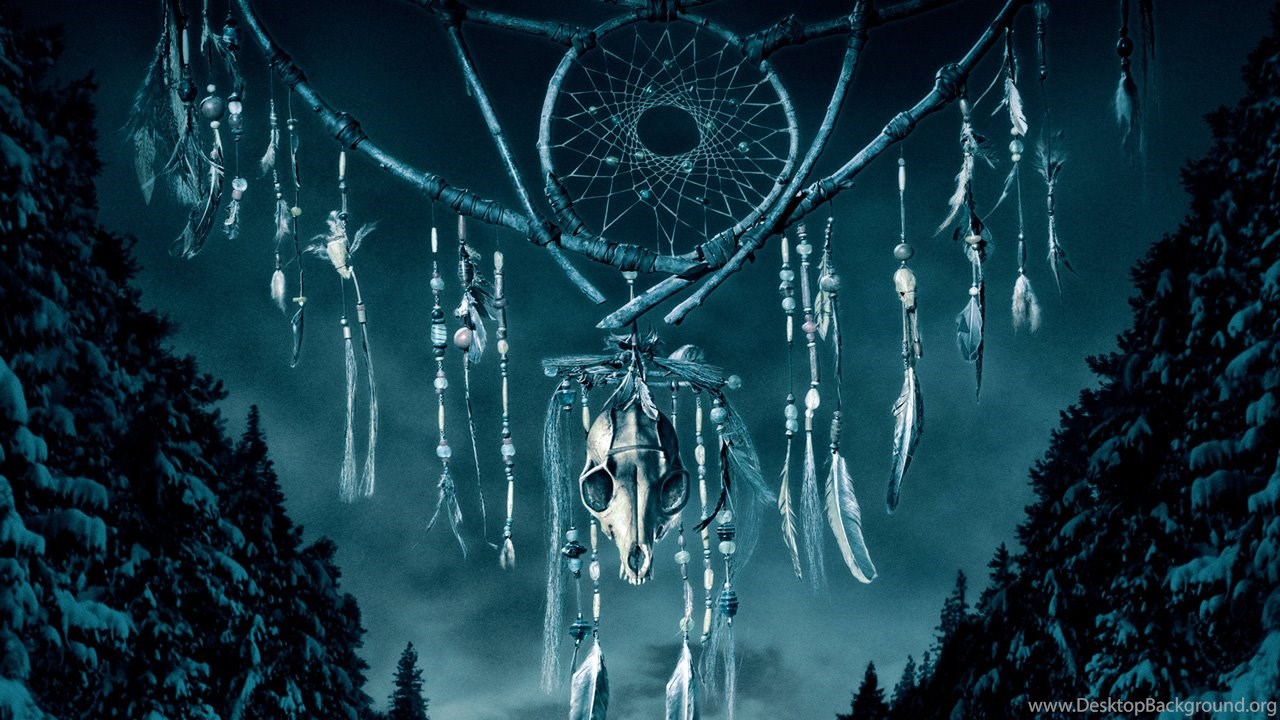
This sculpture superficially takes the form of an Ojibwe Dream Catcher, here a circle four feet in diameter. Quite deliberately, as a refection on Cultural Appropriation, every one of the traditional First Nations concepts behind their objects are rendered incorrectly, specifically to indicate ‘European’ based contemporary Canadian distortions, forms, and concerns. Following the 'Western' concept of ‘everything has to have a function’ the piece also incorporates an equatorial sun dial.

- The scale is enormous, at four feet diameter, where the Ojibwe objects are small enough (3 - 5”) to hang from a baby’s cradle
- The overall layout and all materials are distinctively modern industrial types, where the Ojibwe objects use carefully selected natural materials.
- The external framing is made of braided steel cable.
- The framing uses 12 attachment points, being the 12 Georgian calendar months (not the Ojibwe 13 for the lunar cycle, although there are variations between individual Nations).
- The internal web is made of industrial wire grid material, not strung from flexible lacing as the Ojibwe.
- Half of this is made of perforated stamped sheeting, not actually a web at all.
- The arrangement of the interior is symmetrical and mechanical, not a reflection of a natural spider’s web as in the Ojibwa myth.
- The opening is both placed off centre, and is a geometric star pattern, not the central, perfect, circle, as called for in Ojibwe tradition.
- A large glass rendition of the planet Earth, as viewed from the Moon, and set slightly off centre, replacing  ‘One glass bead for the Creator’ placed in the exact centre (although Ojibwa tradition, this itself is Post Contact - because of the use of glass). Custom hotworked glass bead by Shannon Scollard.
- Four metal ‘spinners’ are placed at the lower frame edge, replacing a single bird’s feather (traditionally owl for girls, eagle for boys) tied to the end of the web lacing, at the centre.
(For a commentary on the background research conducted see: https://warehamforgeblog.blogspot.com/2022/12/what-dreams-they-had-background-research.html)

Specific ‘Dreams’ are represented as caught in the web. (Never depicted in First Nations objects!)
 - A cluster made of of a female and male pair of clothed ‘fashion dolls’, surrounded by plastic dollar signs and coins. This all representing the dream of Wealth and Celebrity.
- An industrial form disk containing a ring of glass tubes - directed inwards to a bundle of four glass bubbles. This a representation of the dream of Fusion Power (and by extension, the dream that somehow Technology can save us from impending Climate Change.
- A toy pick up truck, wrapped in an electrical cord, it’s end hanging down. This representing the compelling dream of the Electric Vehicle, now blunted by the American auto maker’s insistence in producing large sized vehicles (at huge costs).
- A possible fourth representation (applied to the bottom quadrant) would be a plastic doll’s house. This representing the current greed fueled dream of the Monster House as a profit taking scheme.  (Once the framing is created, a decision will be made on including this element against how cluttered the piece may look.)


The equatorial sun dial slants forward from the circular main frame.
- The wide steel band to mark the passing of time is scribed (hot punching) with hours running from 5 AM to 9 PM - sun rise to sun set on the Summer Solstice (June 20). This band would be made from 1/4 thick by 3 inch wide steel. If the exposed top edges (at roughly 24 + inches above ground level) are considered a safety problem, the ends can be capped with a short length of horizontal steel pipe.
- The material for the gnomon rod will be determined by tests of available materials. The ideal would be a rod of coloured glass or plexiglass (this second less susceptible to vandalism). The intent is to mount a small solar powered LED in the upper socket, so providing glowing illumination at night. Should this not prove feasible, the rod will be replaced with copper or brass.
-This whole element is set at the 44 degree angle required for the latitude of Elora.

As the exact position of the installed sculpture is unknown, the base mount needs to be able to be adjustable to account for the E-W alignment required for the sun dial to function. The bottom base is a flat plate welded in place above the low framing (2 inch wide angle) required to allow the sculpture to be bolted to the existing plinth. A second steel plate is welded to the sculpture framing itself. These two plates are flush mounted, secured primarily by a thick central bolt to allow rotation. Additional holes will be pre-drilled in this top plate. Once the correct compass setting is determined, an additional set of holes and securing bolts will be made through the bottom plate. Drilling these 1/4’ diameter holes represents the main work involved in mounting the sculpture.

As with past years this sculpture is presented as a design rough. It is unlikely to be actually constructed unless selected for inclusion.

Saturday, December 31, 2022

'What Dreams They Had' - Background Research


Just were do ‘traditions’ come from? 

What constitutes ‘authentic’ tradition?


Closest to the elements given below (a)

Dream Catchers are attributed uniformly in descriptions to the Ojibwe, but the making and use had dispersed to other Nations, the Lakota often mentioned.
The core of the legend is :

“ As the legend goes, according to Longboat, "there was a very special woman who was responsible for the children. Her name was Spider Woman, a name likely given as was customary in Indian tradition.
"Her job," said Longboat, "was to web these dream catchers and hang them above a baby's cradle board while the infant was sleeping. As its popularity increased, however, it proved too much for Spider Woman to take on because she could not travel from one location to another and try to look after all of the children.
"So, at that time, she passed the webbing (technique) down to the aunties, grandmothers and the mothers, to look after the webbing for the children and the young.” ” (1)

There may be no other First Nations object that as been so massively appropriated by outside cultures. To the point any attempt at finding design definitions becomes almost impossible. This really should be no great surprise, given how individual lines to tradition have been shattered at European hands. (2)

The following elements appear to be involved :
- Makers : uniformly, the creation was in the hands of grandmothers, aunties, mothers
- Size : for the original purpose of child protection, 3 - 5 inches
- Materials : frame of willow, wrapped in leather, web of sinew
- Form : exterior frame is circular "it was made in a circle ? a representation of the sun that travels across the earth." Other references state the circle also represents the shape of the full moon. However, a tear drop (snowshoe?) shape, frame ends crossed and to the top, also is mentioned (no symbology available).
- Webbing : The ‘making of’ references state the interior web starts at the hanging point and consists of a series of loose loops around the frame, with additional loops progressing towards the centre. All formed from the same length of cord, so resembling a spiders web. This suggests the webbing is more irregular than symmetrical. (3)
- Attachments : The largest variation in description comes in the number of starting loops (there appears no ‘standard’) :
8 for the legs of Spider Woman
7 for the Grandfathers / Prophecies
5 for the sky shapes
13 for the lunar cycle
28 for the days in a lunar month
- Centre : The webbing ends in the centre as a perfect circle. The purpose is to allow ‘good dreams’ to pass through, the evil ones caught in the web, to evaporate in the rising sun.
- Feather : A feather hangs from the dream catcher, which dribbles the passed good dreams down on to the sleeping child.
Longboat states a single feather, ‘owl feather for women, eagle feather for men’. A single feather is attached to the end of the web forming cord, so hanging from the central circle. (4)
- Beads : One source stated that glass beads (obviously post-European) were added originally to replace feathers, at a point where many First Nations ritual practices were outlawed, including the passing and use of certain feather types. Other interpretations
1 for the Creator (placed in the exact centre)
3 for the Three Fires (the Potowotami, Ottawa and Chippewa Nations)
4 for the Four Winds (see below)
- Central X : Used in some examples, marking the Four Winds (compass points)

At this point in time, it is hard not to imagine the dream catcher as a cultural object has now descended totally within the public domain. (A perfect example is the massive and rambling discussion provoked with the commentary "Are Dream Catchers Evil?")

It is worth noting that in an attempt to illustrate this commentary - it proved virtually impossible to find an image of the most basic dream catcher as defined by the elements listed above. (5) 

There are two primary reasons that I can see for this :
a) MASSIVE ‘cultural appropriation by the New Age pagans
b) the inherent design potentials of the basic elements.
c) A flood of commercial versions of what is at core a simple object to manufacture

'The Dream Catcher' - use for a Hollywood style horror film!

Two main references used (from many sought over the internet)
Aboriginal Multi-Media Society of Alberta
- https://ammsa.com/publications/alberta-sweetgrass/where-did-ojibwe-dream-catcher-come-0
Dream Catchers
- http://www.dream-catchers.org/ojibwe-dream-catcher-history/

1) All quotes from Bev Longboat, ‘the executive director at the Niwasa (Little Ones) Head Start Program at Six Nations Reserve near Brantford, Ont’.  (see link above)


2) It has been pointed out that there are several problems with any attempt to gather this kind of information :
a) Individual Nation groups will have different details, perhaps down to a local geographic level.
b) The line of historic through traditional to modern practice has been completely shattered through European impositions (read ‘intentional destruction’).
c) There has been considerable (and understandable) ‘re-invention’, now itself dating back to a period (1960’s - 70’s) starting to be shrouded in memory.
d) Add to this the problem of a difference between definitions of ‘traditional’ (‘what my grandmother told me’) and ‘historical’ (dated objects or writings). This last may reflect my own (‘Western’ / European) perceptions, especially since my focus is to time measured in centuries, not generations - especially since I now myself could be considered a ‘grandfather’ by count of years.

3) A feature of so many modern interpretations is the web having machine like mathematical / symmetrical patterns.

4) Modern interpretations also all show many variations in the number of feathers attached, with multiples tied to the bottom edge of the external frame. Almost uniformly, feathers so attached have cord or lacing over the bare shaft of the feather, with at least one bead inserted on to the shaft.

5) try : https://duckduckgo.com/?q=traditional+ojibwe+dream+catcher&t=ffnt&atb=v41-1&iar=images&iax=images&ia=images
I scrolled down through at least 100 images - to the point were it was obvious the search engine was loosing track and getting very derivative.

Tuesday, July 05, 2022

'Wave Action' - at Paisley ONT


Location : Paisley Ontario (lower Bruce County)

Queen Street, on the east side, just before Church Street (that's on the north side of the bridge in the centre of town.

Wave Action is a joint project of Kelly Probyn-Smith of Elfworks Studios and myself. It was the first of two sculptures chosen to initiate a new Paisley Sculpture Project, under the Paisley Artscape Society . This is a new work, created specifically for the PSP, and is the first major public art project by Kelly.

The original concept was drafted in conversation with Kelly in fall of 2020, who conceived of a human powered kinetic sculpture, inspired after watching 'Mechanical Marvels - Clockwork Dreams' a 2013 BBC 4 program hosted by Simon Schaffer. She was particularly taken by a specific automata, which included twisted flat bars of glass that rotated to suggest flowing water. 

This project has been some time in the waiting, our original proposal had been tentatively accepted in early 2021, but providing for the required stone block mounting bases took over a year to organize. 

Kelly had imagined a series of flying birds, swimming ducks and leaping fish. These figures were pewter, cast into a series of soapstone molds she carved, then individually painted. 

The last elements were groupings of small plants, each element individually hand forged and collectively making clumps of reeds and grasses set along the river bank. She was influenced here by the work of another artist who was also undertaking a residency at the Scottish Sculpture Workshop, during our own time there in 2017

One last larger element was the inclusion of a human figure paddling a canoe (a common activity heading down the Saugeen River from Paisley).

The clip above shows the sculpture in action, with the wheel on the front rotating the set of birds and fish. Simple T handles on either end rotate the twisted bars making up the waves. A simple push / pull lever activates the paddler. 


My contribution here was building the frame and figuring the mechanicals (and the final spray colours on the sides of the main box structure). 

Originally the plan was to use a recycled bicycle main peddle crank for the handle. When the  four by four foot size of the stone mounting block was later established, it was clear that the crank would have to be extended well past the front of the main box, and I was concerned too much torque would be applied if a crank was employed. Fortunately, in the pile of scrounged parts I found a small rubber tired wheel - ideal for use as a means of applying the required motion. Inside the frame a pair of bicycle gear clusters are chain driven off a central main sprocket (other than the chains, all scrounged at the local dump). This cobbled together provides the rotating movement for the diving figures. 

Wave Action will remain in place on the street at Paisley until mid October. 

Come take it for a spin!

I would like to personally thank and recognize EPCOR Utilities, through it's representative : General Manager Mark Egbedeyi-Emmanuel. EPCOR provided funding for the purchase of the elegant cut and dressed stone mounting block seen in the images.

Video of Wave Action in motion shot by Kelly.


February 15 - May 15, 2012 : Supported by a Crafts Projects - Creation and Development Grant

COPYRIGHT NOTICE - All posted text and images @ Darrell Markewitz.
No duplication, in whole or in part, is permitted without the author's expressed written permission.
For a detailed copyright statement : go HERE