Showing posts with label casting. Show all posts

Sunday, January 07, 2024

Upcoming : Classes at SCA events - one

Blue Dragon Studium 3.5

When : Jan 20 – 21, 2024
Where : Woodview Community Centre, 151 Cadillac Ave N, Oshawa, ON L1G 6C3, Canada (map)
Description : The Canton of Ard Chreag hosts Blue Dragon Studium IV

website:  https://ealdormere.ca/blue-dragon/

I will be returning to a couple of teaching style events upcoming for the Society for Creative Anachronism, here in Ontario, over the next two months.

These are the offerings I have proposed / are scheduled for Saturday January 20
 
Historic Pewter Casting

8:30 - 12:00 AM
8 student maximum
14 years and up
materials fee = $10
Students will be required to be masked, considerable dust generated during carving / instructor protection

 
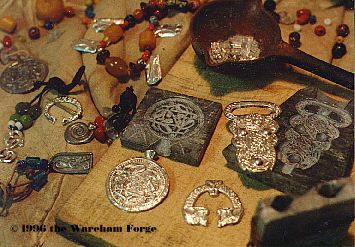
Metals have been cast into stone moulds since the Bronze Age. Simple pendants and tokens of pewter are found throughout the Medieval period. In this class each student will carve their own re-usable soapstone mould, then make several finished castings of lead free (tin) alloy, with needed tools provided *. The class includes a brief historic overview, a discussion of mould making methods and a discussion of designs. Students keep their mould block, which should have room for 2 - 4 objects (depending on size), 4 - 6 finished castings, a simple technique handout.
* Any students owning a demel type rotary tool are asked to bring them (four units provided).
http://www.warehamforge.ca/old-castings/oldcastings.html


Norse Iron 
 
2:00 - 3:00 PM
60 minute lecture / discussion
no class size limit
best suits teens through adults

 
The 'Dark Ages' are known partially through a number of truly impressive objects made from forged iron, Sutton Hoo (Anglo-Saxon) and Oseburg (Norse) being the best known examples. During the Viking Age, iron was used for domestic objects, tools and weapons. Illustrated with artifact images and physical replicas, this session will look at how iron itself was made, the work of the blacksmith, and objects of special interest to re-enactors.
http://www.warehamforge.ca/ENCAMPMENT/artifact.html


Experimental Archaeology for Re-enactors 
 
3:00 - 4:00 PM
60 minutes as lecture / discussion
no class size limit
best suits teens through adults
As you gain skill and experience with Medieval craft works, your personal experience often hits a point where references fail and you think 'Just how did they do that?'. Without realizing, you may have crossed the line into Experimental Archaeology! There are differences to be considered between Experience and Experiment, but surprisingly, adding to formal knowledge can often be the product of fairly simple undertakings. Among case samples are the work the Dark Ages Re-creation Company into Viking Age glass bead making and bloomery iron smelting. 
 
Instructor Bio
 
Darrell Markewitz has operated the Wareham Forge full time since 1992, with experience as an artisan blacksmith spanning 45 years. He is a specialist in the Viking Age, working closely with Parks Canada at L'Anse aux Meadows NHSC, as well as contributing to museum programs in Canada, the USA and the UK. A special effort for the last two decades has been research into bloomery iron smelting, expanded into experimental archaeology and academic papers.
As Sylard of Eagleshaven, his involvement with the SCA extends to the mythic founding of Eoforwic, and he is founder of the Dark Ages Re-creation Company.
http://www.warehamforge.ca/index2.html
 

These are the session descriptions I provided after I had contacted the event organizers back in early December. You can see when you look to the event schedule, I am used to a more formal set of descriptions for session offerings (lost in the web formatting). I am also specifically stressing my real world experience, rather than using SCA personna and accomplishments - especially because of the topic areas.

Monday, December 26, 2016

2017 Schedule - ALREADY!


I have been asked since the Fall for my 2017 course schedule.
At this point I actually have a total of 12 paid deposits against 2017 programs (!)

So here it is - a very (very!) rough draft for how 2017 is shaping up:

At this point consider the outline up to the start of July fairly firm.

Right now DARC is under discussions with Parks Canada about a possible return to L'Anse aux Meadows NHSC. This is likely to bracket 'Parks Day' weekend of July 15 & 16. No real idea at this point about potential team size or demonstration period.
I had been asked if I would be available to come back to the Scottish Crannog Centre for their 24th anniversary event (brackets August 5 & 6). Potentially with a return to the Scottish Sculpture Workshop for Turf to Tools 3.
This makes July and August very tentative.

Early Fall may be modified by the possible ReARC conference, very tentatively the weekend of 21& 22 October.

At this point (December 2016) the intent is most of the course offerings will keep the same fee structure as 2016 rates.

As with past years, keep an eye to the web site descriptions of individual courses for firm dates and availability. Demand is even increased over last year, so you are advised to book (with a deposit) as early as possible!

www.warehamforge.ca/TRAINING/train.html

Sunday, February 17, 2013

Early Bronze Casting...

from a private e-mail :
I was reading with interest Anders Soderberg Viking Bronze experimental bronze age casting, ... I see you had made a few pointers on the subject on one section so I was wondering if you could throw light on the subject, he says that he has 2 hearths one to melt the bronze and one to warm the moulds,  I want to know how the second hearth is heated to warm the moulds? is it connected to the first hearth with another pipe and just hot air passes through to warm them or is there a fire in the second hearth ? 

Aaron
I would never attempt to contradict anything Anders might say on this topic! He most certainly has far more experience, and has researched and done considerable practical work.

Drawing from my own (limited) experience with historic methods, but also relying on some years working in industrial casting... 
The pre-heat temperatures are significantly lower than what is required for melting the bronze itself. Both in terms of speed of heating, concentration of heat and total top end temperature.
So a simple charcoal fire - without air addition via bellows, is quite functional.
Thus the second hearth.

Concentrating heat, especially with the rapid consumption rates for charcoal, is why there needs to be a special set up to the fire on the melting crucible side.

Bronze Casting experiment - Kevin Jarbeau of DARC, 2001. Bellows nozzle at left. Open topped crucibles being slowly moved inwards to heat. One prepared mould seen to two the right.

There are three reasons you pre-heat your moulds:

1) In lost wax, to completely burn out the wax master pattern (or any other organic materials)
This requires at least 80 C or so

2) To completely remove any water remaining in your mould material.
Time can be a factor here, but again 80 C will certainly do this

3) To pre-heat the mould block so the molten metal does not cool faster than it can run into your pattern.
This element is a variable. The freezing point of your chosen metal is one consideration. How viscous your specific alloy might be when fluid. Just how much detail is in your pattern is another. What kind of temperatures your mould material can endure.

When I was working in fine detail castings (dental) the most typical pre-heat for the modern investment moulds (using lost wax) was roughly 2/3 of the melt point of the metal involved. The moulds were first heated slowly, then left for a while at a lower temperature (roughly 150 C) - the first to remove any water, the second to burn away the wax.

Since the clay itself Anders is using for a mould material could actually start to melt at temperatures close to the required melting point of his bronze alloy (likely about 1000 C), it is obvious he is using the lower temperatures of a 'plain' charcoal fire for pre-heating his moulds. (The composition of the crucibles is usually different than that used for the moulds themselves - just because of this endurance requirement.)

Monday, July 09, 2012

Alloys for casting?

 Expanded from a contribution to the Norsefolk discussion group from this morning:

On 09/07/12 4:46 AM, Norsefolk_2@yahoogroups.com wrote:
3a. Re: Pewter casting
     Posted by: "Sam F"
     Date: Sun Jul 8, 2012 4:19 am ((PDT))

I would say, always go with a modern lead-free pewter alloy.  I know we're all serious history buffs, but history is not worth risking your health or well-being over. Lead poisoning is nasty stuff.

I have to strengthen what [earlier poster] Charles has said about being careful with copper based alloys. With the huge increase in base copper costs over the last decade, more and more cheaper metals are being substituted by manufacturers. Here read both Zinc and Lead. I personally had the same low level toxic exposure that Charles warned of this winter. Very nasty. Good news was that I too 'recovered' from the worst of it after a couple of days. I suspect both of us will have built up damage to our tissues (especially potential liver concentrations.) Very, very, double plus un-good.

So - care when purchasing bronze (copper tin) alloys is called for. Always ask for the Materials Data Sheet. In North America, suppliers are required by law to supply this information on request. It may mean dealing in larger quantities and with more expensive industrial suppliers - but toxic heavy metals poisoning is for *life*.

Sam has warned of the same thing with 'pewter'. Modern lead free alloys are typically 92 tin, 6 copper, trace of antimony. The antimony is a problem, but usually is in the range of 1 - 1.5 %. I've said this before, but lead free plumbing solder from your hardware is a safe alloy to use.

One important note however.
Lead in these mixtures does two things. Both are important to our understanding of just how historic casting process will work:
1) Acts to effectively lower the melting point of the metal.
Working with small crucibles in a charcoal fire, you can see why that might influence your results.
2) Acts to reduce the viscosity - improving the flow of the liquid metal. Historically you see lead added to copper alloys for the same root cause as is happening with the degrading of alloys today - cost. Losses during the casting process, and declining access to the correct metals was both accommodated by adding the cheaper and easier to get lead in an effort to 'extend' the valuable copper and tin in the mixes.
There are some ways you can work to reduce the impact of a 'thicker' flow with the modern tin alloys.
1) increase the size of the entry cone 'button' to help force the metal down into the mould
2) pre head your moulds

I have seen modern workers drastically overhead their metal to increase its pouring ability. I most definately would *not* recommend this. All the toxic effects come from metal as vapour - most likely if the metal is overheated.  Better just to adjust your mould!

One of the interesting things is taking a look at the existing stone artifact moulds, for hints of what metals might have been used.

Stone mould for a disk broach

You do find a number of moulds obviously intended for top filling in the historical record. I certainly have never had much luck attempting to top fill any of my own soapstone moulds using modern high tin / lead free alloys.
The reason for this is that the 92 % tin alloy is not only more viscous, it also has a much higher surface tension (which might be related ?). The result is that with a top pour, the metal 'pillows up' , not filling to the edges of the mould. For that reason, all the moulds I have used are designed for edge pour. (This also allows the use of a single backing plate.)

Past work - Soapstone moulds and cast pieces.
 Another clue to historic moulds is looking at the size of the entry cone, the space where the molten metal is poured when filling. A viscous metal requires a larger diameter hole to effectively fill.
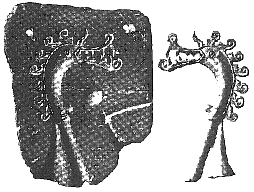
Viking Age slate mould for a small belt mount
 Now, I had made a replica of this same mould, and have always had trouble getting it to fill. Note that it is set up for a edge pour. Also the entry cone is quite small and narrow.
 This certainly suggests two things to me:
1) The smith was attempting to be quite careful about just how much metal was being contained in the 'button'.
2) The narrow diameter of the entry line is more suitable for a very 'thin' metal at molten temperatures.
Taken together this suggest a use of bronze or silver as the intended metal for this object.
The melting points of the alloys of these metals ranges about 1800 F, easily four times the temperature required for a lead based pewter. With the mould pre-heated, a successful casing in bronze or silver can be made in a stone mould. (I do wonder if the back side of the artifact mould shows any heating scars.) I have not personally used any slate moulds, but I do know from experience that soapstone suffers some loss of surface detail due to chipping when used with bronze or silver.

Those interested in trying out simple soapstone moulds for pewter casting can find a technique guide I prepared.


February 15 - May 15, 2012 : Supported by a Crafts Projects - Creation and Development Grant

COPYRIGHT NOTICE - All posted text and images @ Darrell Markewitz.
No duplication, in whole or in part, is permitted without the author's expressed written permission.
For a detailed copyright statement : go HERE