Thursday, May 28, 2009

Norse in Northern Canada

----- Original Message -----
From: Lodin Myklebust
Sent: Wednesday, May 27, 2009
Subject: [Norsefolk_2] Second Canadian Viking Village?

Vikings in Nunavut?
Find may indicate medieval Norse presence on Baffin Island.
By Randy Boswell, Canwest News Service

One of Canada's top Arctic archeologists says the remnants of a stone-and-sod wall unearthed on southern Baffin Island may be traces of a shelter built more than 700 years ago by Norse seafarers - a stunning find that would be just the second location in the New World with evidence of a Viking-built structure.
Link to the full story in the Montreal Gazette

Tuesday, May 26, 2009

John Little - Inflating Sheet


This short sequence was filmed at last weekend's 'Great Lakes International Ironfest' in Buffalo. (May 23, 2009)
John Little is a well known and respected Canadian artisan blacksmith from near Halifax in Nova Scotia. I had met John quite briefly at CANIRON 5, where we both were feature demonstrators. Both of us were extremely busy (smelt for me, his home event) so hardly had time to shake hands at that point. John has also come into Ontario to teach at Haliburton, plus run a workshop for Ontario Artist Blacksmith's Association last fall. I was unable to make that weekend for being busy with other work. So long and short, this last weekend was the first chance I have had to see John work, hear him talk about his work - and actually visit with him.


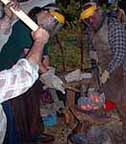
(John working at the anvil, assisted by his wife Nancy)
The quality of the sequence is not great! Something with the lighting in the industrial space used for the event was causing the camera to cycle to dark about every 10 seconds (as you will see). For that reason I kept the clips pretty short. I also was filming from a good 10 metres away, and the hand held footage is a bit jumpy.
What you can see is the second part of a more complex element. John had worked two pieces of 16 gauge mild steel sheet. These were folded down the long axis, then the fold forged and rippled. Last the fold was opened up again, leaving an organic spine or rib down the middle of the sheet. The sheets where then cut to a rough oval, then carefully MIG welded after a length of small diameter tubing had been inserted in one end.
A tube attached to a low pressure air source was fitted, and the two steel surfaces carefully heated. (Also seen in the video clip). As the metal came up to forging temperature, John bled air into the 'balloon' to inflate it. Control of temperature, position and pressure combine to create a fully three dimensional form. Up till now, John has been cutting the finished form in half to produce a number of 'bells'. This follows his interest in forging and creating musical instruments and other 'sound sculptures'.

I was stuck by the possibilities of such contoured shapes for any number of sculptural objects - for example as the bodies of fantastical fishes or insects...

Monday, May 18, 2009

'Quenched in the body of a Slave...'

Modified from a recent posting to Norsefolk. The original conversation had started with a 'traditional' reference to using blood as a hardening medium for Bronze. I had pointed out that all the non ferrous alloys are in fact annealed (softened) through quenching. The topic had drifted, as such so often do...

Effectiveness of Blood (human or otherwise) as a quenching medium:

Last time this came up, I did some actual research, then wrote a long article on my own blog repeating the results. I refer anyone who really is interested in the details to that piece:
Applied Knowledge - Quenching
What is key here is the table near the bottom of that post, showing the effect of salt added to water changing hardening rate. Even small percentages of salt have a noticeable effect.
Blood tends to have quite consistent salt content
Hence the possibility that a bowl of blood might prove an effective quench medium.

Quench a blade in a BODY ? - Foolish!
Now, I want you to think about this:

A body (human or otherwise) is completely inconsistent in nature. It has muscle, fat, liquid pockets, air pockets, various organs with differing densities and fluid contents - even bones.
If you took a hot metal object and plunged it into a body, there would absolutely no evenness to the cooling, thus inconsistent hardness generated down the length. NOT what you want for any cutting edge!
If you took a *long* hot object (sword) and plunged it into a body, and the tip struck a bone (pretty good chance) the part of the object still hot would simply bend due to the force. Now you have a warped inconsistently hardened blade.

If you were to use a LIVE body, that body is certainly going to wriggle as the hot blade is inserted. What do you think happens to the hot (ie soft) end of the sword when you attempt this? Completely warped beyond any usefulness - plus inconsistent hardness!

If a historic smith ever was to resort to such pure theatrics, you can be sure that the 'soul stealing' blade was destined for the scrap heap.
"Here, let me clean that off in the back room" the smith tells the richly paying customer. And down from the wall comes an identical blade quenched *properly* in urine or sea water the day before...

Darrell

(one of my LEAST favourite pieces of 'fakelore' - "A little learning is a dangerous thing")

******** FAST FORWARD **********

Addition - August 2015

I had a personal e-mail sent to me by Professor Helmut Föll, recently retired from the University of Keil (Germany) :

You don't know how right you were in your analysis that quenching a sword in the body of a slave is pure BS!
I found the source of that nonsense, here it is:
 

Let me emphasize that there are no early Arabic texts. The whole thing was a kind of April 1st joke in that Berlin Newspaper in 1894. 

In his blog post, Prof. Föl discusses a number of historic receipts for quenching solutions. He provides the original texts, translations, plus interpretations of the (often hidden) meanings for the individual components.
Not too curiously, carefully manipulated urine figures prominently in many of the historic 'secrets'.

In my own return communication to him, I had mentioned my belief that the original source for the 'quenched in a living slave' concept was from an Early Medieval Arabic text. His research into historic sources has pointed to this itself being nothing more than another piece of the 'fake-lore'!

Tuesday, May 12, 2009

Jake Powning - VA Pattern Welded Sword

I met Jake at CANIRON V, in Annapolis Royal NS, back in 2005. I found Jake to be a kindred spirit. The quality of his work is exceptional, I would say his work on pattern welded blades is amongst the best of anyone working in the field today. What sets Jake's work apart is that each blade is a complete design package from forging to carved scabbard and cast mounts. Truly beautiful work, worth attempting to emulate.

Jake has also produced a beautiful web site, wonderful graphic layout with high quality images throughout. This morning I was pointed to a photo essay he has created, detailing the creation steps on the metalwork for a Composite Pattern-Welded Viking Sword:

The direct link to the full article : Go HERE
(Please go take a look, then come back)


This is the completed sword. The blade is composed of two, 7 layer twisted core rods, with a 12 layer edge wrap. As with all Jake's work, cast bronze furniture and matching carvings on both hilt and scabbard finish the work.

I wanted to point out a couple of things from the working sequence:

You see the two prepared core rods in this image, ready to be stacked and welded to make the full billet for the blade. Jake has welded a flat stack at 7 layers. I normally start at 9. Note to those who think this is mystic! To effectively weld the starting block, you ideally want a pile as high as it is wide, and roughly 4 - 5 inches long. The length is what you can effectively weld in one heat. Balancing the width and thickness means you get uniform heat penetration - thus a solid weld. Turns out that (depending on plate thickness) this starting stack will be from 7 to 11 pieces, with 7 to 9 being most common on the artifact blades. Believe its 'lucky seven' or 'nine for O∂in' if you want...
But the real point: Jake has twisted his core rods as squares. I personally have taken to running a fast set of hammer stokes down the edges of the twisted rods to convert them is rough octagons. I find this makes for less problem with tearing the corners during the tight twisting. Also I find this method is less likely to result in diamond shape voids in the welded billet (spaces from the overlap of the twist).
I mention this, but Jake's results speak for his control of his technique!


I wanted to include this image here, as it is quite interesting. Jake has forged the edge wrap as a single piece, and fitted all the pieces together. These are being held in place with a forged and fitted heavy metal collar. In the image, he has made at least two of the series of 'travelling welds' down from the tip of the billet that join the four pieces together. You can clearly see the borax flux 'downstream' from the last weld location. That the metal remains so clean suggests the use of a gas forge (Dark Side of the Forge!). There is amazingly little compression or distortion of the welded areas, which makes me think that Jake may be using the hydrolic press he mentions for the weld (or maybe he is just a heck of a lot more precise than I am!).
Again, you can only effectively weld at best 6 inches of material in a single heat cycle. As Jake runs the travelling weld series down from the tip, he will tap the collar forward. (Scott Langton used this collar method on his reproduction of the Sutton Hoo sword.)

Thanks to Jake for publishing such a clear description of the creation of a pattern welded sword. Would be sword makers are advised to study the article closely, there is a LOT of good information there.
(Images are Jake's, loading direct from his web site.)
 

February 15 - May 15, 2012 : Supported by a Crafts Projects - Creation and Development Grant

COPYRIGHT NOTICE - All posted text and images @ Darrell Markewitz.
No duplication, in whole or in part, is permitted without the author's expressed written permission.
For a detailed copyright statement : go HERE