The following from a (long winded) post related to an ongoing discussion on the Dark Ages Re-creation Company list on suitable knives for the Viking Age...
> All the ON knives I've seen or seen pictures of have been single edge -
> Romans had double edged daggers and there is a Merovingian short sword /
> fighting knife that I think is double edged, and some very short double
> edged swords / long daggers from immediately post-Roman Briton. This
> doesn't seem to have carried over into the Scandinavian world / Viking age.
> I haven't seen any good sites discussing ON period fighting knives, but
> there is some interesting martial arts work being done in the US these days
> on Bowie knife techniques which could be very similar due to similar blade
> size & clip point shape....
>
> (Steve)
Just from a technical standpoint - and based on real sloppy memory. Much to my embarrassment, I find I have NO reference images on my own web sites! You should also check the earlier blog entry discussing general knife construction.
Most of the VA knives are short - in the 4 - 6 inch range. They almost all without exception have no cross guards. As I may have mentioned, these are grouped in two types:
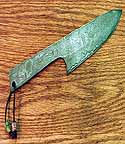
Woman's knives are long thin triangles, tend to be relatively thin - maybe 3/4 of an inch or so at the handle. Think of a kitchen paring knife. As might be expected, these blades are lighter and more suited to food preparation and textile working. Expect the 'hanging pouch' type of scabbard.
As a base blade for these, the Russel 'Ripper' blades are about perfect. These as finished blade blanks (no handles) can be had from Atlanta Cutlery or Log Cabin Sport Shop http://www.logcabinshop.com (my past supplier). Cost is about $8 US plus the shipping. The Russels will have to get their full tang ground down to a thinner width. The best version of this I've made up is Bera's knife (ask to see it this weekend).
I've got one of these two - but its from the pre DARC days and has an etched blade and the full width tang with riveted slabs. (Those with long memories will remember the days when I had sold hundreds of these in Ealdormere!) Not suitable on four counts...
Mens knives tend to be the seax shape. Basically a straight edge, with a diagonal line down from the back that creates the point. The back may slope slightly upwards from the handle to the start of that diagonal. There are some that have the back parallel to the edge, or even sloping down slightly from the handle (more on this).
Now, within the seax type - there would appear to be 'kind of' three general size and shape ranges:
Small Tool - these tend to the four inch range. Generally the blades have the parallel back and edge, although there may be some widening to the tip. As might be expected, these are by far the most common. They represent the basic tool type - a more robust knife than the classic womans blade , as suits heavier general working tasks. Again expect the hanging pouch scabbard.
Heavy Hacking - There are a range of samples that run from the top end of the small tool range (about 6 inches) up to maybe 12 inches plus. These blades are wider and thicker, and generally tend to the shape that is tapers wider from the handle to the start of the diagonal line. Again generally the straight edge, but more likely to have a slight upwards curve near the point. (This is a function of the forging process by the way.) This style of blade is most likely to be worn across the back - with two suspension loops holding the blade parallel to the ground.
The construction with the width just back of the point places the greatest mass forward - such blades would hit heavy, but not move fast. Note again the lack of any guard for the hand. These blades are great for splitting kindling, but basically too awkward for any other purpose that that - or fighting. Steve's comment about parallels with the American version of the ancient 'clip point' shape are well taken.
'Knife / Sword' - The last class is much longer - with samples ranging closer to 18 to 24 inches (there is one in the British Museum that is closer to 30 plus inches!) These are more likely to have a slight taper from the handle to the start of the diagonal - and are relatively narrow in proportion to the great length. Although the length puts them into the range of short swords, they remain single edged and without guards. (I actually can't think of any artifact samples that we would consider a 'short sword' from the Viking Age.) I have seen one artifact sample that was locked inside a sheet bronze scabbard. (My own 'Serpent's Tongue' is based on that artifact.) The scabbard had two suspension loops, but the length was such that it would have been only practical to wear the blade on a baldric. The blade hangs edge UP - as seen with Oriental short swords.
Taken altogether, this suggests a light, fast moving and extremely sharp cutting blade. Likely useless against armour, but quite effective against 'street clothes'. I'd suggest looking to Japanese technique as a model.
So the long and short (da!) of it is that we should be looking to smaller knives in the two distinctive sex linked blade shapes, ideally with pouch scabbards. Good references are the 'Knives and Scabbards' book in the London Museum series and the "Ferrous Metalwork' book in the York series. There are supposed to have been something like 500 knives uncovered in Dublin at Woods Quay - but that has not been published yet.
Darrell
Wednesday, August 30, 2006


Sunday, August 27, 2006
"Outlander' - Norse film objects
What I've Been Up To # 4
I was contacted about a week after I got home from the Goderich Celtic College and Festival by Ian Greg - a well known Halifax area set designer.
'Outlander' is a feature film being shot in Nova Scotia, with principle photography scheduled to start October 1. The story is set in Sweden circa the early Viking Age. Ian is in the process of building a small Norse village with about a dozen structures. Along with the chieftains hall and various other dwellings, there will be a blacksmith's shop. Ian has a reputation for attempting to get historical details as accurate as possible (given this IS the world of film!).
The plot of Outlander is best described as 'Beowulf meets Alien'. Add a science fiction twist to the ancient Saxon story of hero's and monsters. Make both the hero and the monster from a crash landed space ship. No technology other than what is local. Depending on how the story is treated, this could actually work quite well (but once again - this IS the world of film!)
This is a fan based plot overview :
http://www.twitchfilm.net/archives/002060.html
I have been asked to provide a wide range of historically accurate cookware and tools. All the pieces are being created to 'replica' standards - the forms are based in most cases on known artifacts. Most pieces are heavily forged mild steel, with things like arc welds used and then surface dressed to hide them. There are a wide range of cook pots of various sizes and materials. I will be taking a bit of effort on the decorative cauldron hanger, as I can see it may end up in a number of film shots.
So - it looks like September is back to the Viking Age:
Labour Day - Iron Smelt with all VA equipment at the 'Baron's Howe' SCA event
Sept 15 & 17 - 'The Vikings Return', a presentation by DARC in Rhode Island
... and a pile of stuff to make for Outlander.
I was contacted about a week after I got home from the Goderich Celtic College and Festival by Ian Greg - a well known Halifax area set designer.
'Outlander' is a feature film being shot in Nova Scotia, with principle photography scheduled to start October 1. The story is set in Sweden circa the early Viking Age. Ian is in the process of building a small Norse village with about a dozen structures. Along with the chieftains hall and various other dwellings, there will be a blacksmith's shop. Ian has a reputation for attempting to get historical details as accurate as possible (given this IS the world of film!).
The plot of Outlander is best described as 'Beowulf meets Alien'. Add a science fiction twist to the ancient Saxon story of hero's and monsters. Make both the hero and the monster from a crash landed space ship. No technology other than what is local. Depending on how the story is treated, this could actually work quite well (but once again - this IS the world of film!)
This is a fan based plot overview :
http://www.twitchfilm.net/archives/002060.html
I have been asked to provide a wide range of historically accurate cookware and tools. All the pieces are being created to 'replica' standards - the forms are based in most cases on known artifacts. Most pieces are heavily forged mild steel, with things like arc welds used and then surface dressed to hide them. There are a wide range of cook pots of various sizes and materials. I will be taking a bit of effort on the decorative cauldron hanger, as I can see it may end up in a number of film shots.
So - it looks like September is back to the Viking Age:
Labour Day - Iron Smelt with all VA equipment at the 'Baron's Howe' SCA event
Sept 15 & 17 - 'The Vikings Return', a presentation by DARC in Rhode Island
... and a pile of stuff to make for Outlander.
Wednesday, August 23, 2006
Norse Meat Spit - Period Fluxes?
Joel wrote:
> ... I was trying to reproduce a roasting spit artifact from the Lund
find.
> It looked in the picture like the pointy end was tripled back on itself
> and "apparently" forge welded. We tried this, and it worked quite
> well, producing a replica that looks just like the picture. Here's the
> question. Assuming Viking Age smiths could forge weld, what did they use
> for flux? Borax wasn't found in Scandinavia was it? Do you know how
> they did it? ...
As it happens I have to make up one of these same sword spits latter
this week. (This as part of a package of Viking Age domestic ware and
tools being ordered for a film under production - more on that in an
upcoming post here!)
The object under consideration is a type of Viking Age meat spit called
a 'sword spit' . The artifact is from Lund, Sweden and is dated to 1000
- 1050. Its total length is 111 cm. Roughly the front quarter (about 30
cm) is flattened to a long rectangular sectioned point. There are two
short prongs which bend forward at the base of the blade, which look to
be round profile and end in points. The remainder of the shaft is square
cross section, all twisted in one direction. The far end is equipped
with a ring held by a simple loop.
Viking to Crusader (Number 62 page 244) describes it as having " the
prongs being cut from the shaft and bent forward"
Viking Artifacts (Number 46 page 17 / 201) describes it " At the base
of the blade the outside edges are cut and bent to form prongs parallel
to it."
Both the books have images too small to see this kind of detail.
I can see maybe three ways of doing this:
1 - shaft and sword are one piece, two smaller rods welded on for the
prongs (a pain to wire on the small pieces while heating)
2) sword is flat stock, slit back at one end for prongs. Shaft is lap
welded on to this. The long shaft could also have a short slit made in
it (Imagine the blade with a short taper between the barbs > >- and a
matching V slit on the shaft. This is how I intend to do it by the way)
3) one thicker piece. Two diagonal slits made that get lifted away to
form the prongs. The blade is forged (slightly drawn out). Then the
length of the shaft is drawn out.
I have never been able to find a close up image of the artifact, or have
never seen it in person. (if YOU have I'd really appreciate a jpeg of
the thing - especially at the joint!)
One general comment; In the Viking Age, the source material would be
shorter and thicker 'currency bars'. These are typically about 5/8 to
3/4 square and about 12 - 18 inches long. I doubt a single one would
provide enough material for the Lund spit. For the Norse smith, the more
obvious way to work would be at the least to make the head from one bar
and the shaft from another. ( If I was REALLY doing a high end
reproduction I would try working down from the thicker stock!)
A second consideration - which is going to lead to your second question.
Remember that this would have been WROUGHT IRON (technically bloomery
iron) rather than our modern mild steel. This changes how you make a lot
of things, as the material has a distinctive grain to it from slag
occlusions during its smelting from ore. This would assist you in
determining the actual method used originally - if you had detailed
photos or the object to look at. Things like welds and joined pieces
show up pretty clearly on the artifacts.
This relates back to the welding. Period iron is to a certain extent
'self fluxing'. Often no extra flux is required to weld it. I have to
admit that I always use borax - even on the few times I have forged
welded antique wrought iron. (Which frankly has not been all that often,
as I save the material I do have for layered steel work primarily.) This
mainly on the better safe than sorry theory. Borax is what I have always
used - the cheaper washing soda variety.
You are correct that Borax was not available to northern Europe
historically. (This came up as a discussion topic just this week on
ARCHMETALS - but in the context of bronze casting and smelting.)
I have read and heard that traditional English smithing uses 'fine white
sand' for flux. This is a silica sand? I can't imagine the quartz sand
more typical here in Ontario would melt at forging temperatures. Again
one of the things thats on the (too long) list of things to try!
Hope some of this helps
Darrell
Friday, August 18, 2006
Where is He??
To my regular readers:
First - thanks for bothering!
I have been trying to get something up at least twice a week. Generally I've also been trying to keep to topics related to the Viking Age and Metalwork. As Steve commented after the Lebanon post, better to stay focussed and avoid the black pit of political commentary.
From August 5 through August 15 I was involved at the Celtic College and Festival at Goderich Ontario. This is an extremely intense 10 days. I always come home entrenched in the viewpoint of the artist and sympethetic to the Irish. Now have to quickly switch gears and get back to the Viking Age and museum related work.
There is a new feature film being shot in Nova Scotia. Its set in Sweden in the early Viking Age. They are creating a village set with about a dozen buildings, with principle photography starting about Oct 1. I was asked to provide a rush quote for a wide range of cookware, tools and other metal objects. Like usual, now its hurry up and wait. Will see how this works out.
Labour Day is our anual trek to Bonfield (near North Bay) Steve Mulhburger is an ancient friend who holds a camping event on this farm over that weekend. This year the theme is the Viking Age. DARC will be undertaking an iron smelt using all period equipment and what we have learned on historic method. One element to this smelt will be that we will be working inside a replica of House site J at L'Anse aux Meadows. In past years a cut out on the same measurements as found at LAM has been constructed, and we intend to base the smelter and positioning of equipment on the archaeology. Hopefully our smelt in the same arrangement of space may contribute to our understanding of what may have happened in Vinland circa 1000 AD.
After that project - a team from DARC will be traveling to Rhode Island for a weekend demonstration at the Haffenreffer Museum of Anthropology (of Brown University). Neil Peterson has constructed a large event web site featuring images of DARC team members. Worth a look at :
http://www.treheima.ca/temp/haffen06/vikings.html
First - thanks for bothering!
I have been trying to get something up at least twice a week. Generally I've also been trying to keep to topics related to the Viking Age and Metalwork. As Steve commented after the Lebanon post, better to stay focussed and avoid the black pit of political commentary.
From August 5 through August 15 I was involved at the Celtic College and Festival at Goderich Ontario. This is an extremely intense 10 days. I always come home entrenched in the viewpoint of the artist and sympethetic to the Irish. Now have to quickly switch gears and get back to the Viking Age and museum related work.
There is a new feature film being shot in Nova Scotia. Its set in Sweden in the early Viking Age. They are creating a village set with about a dozen buildings, with principle photography starting about Oct 1. I was asked to provide a rush quote for a wide range of cookware, tools and other metal objects. Like usual, now its hurry up and wait. Will see how this works out.
Labour Day is our anual trek to Bonfield (near North Bay) Steve Mulhburger is an ancient friend who holds a camping event on this farm over that weekend. This year the theme is the Viking Age. DARC will be undertaking an iron smelt using all period equipment and what we have learned on historic method. One element to this smelt will be that we will be working inside a replica of House site J at L'Anse aux Meadows. In past years a cut out on the same measurements as found at LAM has been constructed, and we intend to base the smelter and positioning of equipment on the archaeology. Hopefully our smelt in the same arrangement of space may contribute to our understanding of what may have happened in Vinland circa 1000 AD.
After that project - a team from DARC will be traveling to Rhode Island for a weekend demonstration at the Haffenreffer Museum of Anthropology (of Brown University). Neil Peterson has constructed a large event web site featuring images of DARC team members. Worth a look at :
http://www.treheima.ca/temp/haffen06/vikings.html
Subscribe to:
Posts (Atom)


 Posts
Posts