Friday, October 31, 2008

DARC Fall Smelt

Saturday November 8 - Wareham

Regular Readers - You would have all gotten some the background for the Icelandic smelt series that Neil Peterson, Kevin Smith and I have been undergoing of late in bits through earlier postings (search HALS) A nicely formated overview is now available on the Wareham Iron Smelting site.

Our last test smelt at Thanksgiving was just barely snatched back from disaster. Obviously we need more practice with the blow hole and bellows plate set up. It was clear that adding the lack of ability to access the tap arch space was a bit too much. I don't think the overall layout for the HALS set up is a problem of itself, other than the restriction that will be imposed by the location of the bellows.


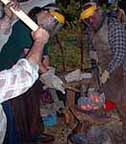
(left) Bellows plate and blow hole with set back bellows tube - just at the point were the slag bowl started to freeze over and restrict air flow.

(right) Solution that saved the smelt - reverting to ceramic tube as insert tuyere.

(left) The lower rear wall after the smelt. Note the broken area and deep fractures to the upper left. The front (above the tuyere) was completely broken away.
The smelter shaft constructed for Thanksgiving is pretty much shot. At this point there is only about half of it remaining. So it will be just as easy to build a new shaft. (The weather is supposed to warm up here over the next couple of days.) I'd like to try to work with the horse manure for the entire furnace (more like Michael Nissen does). Whether I can gather enough dried manure (this late in the season) will be the bottle neck here.

I will forge up a tapered bellows pipe like the one Michael has described. Remember we had started to lean that way with the copper tuyere. Ken Cook and Gus Gissing have long been suggesting this approach

On ore, our stocks are starting to deplete. All the taconite got used up on the last smelt (athough I'm sure we can get more). There is some of the DARC dirt 1 remaining, but not enough for a smelt on its own. There is some of the poorer Virginia Rock roasted but in need of crushing. I have several hundred pounds of the hematite grit, and suggest mixing those two.
Altogether there is enough of the Williamsburg rock for one smelt. Maybe enough raw for three using the poor Viriginia mixed 50/50 with hematite. I will be picking up another bag of spanish red to mix to DARC dirt. There is also a pail full of gromps - but best these be used in a smelt in a standard furnace.

The last hole in supplies is charcoal. We currently have enough on hand for one full smelt and a bit (I think there are about 100 kg taken altogether, mainly as Black Diamond ) We have been more fuel efficient of late, mainly by going straight to full sized ore charges and reducing the length of burn down.

So in detail:


work inside the Hals layout
new 5 cm smelter shaft
bellows plate and blow pipe
switch to tapered tube (blower)
hang air pipe system to free tap arch
ore 50 / 50 poor Virginia / hematite (22 - 25 kg?)
(aim for Hals sized bloom - 15 x 15 x 10 / 5 kg)

Wednesday, October 22, 2008

Sunday, October 19, 2008

Medieval Cast Iron?

As a short answer to a question posted to the SCA Ontario discussion:

'Is cast iron cookware historically correct for the Medieval Period?'


First challenge - Define 'medieval'?
(The SCA officially runs from 'the fall of Rome to the English Civil War' = 450 - 1650 AD )

Second challenge - do you conform to materials and objects inside your personna time frame alone?

Third challenge - some fast metallurgy:
- The element iron will absorb carbon during its processing from iron oxides (ore) as it is reduced to actual metal.
- If you have no carbon, you get soft 'wrought' iron. This is easy to hot hammer, relatively soft but flexible. Ideal for hinges and handles.
- If you have small amounts of carbon, the metal becomes increasingly hard and brittle. By small I mean from .2 to up to about 1 % (not very much). Our modern mild steel has roughly .2 %. A machette or axe has roughly .5 %. A carving chisel or scaple has roughly 1 %.
- Over about 1.5 % the characteristics of the metal change, alowing you to liquify the metal without damaging it (actually 'burning' it back to iron oxide). This allows you to pour into sand molds for pots and pans. This is cast iron. The cost is that the metal is extremely brittle (drop and it shatters).

Now the time points (real fast!)

- For the period up to the Crusades (- 1200), NO cast iron
The direct bloomery furnaces used to turn iron ore into metal had little predictable control over carbon content. If high carbon liquid cast iron was produced, it was considered a waste product and returned into the furnace. No objects were made of this material in the West. (China is another story)

- In the central part of the Middle Ages proper (1200 to 1500) - RARE cast iron.
The creation of metallic iron from ore was a larger scale two part process. A higher carbon metal was created from ore, then the carbon selectively removed to the desired point in a second furnace / forge process. So cast iron was produced, but for objects was a curiosity rather than a normally employed material. You will find some small objects, mainly things like jewelery or small sculptural pieces (think fist sized). These are quite uncommon and tend into the Rennaissance .

- Post Medieval (1600 +) - LIMITED cast iron
True use of deliberate cast iron does not develop untill the introduction of coal as a smelting fuel in the very late 1500's on the continent and into the early 1600's in England. By the time of Jamestown Virginia (1610 +) there are starting to be small pots available. These were extremely expensive and limited to the upper class. Think of the 'witches caldron' shape with three legs, maybe holding one or two gallons.

- Settlement Era (1700 +) GENERAL use of cast iron
Cast iron becomes easier to produce and control. It still is expensive, but prices and availability have dropped to the point that many families can affort a SINGLE pot or pan.

- Industrial Age (1820 +) EXTENSIVE use of cast iron
Cast iron cookware will not become both cheap and widespread until the introduction of steam powered technologies. The Victorian period has the largest use of cast iron for all kinds of objects, from personal goods to architectureal.

Simple answer:

No cast iron cookware in a medieval setting. All pots and pans made of riveted iron or copper alloy (early period bronze, later period brass) sheet. Few pieces per household.

For a simple overview of pre-Conquest cookware
Norse Trade Goods - Cookwares

Saturday, October 18, 2008

...and now for something completely different


Tangerine Dream - Ricochet

Recorded in 1975, Live (I think at Coventry Cathedral)

My favorite of all their pieces - boy I wish I had been there! (and yes, I was listening to this when it was pretty much new)
 

February 15 - May 15, 2012 : Supported by a Crafts Projects - Creation and Development Grant

COPYRIGHT NOTICE - All posted text and images @ Darrell Markewitz.
No duplication, in whole or in part, is permitted without the author's expressed written permission.
For a detailed copyright statement : go HERE