Wednesday, November 12, 2008

Gazing in the Crystal Ball

May 4, 2006

Military action may halt currency meltdown
By Braun McAsh


...

The U.S. economy is in terrible shape, thanks to the Bush administration racking up a greater debt than the 42 previous presidencies combined. The national debt is at US$8.4 trillion, with US$1.6 trillion held by foreign governments. The trade deficit is US$750 billion and rising. And due to the Bush tax cuts, federal tax revenues as a percentage of the gross domestic product are at their lowest since 1950, according to the U.S. General Accounting Office.

The world's oil is bought and paid for in American dollars. This constant demand for the U.S. dollar stabilizes the currency. Oil is the single most important factor dictating the value of the U.S. dollar. (U.S. currency hasn't been linked to the price of gold since 1971.)

When the Bush administration invaded Iraq three years ago, many assumed it was about seizing the oil. As it turns out, this was a valid assumption, just not in the manner originally stated.

....


Go read this article by my old friend Braun McAsh.
Note the date - May, 2006

Some one did too warn you about this.

Tuesday, November 11, 2008

'For Our Honoured Dead'

'For Our Honoured Dead'
mixed media

Last year I attended a theatre opening and reception, very shortly after Remembrance Day. In the room was a plinth holding a book — a Book of Remembrance, which held the names of all those who had died from that town in Canada’s wars. I was outraged to see how the unthinking would litter the Book with their empty glasses and garbage.

Regardless of your attitude towards War, soldiers continue to die in your place and at your command.
A people will be known by how they respect those who placed themselves to be killed for the welfare of all.


I was driven to create 'For Our Honoured Dead'.
The exhibit was well into its planning stages last fall, and I had actually intended to work on something related to Norse burial customs as one of my submissions. The events described in the brief statement above (from the Grave Goods catalog) electrified me however. I have rarely made political or pointed social comments with my work, but I could just not let this one go past.

For this work, I wanted to echo a number of conventions seen in War Memorials:
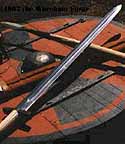
- The shield and sword are both created at about 25 per cent larger than life sized. So often this enlarging past normal human scale is done by memorial artists. It must be intentional, to make the heroic figures literally 'larger than life'.
- The shield was made from stainless steel. Of all the metals in the work, the shield, symbolizing defense, is rendered in a metal which endures. We must remember to keep ever vigilant to protect our society. Combat as defense can never be seen as wrong, even a pacifist may fight to stay alive.
- The sword has been left rough finished. It is a functional tool of war, not intended to be considered a work of art. The spring steel of the blade, as well as the plain steel of the hilt has been left unprotected. Already the blade shows surface rust from handling. The patriotic rhetoric that encourages us to fight never survives the first shock of actual combat. After a time, the reasons 'why' will corrode away like rust.
- The main figure on the shield is a Crusader's Cross. It is made of thin mild steel, already covered with rust and soon to corrode. Over the centuries, more blood has been spilled in the name of God than for any other reason. In the last 1000 years of the West, all leaders have claimed that God is on their side. How can this be the case?
- At the top of the shield are a pair of maple leaves, made from copper and brass. These metals are certain to change colour with time, yet will remain long after the steels of God and Weapon have dissolved. At core, we fight for place, for home. The exact details of this often fade with time, but these reasons remain.
- The trash covering this memorial has been carefully chosen. The symbols of mainly multi-national corporations, almost all American, can be found. How much more 'American' can you get than Coke, or McDonalds? "We fight for our way of life" is a statement so often lipped by politicians. But who stands to benefit the most? 'Just knock together a pile of plywood tanks and get into a nice little shooting war - its good for business' * Are we being asked to die for Mom and Apple Pie? Or is it really for those industries that know no loyalty to nation, who will do anything to any one for the bottom line?

'For Our Honoured Dead' was intended to provoke.
I know from my own experience on the opening night of Grave Goods, may did not read the description. The deeper symbology was buried even deeper still.

Right now the United States of America is involved in a 'foreign adventure' that is nothing more than support by force of Bush's family oil business. I am constantly amazed that after Viet Nam, that nation has allowed itself to be lied to so completely. Another generation of youth are being wasted to grease the corporate wheels. In an age of mass media and information access, it all seems to transparently a lie.

Remember : " We won't get fooled again..." ??


* I actually overhead that statement on a train to Peterborough Ontario back about 1975. I was in the Canadian Reserves at the time. So I would have been one of the bodies sacrificed on the alter of business profits suggested by that group of fat and lazy corporate owners.

Monday, November 10, 2008

Icelandic 4 Iron Smelt

A fast overview report

On Saturday November 8, a small band gathered for the normal Fall DARC smelt. This was number four in the main sequence of our Icelandic / Hals series.
Building on the work from the October (Thanksgiving) smelt, this experiment focused primarily on the use of the bellows plate and blow hole combination. Ken Cook served as Smelt Master, with Neil Peterson assisting. (And Darrell constantly sticking his nose in to keep things on track.)
About 3 1/2 hours into the main sequence, the smelter starts to self tap. You can see the arrangment for the air system, handing from supports.

Total Fuel : 48 kg
Total Time : 5 hours (plus 2:40 preheat)
Total Ore : 23 kg (mixed poor Virginia Rock / Hematite grit
Total Bloom : 4.25 kg
Total Yield : 18 %

Average Burn Cycle : 12 minutes per standard 2 kg bucket

The bloom was less consolidated on extration than what is seen from a smelter with an insert tuyere - more of a 'lumpy' texture. It also was positioned a bit futher back from the air inlet than expected, and had a marked crescent shape.

As with the Thanksgiving smelt (which also used the plate / hole) there was a choke point at roughly 2 1/2 hours into the ore charging / about 7 kg. The developing slag bowl threatened to drown the air intake. On this attempt we were better able to control this, and the smelter would settle down once the slag evolved from the early green silica type to the later black iron rich type.

Friday, November 07, 2008

Segmented Urn

For Grave Goods, one of the objects I wanted to create was an urn for cremated ashes.

Image : Detail of Tension Deficit by Lee Sauder
Originally I had two overall concepts. One would be a bowl shape forged out of a single iron bloom. My inspiration here was the sculptural work of Lee Sauder, perhaps the only artisan working consistently with bloomery iron. I wanted to have the solid metal cleaned and roughly polished in the centre, but the fragmented edges of the bloom would remain along the edges of the bowl to show its genesis in the smelter. I had intended on having a glass artist (likely Kathyrn Thomson) creating a blown glass lid to match the irregular contours of the forged bowl and act as a cover. Time constraints and the raw scale of working a 3 - 5 kg mass of iron made me shelve the project (at least for now). An echo of what I was imagining can be seen in the smaller piece I did in September 'Offering Bowl'

The second concept was developed into this object :
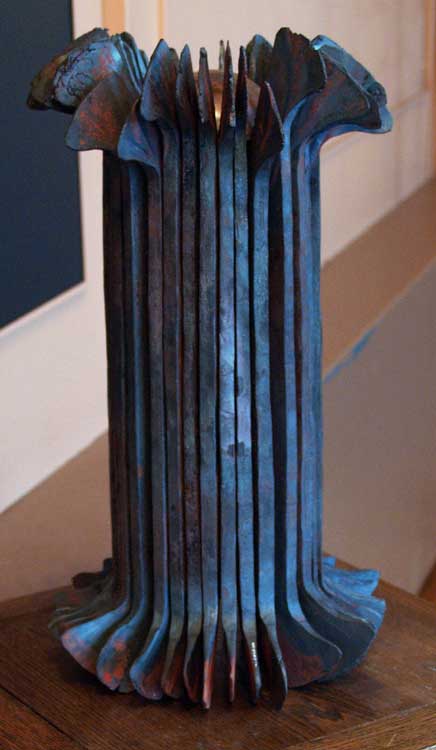
'Segmented Urn'
forged and fabricated wrought iron
(This object for sale- $1200)

" The body of the urn is composed of a number of individually hand forged strips of antique wrought iron. I saw samples of the basic technique employed by the Japanese blacksmith Takayoshi Komine at a workshop / demonstration two summers past. (Taka uses the method to make subtle oil lamps employed in the Tea Ceremony.) Actual historic wrought iron has been chosen for the construction because of its excellent forging characteristics and special durability. The metal itself is already some 150 years old — and should easily endure for centuries more. A fitting resting place for the memories of one past beyond us. "


In the creation of 'Segmented Urn' I wanted a massive object, the raw weight and scale conveying durability. As finished, the piece weighs 17 kg (thats almost 40 lbs). It stands 38 cm tall and is about 23 cm wide (15 x 9 inches). The inner volume is a cylinder roughly 25 cm tall by 10 cm diameter (10 x 4 inches).
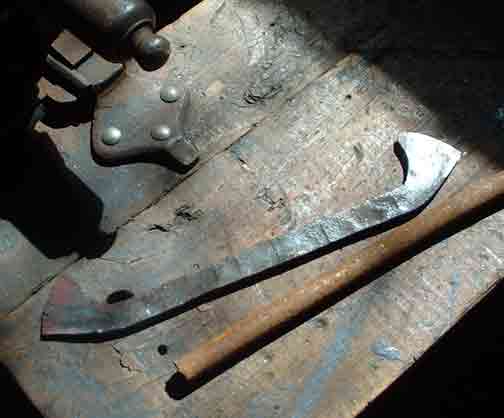
As the short description from the exhibit catalog states, the material is antique wrought iron, most of the bars from a bridge originally constructed in Ohio during the 1860's. Some additional elements were forged down from retaining pins that were salvaged from a log barn that was the original homestead from my brothers property near Buckhorn Ontario (most likely 1850's). Besides the special durability of wrought iron (it corrodes much slower than modern steels), I specifically wanted to highlight the textural differences within this historic metal. For that reason, I quite specifically chose not to re-weld any developing cracks as the metal was forged down from the source bars. The two ends of the bars were aggressively flattened to produce de-lamination lines intentionally. This was also the reason a number of rods from the barn were included, as this material was a lower quality iron that I knew would start to fracture as it was worked.
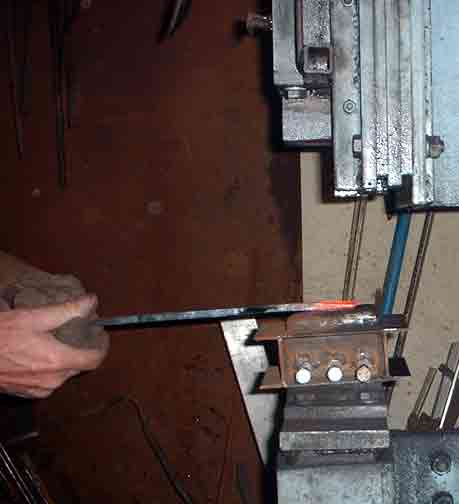
One thing that is invisible in the creation of the object is the huge amount of work required in forging each of the 34 individual uprights which make up the body. These started as long lengths (typically 60 plus cm / 24 inches) of cm (3/4) diameter round rod. This was forged out (admittedly using my air hammer!) to the 6 x 25 mm (1/4 x 1 inch) flat stock required for each element.
I then flattened both end of the bars using a special 'Hoffy' style crown die I made for the hammer. The last step was bending the flattened ends down to about a 60 degree angle.

The Taka technique mentioned in the description involves carefully MIG welding the edges of a stack of separate flat bars, then very gently forging them into three dimensional contours. For Segmented Urn, I made up a special jig that let me set the rough angle between pairs of the uprights. Next the pairs were welded to groups of 4, two groups welded to create rough quarter sections, then pairs welded to produce half sections. At this point it was found that an additional set of two would be required to produce an even full circle, and two more bars were forged and welded to place. I was actually quite surprised just how close together the two half sections were to a close fit. Consider the variation between individual elements, and correctly judging all those angles between the 34 pieces! One weld was made to joint one side of the two half sections. To correctly fit the other edge of the two sections, it would prove necessary to heat the entire bundle (all 17 kg worth!) up to a forging temperature. This was accomplished by building a fire brick chamber and using one of my larger propane burners to make a special custom forge.
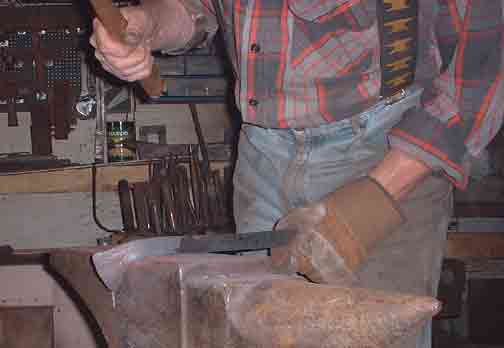
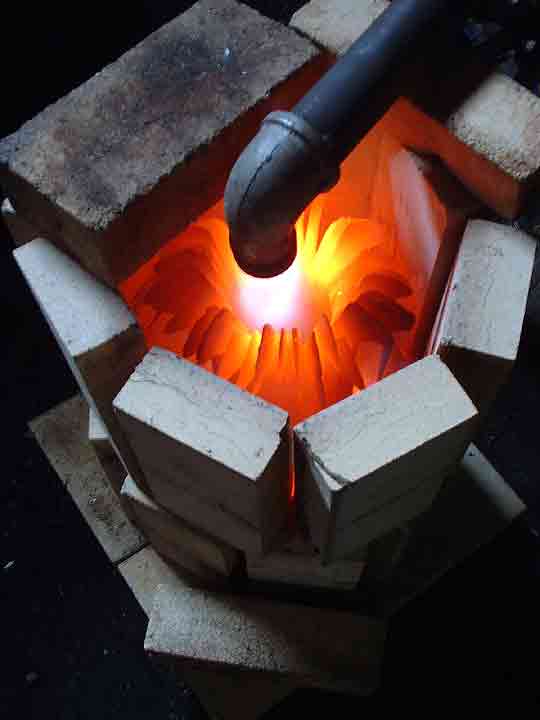
It took a good half hour to bring the entire mass up to an orange heat. With some effort, the bundle was placed on the anvil, then tapped with a wooden mallet to adjust the alignment along the last edge. I decided to leave the piece to air cool just sitting on the anvil face. As I turned away, the whole piece slowly rolled off the anvil and seemingly in slow motion, dropped to the earth floor of the workshop. Given that it was still at a read heat, and considering the huge mass involved, it was no surprise that the relatively even cylinder now was flattened on one side!
At this point I just wanted to finish the project, so the next day I welded up the final seam. Fortunately, other projects (like getting the artists ready for the exhibit) intervened, so I had several days away from finishing the urn. On returning to the work, I decided anything worth doing was worth doing well. So I set up the brick heating chamber again, and waited until the whole piece had once again reached forging temperatures. It proved possible to work over the surface with the mallet and return the overall shape to closer to an even cylinder.
Next I cut a disk out of heavy sheet (3mm / 1/8 inch) and welded it in place up inside the lower part of the cylinder. As a lid for the urn I took a piece of 1/4 inch (7 mm) thick copper I had been saving and cut it into a rough octagon. This was then forged to dish and raise the flat plate into a slightly irregular hemisphere. This was then adjusted to produce a tight fit inside the upper edge of the cylinder, snug enough that it can be tapped into place with a rubber mallet.
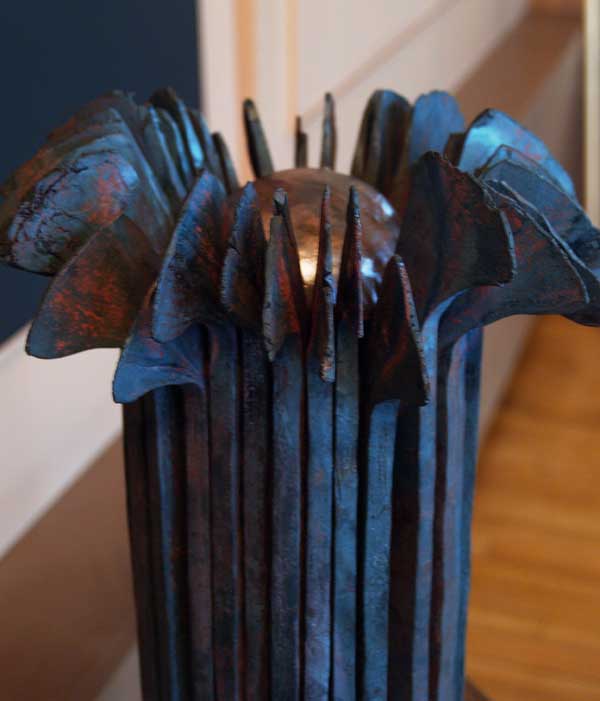
The finished piece intentionally retains the dark 'straight from the forge' scale finish. There are also patches of red iron oxide, a surface effect typical on heated wrought iron.

I was extremely pleased with the final results. The raw mass of the urn gives it a feeling of permanence. The irregular and slightly fractured surfaces of the uprights, each similar but obviously individuals, gives the overall object the look of an ancient artifact. Through the edges of the flanged bars can be seen the bright roughened surface of the forged copper cap.

An ideal resting place for a metal worker obsessed with history and the mysteries of iron?
 

February 15 - May 15, 2012 : Supported by a Crafts Projects - Creation and Development Grant

COPYRIGHT NOTICE - All posted text and images @ Darrell Markewitz.
No duplication, in whole or in part, is permitted without the author's expressed written permission.
For a detailed copyright statement : go HERE