Tuesday, August 10, 2010

Oatmeal Sealling an IRON cookpot

I had written earlier about a recent project - a replica of a Norse cook pot, constructed from actual wrought iron sheet.

As the seams of the pot were riveted, to get it liquid tight, a historic method was indicated as well. This is a fast look at the 'cook some oatmeal' method.


Here is a nice view of the pot when first placed over the fire in the cooking shelter here at Wareham. The simple hook style trammel is also loosely based on a Norse artifact, and was made specifically for the upcoming DARC at LAM 2010 presentation.


The pot was first heated, then a pre-soaked mixture of oatmeal was added. I had used all the oats we had on hand, maybe about enough (unsoaked) to fill a one litre container. I suspected the seam along the bottom of the cylinder, where it attached to the dished base, to be the most likely to leak. For that reason, I wanted to start the process with fairly thick material.


To effect the side seams as well, I filled the pot with water, mixing up a medium thick 'gruel'. The result was something more like a thick oat soup than 'stop a bullet' breakfast oatmeal. I have not directly measured the volume of the pot, but it must be something about four litres.


This closeup shows the spot which initially leaked the most. Although when the full addition of water was made, it did run out a bit, that was reduced to a dripping after a couple of minutes. I tried to catch a drop just as it formed and fell in this image. After about five minutes however, even that one per second dripping had stopped.


In keeping with the method, after I dumped the contents (happy pond fish!) I scrubbed the interior with sand - but the interior only. Any baked debris were left on the outer surface. The whole process was fast and easy. If I had a hall full of Norse to feed, the oatmeal gruel would not have gone to waste.

I expect Vandy / Bera may have some commentary on her blog later - when the pot is used to cook lunch for us all at L'Anse aux Meadows starting next week...

Sunday, August 01, 2010

Out of touch in AUGUST


August 1 - 8 : Celtic College / Earth, Air Festival - Goderich

August 16 - 25 : DARC at Vinland - L'Anse aux Meadows NHSC

That second also includes four days each end travel to north Newfoundland (Its as far as you can drive!)

So for friends and general inquiries, I will only be in spotty communications for most the month of August.

" See you, In September "


'On the Viking Saga - 1995' Photo by Susan Gold

Wednesday, July 28, 2010

Maile from Bloom Iron?

... I began looking at smelting in the early MA when I was trying work on mail armor. Actual examples of mail are few, and often (tho' not always) fragmentary. My idea was to understand the production of iron--a necessary commodity--for comparison reasons. Much of what I read does not go into exact production figures, but from descriptions of what I've read, the large smelting sites seemed to exist so enough iron could be made to be useful. Thus, mail armour was a luxury item owned by the few ...


Thats entirely my take on Early Medieval as well.
There are a number of sweeping changes in the technologies used in iron creation over the years so loosely grouped as 'the Middle Ages'.
My work has centred on the 'Migration Era', post Roman and pre Crusades. Primarily using Norse sources (so Scandinavia, 800 - 1000 as the prime reference). Roman systems tend to be passive air, after about 1100 furnaces use water powered machinery. Good news is that for the most part, Norse furnaces tend to be smaller and thus easier to duplicate.

One thing that people completely miss is the more or less random quality of the individual blooms created. There is a useful limit to the size as well. Although relatively large (10 - 20 kg) blooms are certain possible, it becomes increasingly difficult to manipulate such large masses with only hand tools. Artifact blooms are actually fairly rare, as each represents the expenditure of considerable skill and man power to create, and thus are valuable. In practice there would have been a lot of picking and choosing - individual blooms with quality suited to various objects.

For drawing to wire for mail, you would have to have the highest quality of metal. Here I'm referring to lack of slag inclusions in the starting mass. I'd think extra folding steps at the consolidation of bloom to working bar stage as well, again to reduce these inclusions. Its the slag remaining that causes wrought iron to crack as it is forged. This especially a problem with aggressive forming - and making mail wire is just about as aggressive as it gets!

So just from the problem of the raw material for making mail, you are looking at the 'best quality' metal. Add that factor into your estimates on costing as well. I think too many modern makers totally forget the raw cost in material, with modern wire so inexpensive.

The nature of the metal used is certainly going to have a huge effect on both the labour involved and the quality of the finished mail itself. Unlike modern steels, bloom iron certainly has a pronounced linear texture. Few modern blacksmiths even have any experience with antique wrought iron, and that material is more like later Medieval metals (post 1600) at best. I've worked with this stuff only a bit, and certainly have never attempted to forge it down as fine as would be required for mail making.

The more we learn about ancient methods, the more we realize what a huge undertaking making *anything* actually is.

(Sorry - this is a re-cycled response to an e-mail. With Goderich Celtic starting in 4 days, then the massive DARC at LAM 2010 immediately following, blog posts may be thin over the next five weeks!)

Thursday, July 22, 2010

DARC at LAM - 2010

the Viking Age comes to LIFE
August 15 - 25, L'Anse aux Meadows NHSC


http://www.warehamforge.ca/DARC-LAM/DARC-LAM-2010.html


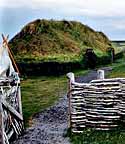
In case any readers missed it (??) the Dark Ages Re-creation Company has been asked by Parks Canada to mount a major presentation at L'Anse aux Meadows NHSC. The 10 days of living history is to help mark the 50th anniversary of the discovery of the archaeological site in Vinland.
 

February 15 - May 15, 2012 : Supported by a Crafts Projects - Creation and Development Grant

COPYRIGHT NOTICE - All posted text and images @ Darrell Markewitz.
No duplication, in whole or in part, is permitted without the author's expressed written permission.
For a detailed copyright statement : go HERE