Friday, November 11, 2011

Afghanistan ... and Viet Nam

So now we're getting out of Afghanistan...


 To Hear this Sound Clip

... And now, of course, we're leaving Vietnam... We're leaving through Laos, Cambodia and Thailand. It's the overland route. It's the long way out. Ya gotta go through China and Russia to get out that way. What'll we tell them, man? "We'll only be here six weeks. Just looking for the Ho Chi Minh Trail!" Wow. Maybe they'll buy it, y'know. Of course, you have to remember why we're over there in the first place...
Oh, yeah! It always comes to me. To free those people...
So they can have industry- yeah! US industry- YEAH! Those are the middle two letters of the word 'industry'..US. And that is our job around the world. Run in, free some people and whip a little industry on them. "Here's your industry. Cool it awhile, willya?"
...
Then you have to have to remember the sexual side of Vietnam which a lot of people don't notice. ...  But they're always afraid of pulling out. That's their big problem, y'know? "Pull out? Doesn't sound manly to me, Bill. I say leave it in there and get the job done!"
'Cause that is, after all, what we're doing to that country, right?

George Carlin
*1972*

The more things change, the more they stay the same.

                   Afghanistan                               Viet Nam

US

'begins'        October 7, 2001                       November 1, 1955

'ends'         'Home by year's end' - 2011        August 15, 1973

'duration'    10 1/4 years                              19 1/2 years

troops        131,000 (Coalition total)             536,000 (US)

deaths        2713 (Coalition total)                 58,220 (US)

%               .02 (1 in 48)                             .1 (1 in 9)

Canada

'begins'        October 7, 2001                     unofficial

'ends'         'End of  December' - 2011        unofficial

'duration'    10 1/4 years               

troops            3,000                                 '30,000'

deaths            158                                    '117'

%            .05 (1 in 19)                            .004 ( 1 in 256)


Data gathered from Wikipedia, so should be considered 'soft'


I was intending to wax poetic about 'never should have done it'.
But those numbers should depress the hell out of anyone reading them.

One
in
Nineteen


Wednesday, November 09, 2011

Slag Pit Two - Report Ready

Image by Vandy Simpson
The full report, with many images, has been published!

Go to the Wareham Forge Iron Smelting Documentation : Slag Pit 2 - November 5, 2011

Monday, November 07, 2011

'It came from the PIT'...

November 5, 2011
'Celtic Iron Age' slag pit with Short Shaft Furnace.
Participating: Darrell Markewitz / Neil Peterson / Ian Fleming / Lloyd Johnson

   
Bloom after sectioning
 Results:

Total Time : 3 hours 45 minutes (main sequence, not including compaction)
Total Ore : 19.2 kg industrial taconite
Total Charcoal : 45 kg (33 kg graded)

Total Bloom : 6.4 kg (including smaller fragment)
Total Yield : 33 %

I am extremely pleased with the operation of the furnace and the results!

It is clear that the results of the October 9 smelt were entirely due to the poor quality of the ore. With virtually identical layout, this second smelt using the slag pit system produced an excellent return of nicely compacted workable iron. The bloom was virtually slag free when it was extracted, with very little lacy 'mother' attached. Later spark testing indicates the metal has a slight carbon content, a bit less than standard 1018 mild steel (so about 1010 equivellant?)
It should be noted that our normal high volume air  and furnace layout produced the type of dense 'puck' style bloom we normally expect.

Slag block exposed
The slag pit system worked virtually flawlessly, at no point was there any obstruction to the tuyere. As the taconite contains only a small amount of silica, the available slag was also considerably less than last time. Pieces of the clay 'donut' can be seen in the upper area of the pit itself, where they had broken free and sank dowwards as the heavier bloom had developed. Although not entirely clear in this image, the liquid slag hand run down through the central hole and eventually carbonized the supporting sticks.

The furnace itself remains in almost perfect condition! (In fact, the repairs made after the first use proved more durable than the original structure.) With a bit more care taken, the furnace was slid on wooden rails off to one side, then returned to place after the slag block was excavated and the pit re-filled. There is no reason that this furnace, with the original tuyere still in place, could not be used for another smelt.

Excellent work all round!

Thanks to Ian and Lloyd, who provided some much needed fresh hands for the compaction stage.

Saturday, November 05, 2011

Slag Pit Two

(or 'If first you don't succeed...')

DARC undertakes its annual fall smelt the weekend following Halloween each year. Although we are starting background research (on clay bodies) to return to our Hals / Icelandic series, we really did not have enough time from lab report through commercial sources to mount anything useful. I also wanted to give the 'Celtic Iron Age'* slag pit system one more try - this time with a half decent ore!
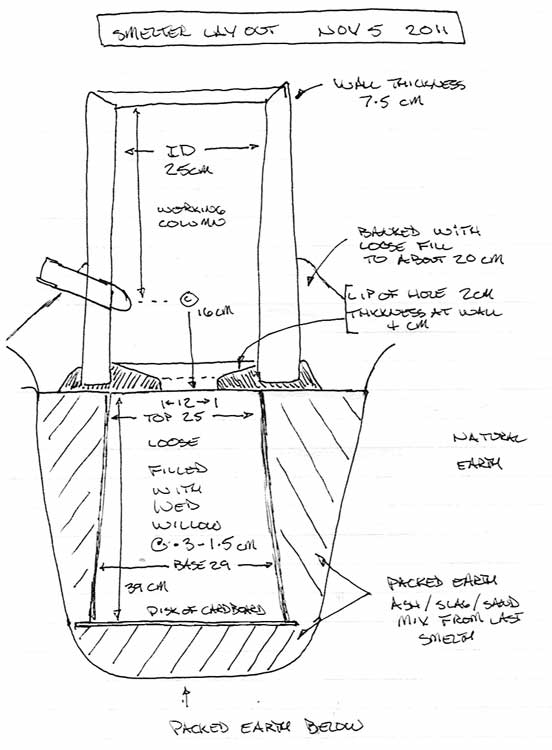
Furnace Layout
Part of the utility here is that we were able to save the actual furnace from the last smelt with minimal damage. The primary set up work (I thought) was going to be in building the pit portion of the set up. As you can see from the layout, this consisted of digging out the loose packing from the last smelt, then planting in another plastic pail.
A note to other experimenters: Although the original idea for using the plastic pail was based on simple ease and speed, in retrospect this proves an excellent method. The pails are standard - and easily acquired. As we found out from our last experiment, one holds about 40 kg of slag.
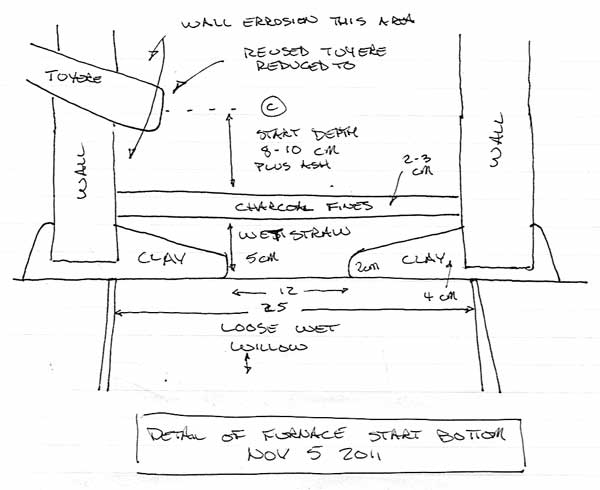
Detail of Base Layout
Acting on some advise from Lee Sauder (and after looking again at the work of others and the archaeology), I have placed a 'donut' of clay at the base of the furnace, to constrict the movement of slag into the pit. Based as much as what I had on hand, this material is a mixture of clay with about 50% charcoal fines. The sticks packing the pit are also much less uniform than those used on October's experiment. Here I did not trim off the smaller side twigs from the lengths. These were also cut from some branches I had soaking for a month in the pond (hoping to sprout them). Again, I will use the wet straw as a pad at the bottom, which worked extremely well last time. If I have any concern with this layout, it is that the space below tuyere level is going to be reduced to about 8 - 10 cm, which I think is going to prove a bit tight. Balanced against this is that the clay plug is very thin, and can easily be poked through with a rod from the top of the furnace.

View down inside the furnace - showing the clay donut. 

   
The furnace was generally in good shape, although there had been some construction problems originally that did lead to some cracking. Not surprisingly, the thing weighs some 50 kg +, and is bloody awkward to move for one person! The net result was even more piece breaking off and needing patching.
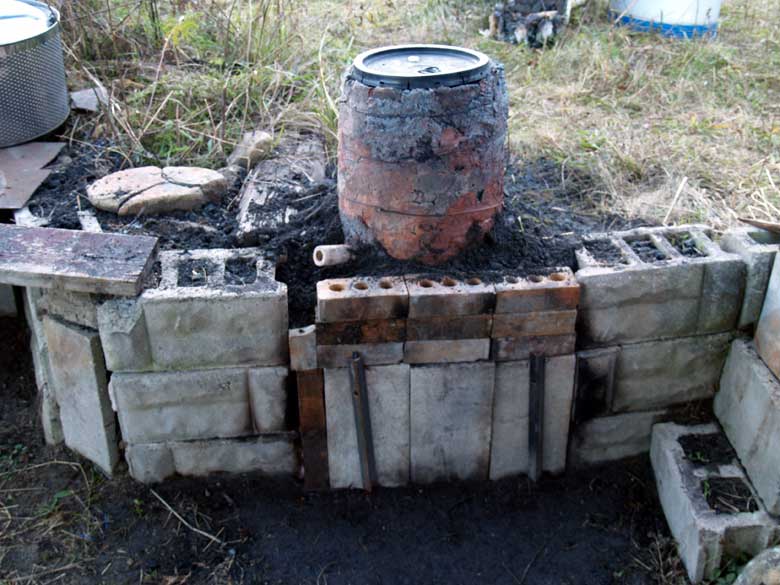
Completed furnace
 The extend of the breakage and repair work can be seen via the colours on the surface. The spotty grey material is new clay that was added to patch in some of the pieces. The very red coloured clay here is the original furnace surface. You can also see several of the loops of heavy fencing wire I bound around the body 'just in case'. Expecting some problems with venting via these cracks, I have buried the bottom 20 cm or so of the furnace with loose packing (mix of dirt, sand, ash & slag fragments) left over from past smelts. This material is slightly damp via the rain we had earlier in the week.  You can see that I have shored up the front wall with a double row of house bricks. (The plastic bucket lid was just temporary for over night.)

As ore was the primary reason for lack of a bloom last time, a better quality ore is certainly indicated for this experiment. There are three possibilities (easily) on hand:
Industrial Taconite
Gromps from past smelts
Forge scale sweepings
For now, the plan is to use the half pail of taconite (given by Mark Puigmarti), a total of 21 kg. This material appears pre roasted (black colour and mildly magnetic). It is untested, and the actual iron content is unknown (although normally this type of material is in the 65 % Fe range). This quantity is enough for a small to medium bloom - estimated in the 5 + kg range. If anything, it may prove a bit 'dry' for the best use of a slag pit furnace.

Wish us luck!

(at least we *think* we know what we are doing!)

* For those sticklers for absolute historic accuracy:
I'm referring to this series as 'Celtic Iron Age' primarily because of the end use of this series. This a potential full working demonstration at the Earth, Air Celtic Festival in August 2012. Yes, I realize we are really sticking a Viking Age short shaft over a pit, which really is not the same as the know Celtic Iron Age furnaces. Bare with me - this is still early days with this experimental series! (Working from what is known to work back towards a more accurate duplication of a possible historic method.)


February 15 - May 15, 2012 : Supported by a Crafts Projects - Creation and Development Grant

COPYRIGHT NOTICE - All posted text and images @ Darrell Markewitz.
No duplication, in whole or in part, is permitted without the author's expressed written permission.
For a detailed copyright statement : go HERE