(Starting note to Readers : This is a very long article. Part way through this I said to a friend, "I've got to get a hobby". His reply was "Dude! This is your hobby".)
“ Medieval Wisdom explores the ingenious solutions of the Middle Ages that still amaze us today. Dive into a past filled with creativity and discover how these ideas can inspire the present.”
https://www.youtube.com/@MedievalWisdom
I was made aware of this collection recently, related to a specific title : “What Was Bog Iron? The Medieval Blacksmith's Rustproof Metal You've Never Heard Of” that was made available on February 9 2026.
Part One : ' the Medium is the Message'
Medieval Wisdom appears to have no associated web site, a simple internet search did not find anything beyond the YouTube channel. This channel is given as dating from 2011, but the oldest content only dates from the past year (January 25, 2025), with a total of 181 videos listed. The location given is USA, but there is no information of just who is behind the collection.
The same individual is shown in the most recent videos, who, judging from appearance, is an Early Medieval (Viking Age?) re-enactor. This person (presumed the producer?) is never identified. Typical offerings run about 20 minutes. Worth noting here that this is a creation rate of about one every three days. For research, writing, gathering visuals, narration and final editing?
The titles of almost all these videos contains phrases like 'Copy This...', '...That Scientists Now Say Were GENIUS', '...That Modern Engineers Can't Replicate', 'BANNED...'. The thrust of almost all the content is 'Medieval methods are better, They were smarter than us'. Pure click bait titles, deliberate selection of evidence to stress bias.
As soon as you launch any of the videos several things become apparent :
All narration is via a computer synthesized voice, AI generated from a prepared text. This makes the pacing irregular, especially in terms of incorrect stress and flow. Any non-English names or terms are most commonly incorrectly pronounced for just this reason. Quite annoying for content based on the European Medieval period, country locations, and the many languages involved.
Video content is a combination of AI images, sequences from video games, very short clips from feature films, images and clips taken from personal web sites. Likely all used without any permissions, with no specific credits given. Clips are uniformly very short. The use of AI generated segments specifically presents a problem for content presented as historical facts.
Perhaps because of the sources used, often the visuals do not match the actual narration, sometimes found to be not at all representing what as being described.
Many of the points presented are at the least distorted, if not misrepresented. (based on samples viewed)
I viewed portions of six different of these videos. Four picked more or less at random (one the first in the series). Two were topics in which I could certainly be considered 'expert' in (see below).
The narration is cloaked in the tones of authority. However, at least based on the samples viewed, information is specifically framed to stress 'Medieval was Smarter'. This represents a clear bias, often outright distortion, with some points dramatically stressed, while related aspects missing entirely.
The tone of the productions, and the visuals themselves, added to the extremely short creation schedule, all suggest these videos are content primarily generated by AI systems.
Part Two : 'What was Bog Iron?'
'What Was Bog Iron? The Medieval Blacksmith's Rustproof Metal You've Never Heard Of'
https://www.youtube.com/watch?v=pe3CgMzwVD0&t=4s
(text description)
“Medieval blacksmiths harvested iron from bogs and swamps — a renewable resource that regenerated every twenty years. The resulting metal, naturally rich in phosphorus and silicates, resisted rust far better than modern steel. From Viking longship nails that survived a thousand years to wrought iron railings still standing in New Jersey, bog iron challenges the assumption that modern metallurgy is always superior. This video covers the complete process: how bog iron forms, how it was smelted in bloomery furnaces, why phosphorus gives it corrosion resistance, and what we lost when industrial blast furnaces replaced the medieval method.”
Within two days, this video was posted to the 'Iron Smelters of the World' discussion group on Facebook, which consists of the majority of the participants in 'Early Iron' activities, admittedly dominated by Europeans and North Americans. (I have been an active core member since inception.)
The very first set of comments within the group related to the repeated inclusion of both images, and often extremely short video clips, of well known current iron makers. As it turned out, none of whom even knew about this production, or certainly had not given any permission for the use of their own copyrighted images or material. This was material gathered from the open internet.
A large number of things jumped out at me on viewing this specific video.
Although a list of references is given in the written description, these are clearly the result of a simple internet search. No direct links are given. On examination, these are certainly not the best easily available sources for this topic. Many of these sources are dated, even questionable, in terms of the information they presented. This all becomes an even bigger problem when you consider the sources where so many of the images and short clips were gathered, which commonly have far more complete and accurate information, were not referenced (and I question even consulted).
So perhaps not unexpected that the presentation itself would not be the most reliable?
Looking at a very fast internet search, it would appear the primary source used for for any information presented related to the history of iron smelting itself was actually taken from the Wikipedia article 'Boomery' – this includes a number of the images used. (1)
(from start) “ You are looking at mud. Foul smelling, sticky mud from the bottom of a Scandinavian peat bog... because inside that mud is iron.”
A major problem through this presentation is that there will be no distinction between fresh 'primary bog iron ore', as is shown, and rock like limonite, which is a much older (often ancient) formation from the same initial source. This is perhaps not surprising, as 'bog ore' is a very loose term, often applied locally to any iron ores found in proximity to water.
(starting about 0:40)
The short section on 'corrosion of mild steel' is distorted at best.
- First off, The juxtaposition of the endurance of railings made of antique wrought iron, likely referring the Trenton Iron works which was established in 1854 (2), against economics of modern industrial mild steel infrastructure is deliberately misleading.
- Second, the section of rusted to failure modern pipe shown at roughly 1:00 is most likely cast iron, the way it breaks on hammer blows certainly suggesting this. Narration stating “... a problem that Medieval blacksmiths partially solved with swamp mud” is both sensational and extremely simplistic.
(about 3:00)
In the discussion of the correctly described 'renewable' nature of continuously deposited bog iron ore in undisturbed wetlands, another extremely important factor is left out. Although a fresh layer of the ore can re-accumulate in as little as 20 years, the total amounts are relatively small. In practical terms, this amount is typically 'another smelt's worth', so in the range of 10 – 20 kg at best. The expected yield from a single smelt in this size would be raw bloom in the range of 2- 5 kg. Stating, “economically useful” is a distortion, which could only apply to the smallest Early Medieval unit, the extended family farmstead. (3) (This reality needs to be born in mind when considering the description of potential yields later in the presentation.)
(about 3:30) “In Scandinavia and Finland, bog iron dominated iron production from roughly 500 to 1300 CE. That is eight centuries of continuous use.”
Archaeology places the start of the Iron Age in Scandinavia to roughly 500 CE, and bog ores would be the main type. Bog ores were still being utilized in Sweden up into the 19th century. This is considerably longer than the eight centuries stated in the presentation. (4)
(at 3:45)
The narration is about iron smelting in Iceland. The initial image shown is in fact a reconstruction experiment at the Ribe Viking Centre, in Denmark. (5) Pictured is a clay built furnace, most certainly not the type used in clay poor Iceland. (This is actually described later in the program.)
(about 4:05) “The process of turning bog mud into useable iron followed a sequence that was fundamentally the same over all of these regions, even though they had no contact with one another. The universality of the method suggests it was not invented once and spread, it was invented multiple times, independently, because the logic of the process is self evident once you understand the material.”
A number of core problems with this statement.
It is incorrect that there was no contact between these Northern European areas. Since the stress of this presentation is celarly on Scandinavia, and Norse expansion over the North Atlantic, these people shared a similar material and technological culture, even related languages. Artefacts prove that there was considerable and regular trade within these regions and well beyond into England, mainland Europe, the Middle East and even beyond.
The dating of iron smelting sites from the Middle East into Europe indicates the earliest smelted iron is from norther Iran / Iraq (at roughly 1500 – 1200 BCE). The iron smelting process spreads relatively quickly west and north through Europe over the next 700 years (as mentioned above)
“...the logic of the process is self evident once you understand the material.” This is a massive overstatement (as someone personally involved in the process of recovering these exact same skills). The initial concept that red mud could possibly be converted into useful metal is completely counter intuitive. Individual bog ores, at specific locations, can can have quite different elemental concentrations, no all bog ores give good results. An iron smelting furnace operates at higher temperatures than other furnaces. (Hundreds of degrees celsius beyond that of a pottery kiln for example.) A single smelt consumes a large amount of carefully prepared resources, and success is dependant also on following the correct working sequence over many hours. (6)
If nothing else, the archaeology shows that a basic concept of how an iron smelting furnace may function has been repeatedly adjusted by widely separated workers to suit specific locally available resources. (Reference to this, related to Iceland, is featured later in the video itself.)
(starting at 5:10)
Roasting bog ores? There are a number of mis-conceptions given in this section:
Baking dry? Although it is true that water can consume considerable energy in a burning system, the simple truth is that so much energy is available in a smelting furnace that moisture has little practical effect. Merely increasing the effective stack height of the furnace will quickly expel any remaining dampness in the ore.
Porosity? One of the huge advantages of smelting bog ores is that they are already quite porous and additionally quite easy to break up into suitable sized small pieces for adding to the furnace. (It needs to be remembered that the reduction process that will be described later in the production is a gas on solids one.)
(starting at 5:40)
Furnace construction? The primary distortion here is that the term 'Medieval' is being applied so loosely here as to be misleading. The furnaces described are from both from early history and very regionally specific. Furnaces built under the Romans, tend to be much larger (~ 1.5 m ID / ~ 2m tall) that operate under passive draw air. The introduction of water powered machinery into Europe (so very roughly 800 – 1100 CE, starting in the south and defusing northwards) will significantly change the scale of furnaces. What is described are furnaces most typical of the post Roman period, from roughly 400 – 1000 CE in Europe (often called 'the Dark Ages'). Although clays, and especially clay mixtures, are ideal construction material for smaller, limited use furnaces, stone construction was also commonly used for more 'industrial' multiple use structures.
(starting at 5:58) “The furnace was loaded with alternating layers of charcoal and crushed, roasted ore. With a typical ratio of one to one by weight adding seven to fifteen kilograms of ore incrementally over two to four hours”
The way this is stated represents two entirely different methods of working sequence during a smelt :
“The furnace was loaded with alternating layers of charcoal and crushed, roasted ore.”
This is a method that only will work properly with massively tall, typically passive draft iron smelting furnaces. The primary example are the types documented and used in Africa, and this method also works for the earlier Roman builds. Although initially placed in thick alternating layers of ore and charcoal, in effect the tumbling of individual pieces of charcoal within the furnace as they fall will evenly mix ore and charcoal together. This is critical, as a thick slab layer of ore will effectively choke the furnace otherwise. Although this method is still incorrectly illustrated for the small furnaces featured in this presentation, it has repeatedly been proven not to correctly function at this scale.
“With a typical ratio of one to one by weight...”
Not at all, this is incorrect on two factors (or at least indicates very poor method).
As the reduction process starts, it is exothermic, this additional energy will raise temperatures inside the furnace. This excess temperature is controlled by increasing ore amounts combined with fixed measures of charcoal. This “one to one by weight” is only an averaged amount, determined mathematically afterwards from the overall totals used. This is an equivalence based on simplified reports by only a small number of makers. It does not take into account the total amount of charcoal to pre-heat then bring the furnace to correct operating temperature, or during the final burn down phase. (7)
“...adding seven to fifteen kilograms...”
This blanket statement is so simplistic as to be mis-information.
a) Later in the program there will be a (greatly simplified) discussion of the dynamics of slag bowl formation for the collection of a workable iron bloom. There needs to be a certain amount of ore material added to establish this system, before any bloom iron at all will be created. The elemental components of a given ore determine this formation, so certainly there can be no standard given as a minimum ore amount. (Our own experience, working with ores in the 55 % elemental iron content range, is that a minimum of 8 kg ore is required before any recoverable bloom will begin to form) (8)
b) Once the working slag bowl system is formed, the more ore that is added, the larger the bloom. Importantly, the bloom compresses itself as more and more weight is added. Although it is true some iron may be recovered, utilizing extremely high elemental iron content bog ores with total additions in the range of 10 + kg, the resulting blooms will be lacy, fragmented and so extremely difficult to effectively forge into workable iron bars (9) Larger ore amounts (using the same ores) have been shown repeatedly to greatly improve not only overall yield percentages, but also greatly increase bloom density itself. (10)
“...adding ...incrementally...”
Although the functionally the ideal method, this directly contradicts the description made in the previous sentence. (??)
(at 6:15) “The smelting temperature reached between 1100 to 1300 degrees celsius.This is critical to understand.”
And also wrong. A bloomery furnace is operating at temperatures, recorded at the hot zone above the tuyere, in the range of 1300 to 1450° C. Obviously the very base of the furnace (below the slag bowl) will be cooler. These temperatures are well documented scientifically and from measurements by any number of experimental teams. (This including a team specifically featured in this presentation.)
(from 7:00) “ A bloomery furnace typically only converted 10 to 20 percent of the iron that was in the ore into useable bloom.”
Importantly, this statement does not clearly distinguish if what is meant is the iron ore weight or the elemental iron amount. As discussed above, the exact elemental iron content of the staring ore has an impact here, as does the total volume of ore used. Again, this is not the evidence from archaeological furnaces, or the experience of modern bloomery iron makers. Modern makers typically expect a minimum of 20 % return by weight of ore into a bloom, a 10% return would be considered a failed effort. Ranges into 30 % are common, and for large volume ore smelts results in the 40 + % range have been achieved) Considering elemental iron content to proportion converted into extracted blooms, my own team average is 36.6 % recovered. (11)
(at 7:35) “The result was wrought iron, a low carbon iron that could easily be shaped into tools, nails, hinges, knives and weapons.”
A complete misunderstanding and gross simplification:
In actual fact, carbon alloying content will vary between individual blooms. Even within a single bloom, the carbon content will vary between bottom (first deposited) an top (last deposited and typically at a higher temperature).
An experienced smith can estimate the relative 'hardness' of metal being hammered by how easily the piece will deform under the same hammer blows. This harder metal is more suitable for objects requiring physical hardness, tool working surfaces and knives being the obvious applications. Yes, softer iron requires less effort to forge and is easier to fire weld. This quality was most likely the more desired product, as it would be used for the bulk of every day items and hardware.
Weapons, however, require qualities that are at opposition to each other. A very hard carbon iron alloy would certainly take, and hold, a sharp cutting edge, but at the same time hardness increases, so does brittleness. A softer iron would accept shock well, but would be most likely to simply bend in use, and would never hold a sharp edge.
As stated, slight variations in carbon content would be the primary reason for these variations in hardness. This is not the only reason for variation in the iron metal made from bog ores from different locations. There can be other metallic trace elements present, which can have impact on the qualities of the resulting blooms.
(at 8:18) “ But bog iron ore is naturally rich in phosphorus.”
Distortion. This is absolutely dependant on the specific ore sample, certainly in location and also over time. This concept of different deposits resulting in differing qualities in the smelted iron was well known. (As an ongoing natural accumulation, changes in local environment over time can alter the characteristics of deposits, even at the same physical location.) The bog ore recovered in the archaeology at L'Anse aux Meadows, described in detail later, had almost no phosphorous content as a good example.
(from 9:25)
The right hand image is labeled 'Ancient bog iron, pristine glassy surface'
To my (experienced) eye, this looks to be a piece of waste slag. The smooth, dark black, glassy surface is typical of tapped slag. So the appearance of this piece has absolutely nothing related to phosphorus content in bloomery iron itself. (I was unable to find the source for this image.)
(at 9:52) “Between the 5th and 14th century, European sword smiths created...”
Incorrect dating :
“ Use of the process largely vanishes from western European blades beyond the 11th century. ” (12)
The term 'pattern welding' as is (correctly) applied here refers quite specifically to the 'multiple twisted core' construction method. This is primarily a technique found in Northern Europe, the finest examples found in Anglo-Saxon burials (Sutton Hoo, c 625 CE). Many simpler (two core) samples are known from the Norse / Viking Age, including the well documented '+ULFBERTH+' inlayed swords.
(at 10:05) “Phosphoric iron from bog ore was used specifically as one of the contrasting metals specifically because it corroded at a different rate that the plain iron and steel layers.”
After considerable attention was paid to the difference in potential hardness, the assumption is made that it was for simple differences in contrast appearance that phosphoric iron was incorporated into these distinctive pattern welded blades. This ignores the reality that combination of iron and 'steel', and likely phosphoric content iron / steel, were combined primarily for their differing functional qualities (as discussed above). It is clear that additionally the complex patterns of alternating twisted and straight line sections to the core bars was done intentionally for decorative effect
(at 10:15)
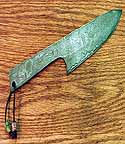
Totally incorrect image. There is a close up of a etched (modern?) knife blade surface, which is clearly not 'multiple layer, twisted core', but in fact wootz. (13) Wootz is a material made not from welding differing layers together, but is a crucible process, where a combination of carbon content irons are melted together into a solid ingot, where carbon varies as the mass cools. The method was certainly known and concentrated to the Mid East, specifically in Damascus. The evidence that these complex production methods were known and undertaken in Europe is controversial at best.
(from 10:18) “..the phosphoric iron remained bright, while the other metals darkened. ... The patten welded technique relied on the corrosion resistance of bog iron to make the patterns visible.”
Misleading. What is hidden here is that all the metals involved were smelted from bog iron ores. The ancient smiths had deliberately chosen bars from blooms with differing characteristics, almost certainly made in widely different locations (so trade items). In fact, the primary difference in colouration will come from variations in carbon content between the starting bars. Carbon containing alloys will react to acid solutions, turning dark. A carbon and phosphorus free wrought iron reacts inconsistently, microscopic contained slag (so glass) layers becoming visible resulting in a light grey 'ropy' texture. (14)
Much is detailed in this section about the historic use of phosphorus rich bog ores. There is no mention made of the significant difference in understanding of the underlaying chemistry between the Medieval period (so here specifically Anglo-Saxon and Norse) and modern (post Victorian) metallurgical science. It is clear that those historic sword smiths understood the difference in working metal quality between individual iron bars, and if proven trade patterns is any indication, quality between iron created from ores in differing locations. But they had no understanding of just what make bars from one location different than those from another. The individual skill and experience of the specific iron master would also be a major functional difference between separately produced bars.
(starting 10:50)
As I am intimately familiar with L'Anse aux Meadows NHSC (LAM) and the iron smelt there by the Norse circa 1000 CE, I have considerable insight here. (15)
First off, the use of AI narration showed another of it's problems here. Three times the location name was given, each time pronounced not only incorrectly, but also differently each time. (From the French?)
This segment is based on the original interpretations of the archaeology, from the later 1960's. These impressions are quite dated, and certainly not the current understanding of the site, particularly related to the single iron smelting attempt made there. The suggestion that there was a direct link from boat repairs to a requirement to smelt iron has certainly been challenged in the light of direct experimental results. (16)
(from 11:14) The building shown is a more fanciful interpretation, actually located at nearby Norstead (which is best described as a 'historic based entertainment'), not the archaeologically more accurate structures recreated at LAM.
(at 11:20) “Archaeologists have recovered...along with 15 kg of slag”
Incorrect. The actual amount of iron slag recovered archaeologically related to the iron smelt was in fact only 10 kg, the amount of 15 kg was at best a semi-educated guess.
(at 11:30) There is a significant difference between a nail and a ship rivet. (Noting nails and rivets are distinguished earlier) The artifact nail described, has a square cross section and long taper, and was found at one of the house entrances, suggesting it was part of a wooden door. Rivets on the other hand, are round cross section, straight shafts and are peened over on both ends.The rivets found at one of the small workshop buildings were cut into two pieces, indicating that they had been pulled out of what was most likely a smaller fishing boat boat sized vessel. It is true that the single nail described did have an elemental composition matching that of roasted bog ore recovered at the smelting furnace (not the slag, as is stated).
(from 11:36) “A single Norse longship required approximately 7000 nails, forged from around 400 kilograms of finished iron. Producing that much iron from bog ore means a blacksmith would have to process roughly thirty tons of raw ore.”
No idea where those numbers come from? (It may be a single incorrect value has distorted all the following ones?) Run the math here:
“...approximately 7000 nails...”
This number vastly inflated. Both the archaeology and the physical replica work at the Viking Ship Museum in Roskilde, Denmark (17) indicates that the construction of a Norse knarr (ocean going freight ship – like the ones travelling the North Atlantic) would in fact require closer to 1200 - 1500 rivets paired with roves). Of course recovered Norse ship hulls range from small light fishing boats through to massively long warships.
“...forged from around 400 kilograms of finished iron.”
Take 400 kg / 7000 = 57 gm each. Importantly here, this is again not counting the weight of all the matching roves. It would be reasonable to assume 10% loss in the conversion of staring 'currency bars' into forged rivets (18), which indicates 52 gm per rivet. The physical size of an individual rivet varies considerably, shaft diameter and length dependant on the type of timber / thickness of the planks. The largest and most complete ship rivet recovered at LAM, #60, was 8 mm diameter, which suggests a replacement rivet at about 50 gms (again not including the required rove). (19) With the more realistic total of rivets at 1500, closer to 85 kg of bar iron would be required for the rivets (again noting the required roves are not included).
“...thirty tons of raw ore”
Given that all the other measurements used in this presentation are in metric units, this is likely to mean metric tonnes = 1000 kg, so a total of 30,000 kg?? This clearly must be completely wrong.
Experience undertaken here suggests a reasonable return at the bloom to bar phase is about 65%. This would suggest that the starting blooms would weigh roughly 615 kg. (20)
So, 30,000 kg of ore used to produce 615 kg of blooms would mean the smelting portion would have a yield at an unrealistic overall yield of only 2 %
Using a more realistic yield number (average from our modern experiments) at 22% bloom from ore the blog iron amount required for that 615 kg would be 2820 kg.(21) (At roughly 3 metric tonnes, this links back to that incorrect ore number?)
Taking the more realistic total number of rivets, losses, and yields together, 1500 finished rivets from 85 kg of bar iron requires approximately 425 kg of bog iron ore. (Again noting that the elemental iron content of the starting ore an important variable here – see below.)
(from 12:02) “ The Settlement at L'Anse aux Meadows was positioned immediately adjacent to a peat bog, it was not a co-incidence.”
There are a large number of practical and strategic reasons why the the Norse Greenlanders would have chosen grass covered marine terrace at the foot of Epaves Bay. The proximity to a peat bog is so low on the list as to be inconsequential (most especially in this part of North Newfoundland, which is widely covered with peat bogs).
(from 12:21) “Analysis of the L'Anse aux Meadows slag shows that significantly more iron could have been extracted from the ore than actually was, suggesting the workers there were competent, but not expert smelters. This supports an important point. Bog ore smelting was common knowledge, not a specialized trade secret specialized to master smiths.”
“...significantly more iron could have been extracted from the ore than actually was...”
Earlier in the video, the (false) opinion is given that early bloomeries operated at 10 to 20 % bloom yield from ore weight (as discussed at some length previously). Using the most simplistic method of (estimated) bloom = output against recovered slag + bloom = input , the yield at LAM would be 3 kg out / 18 kg in = 16.7 % yield – which is well within the return range as stated. The two statements made contradict each other.
The actual analysis of the roasted bog iron ore recovered in the furnace hut at LAM has an elemental iron content of 69.8 % (close to the theoretical maximum for pure Fe2O3). Comparing with the slag content, this puts the amount of elemental iron 'missing' (so into the created bloom) at only 8.5 % (22) Against this pure ore, this is an extremely poor return on the effort.
“Bog ore smelting was common knowledge...”
This assumption, common to Norse researchers 50 years ago, has most certainly been disproven repeatedly by experimental archaeology since those days. (23) Compare with a (very simplified) example : 'everyone' in the West knows 'how' to to make an apple pie. But you certainly would not enjoy eating most of those! Bloomery iron smelting is significantly more complex.
“Analysis of the L'Anse aux Meadows slag...”
Clarification: From the original report, three slag samples were analyzed, averaging with a combined remaining elemental iron content of 61.3 %.
It is also worth noting that the bog ore sample analyzed from LAM contains almost no elemental phosphorus at all.
(from 12:40) “ From Russia to the Revolution “
In this segment, centuries of technical innovation, industrial production from the Renaissance to the early Victorian periods, and individual locations ranging from Russia to Civil War United States of America, are squashed together simplistically. Although it was true that easy to access bog iron ores were often the first types utilized in any given location (where even available), these small deposits could not supply the Industrial Age furnaces. This is most specifically true in Colonial era USA, despite the attempt in the narrative to imply bog iron sources were the primary supply.
(at 13:05) “The first known iron mines in North America reportedly in operation by 1578, at St Johns Newfoundland, were bog iron operations.”
This is incorrect in almost every detail. The earliest record of iron ore observed on Bell Island is from 1578. It was not until 1628 the first samples were sent back to England for assay. It would not be until 1895 that the Wabana mine was established. This was a hard rock mine, not a surface deposit of bog iron ore. (24)
(from 13:10)
Distortions.
- The Saugus complex primarily a blast furnace operation, producing high carbon cast iron, with secondary production of bars using the finery forge methods. The ore used was limonite, not a mud like primary bog iron ore (as is described earlier in the presentation). (25)
- The Nassawango Iron Furnace did use local bog iron ore but again was a blast furnace for production of cast iron, and was both 200 years later and very short lived (the dates given are incorrect) :
“ The Nassawango Iron Furnace was erected in 1830 by the Maryland Iron Company to smelt iron from the bog ore formations in the immediate vicinity. It is the only furnace in Maryland ever to make extensive use of bog ore. It operated only until 1849... but the quality and distribution of the bog ore may have caused the several financial failures that the ironworks underwent. “ (26)
- (at 13:35) “...specifically valued for it's corrosion resistance.”
From the early 1700's through to about 1840, iron production in the USA was centred on charcoal fired smelters through south eastern New Jersey and southern Pennsylvania. This was due to a combination of available primary bog ore and limonite deposits, forest cover for charcoal supply, and terrain providing ample water power. (27) A large number of both bloomeries for bar production and blast furnaces for cast iron were in operation. I could find no specific mention of specific 'corrosion resistance', and this sweeping generality is highly unlikely due to the large number of furnaces over such a wide spread area and so long a time period. If anything, the primary complaint visible in descriptions of the times was the lack of consistency in quality in wrought iron bars.
( from 13:50) “The shift began with the start of coke fired blast furnaces in the 18th century. These furnaces could process mined ore, particularly hematite and magnetite at vastly higher temperatures and volumes than bloomery furnaces could handle”
There are several distortions.
- Although not European, the first use of coke for iron smelting is documented from China dating to as early as 1000 CE, where charcoal fired cast iron furnaces are known from as early as 100 BCE. The earliest patent for using coke for iron production (in England) dates to the later 1500's. The statement as given appears to refer to Abraham Darby (at Coalbrookdale, England) who established a coke fired cast iron blast furnace in 1709 CE. (28)
- The earliest cast iron blast furnaces in Europe date at least to 1200, possibly as early as 1100 CE. (29) It was simpler to create plates of cast iron from ore, then use a secondary process, the finery, to burn out the contained carbon down to forgeable iron bars. The key here is the introduction water powered, more massive, bellows over human operated sizes, allowing for higher operating temperatures.
- Japanese tatara furnaces, in use from at least the middle 500's CE, where developed specifically to use magnetite in the form of iron sand. (30)
(from 14:20)
This segment strings together a number of elements, that although may be true individually, do not in fact support each other.
- In truth, was is totally ignored here is the massive difference between Early Medieval (pre 1000 CE) production rates and individual access to iron (steel) in our modern Western world. Scandinavia during the later Dark Ages is the main comparison used in this presentation. During that time and place, the average (lifetime) iron share per individual within a farming household is roughly 2 kg each. In comparison for the USA, in one year alone (2023), the steel share per individual was 266 kg (31). Clearly there is a vast difference here, and any attempt to equate these two realities is nonsensical.
- The intention throughout is to equate Early Medieval production and bloomery created wrought iron to modern industrial steels with all it's alloys and applications. The huge difference between corrosion resistance, physical strength and potential hardness of modern nickle content stainless steels and historic bloomery iron alone proves the comparison being made is ridiculous.
(from 14:45) “ The United States alone experiences roughly 240,000 water main breaks every year, the majority caused by corrosion. “
- The majority of these water main pipes will be made of brittle cast iron, not modern steel as is implied.
- This is important as the major reason for breaks is not corrosion, but bursting in winter freezing and impact with machinery.
- The major reason for breakage is simple aging of the long ignored below ground infrastructure.
(from 16:02)
As might be expected, being directly involved with experimental archaeology into specifically Norse / Viking Age bloomery iron smelting, now for over 25 years, again I consider I have insight here. (32)
(from 16:22)
The furnace shown in the background during the segment about Hurstwic, although truthfully that used for their two smelt demonstration program on Iceland, actually does not conform what is known from archaeology about Icelandic turf built furnaces. The furnaces recovered at Hals by K. P. Smith show a conical stack construction method. (33)
(from 16:30) “Successfully producing high quality iron...”
Although this claim has been made repeatedly in promotions by Hurstwic, there has never been any description of what 'high quality' means here. There has only been minimal information made available on the Hurstwic web site, indicating extremely low smelt yields, with no mention of smelt sequence, bloom densities, carbon contents, or bloom to bar losses that would support this assertion.(34)
(at 16:50)“ ...and in some measurable respects, superior to modern materials for specific applications, were corrosion resistance is more important than volume.”
This bold statement is made, with absolutely no evidence what so ever to support it.
Clearly modern alloy steels, with all the specifically engineered characteristics possible eclipse bloomery iron. (35) There may be some truth to the endurance of later medieval ornamental wrought iron grills and gates. But the comparison here is being made to simple modern mild steel, not available intentionally corrosion resistant alloys. There is no consideration being made to weight over strength or forging over machining.
(from 18:00) “The EXARC Journal, an international experimental archaeology publication, contains step by step reconstructions of Medieval bloomery processes. The Hurstwic group's research on Icelandic smelting is publicly available.”
Again, personal bias. One of the publicly available complete guides to operating a historic bloomery furnace on the EXARC Journal web site is in fact my own (as well as a number of other related articles there). (6B) In truth, the information on Hurstwic's web site does not present a working method that could be followed, and they have never contributed to EXARC (or the larger Early Iron community).
(from 18:35) “...in Newfoundland... his ship needed nails... produced the metal he needed.”
This is the second time this mis-conception is repeated (and was critiqued earlier) :
Lief Eriksson (if the Sagas are accurate) was a second generation, professional expedition leader. It is inconceivable that the Greenlanders would undertake the extremely long voyage into the western unknown (a sailing distance equal to travel all the way back to Norway!) without carrying enough ship rivets for emergency repairs.
The weight of specialized iron tools required to smelt iron exceeds the 3 kg weight of damaged rivets that were found. Surely if needed, the large iron tongs necessary for bloom handling would be converted into rivets? Although a basic set of blacksmithing tools might have been standard ship repair equipment, the different tools for iron smelting would not be.
Although there is bog ore in Greenland, there is no timber suitable for making the large amounts of charcoal required for a single smelt. Iron objects and working bars would be the primary import items during the 400 + year life of the Greenland colony. The ability to produce iron in Vinland would be yet another 'boast' of the richness of the newly explored region. (16B)
(from 18:55)
The nail illustrated is in fact clearly a modern, cylindrical shaft, 'wire' nail, made of mild steel. Not one hand forged, or made of bloomery iron, or a Viking Age ship rivet - much less one of the artifacts recovered at LAM. (36)
(from 19:25)
Again, the video presents it's core thesis, that early Medieval bloomery iron was superior to modern steels. Again the figure of world wide losses due too steel corrosion is raised.
As detailed earlier, the massive difference in personal share of metal that is certainly two, if not three, magnitudes greater in our modern world, is not considered.
There is no comparison of the yearly production value of new steel world wide, again massively larger than the corrosion lost number given.
The is no accounting for the overall production costs, in terms of labour and expended materials, in small scale bloomery iron making. (37)
This is such a stunning distortion of the reality, it stretches beyond disingenuous to the intentionally completely false.
Part Three : 'Trouble with AI'
Although the location source for Medieval Wisdom is listed as USA, the repeated stress on research and experiments from Hungary suggests the true source for these productions is in fact Eastern Europe. The use of computer synthesized narrations for English, obviously AI generated from a written text, also suggests a disconnect here as well. This does raise questions as to the true purpose of these videos, especially considering the extremely rapid production rate. Potential data mining (especially directed to those who have subscribed) comes to mind.
As I checked individual statements, it was clear that although the narration text did not directly copy available documents, the content certainly directly paraphrased, particularly from Wikipedia entries. Commonly source information was used in part or out of context, particularly when doing so would strengthen the underlying thesis being presented.
The overall form of the final text has the same kind of feel as summaries produced by the currently available AI language systems like Grammarly or ChatGPT. These systems have no understanding of the content they base their output from, they merely string together pieces into something that superficially appears to be an average description. Given the huge number of distortions and mis-conceptions presented in this video, it is almost certain that the narrated text itself is completely AI generated.
It was worth noting as checked base facts I would often see the individual images used as the background video. Often still images had been converted into a form of 'drift over' panning to impart motion where none originally existed.
In preparing this critique I have spent a rough total of 36 hours (12 day sessions of typically 3 hours each). This could be seen as a reflection of my own (declining) concentration and working speed? I am however quite familiar with the topic area. Over that same number of days (12) 'Medieval Wisdom' has produced a further 12 similar video presentations.
I see 'Medieval Wisdom' is a clear reflection of an ongoing cultural shift related to the internet and content ownership, and the concept of knowledge itself.
Those who initially stocked the world wide web with information content (so 1990's) expected to retain ownership of that content (although perhaps ill considered?). Into the 2010's a new generation (who always had an internet) began to take the opinion that posting anything to the web resulted in total loss of ownership and control (despite clear statements of copyright, watermarking). Over the last year especially, the (alarming) growth of AI internet mining systems and content generation softwares is making outright theft almost standard. Certainly the entire concept of 'originality' and 'authorship' is being discarded.
I have become increasingly concerned with two currently cultural factors that magnify each other :
Lack of critical evaluation skills, most especially among younger people.
Explosion of slickly manufactured, but factually incorrect, presentations.
As someone deeply involved in traditional skills (to the point of recovering lost historic methods), I see a constant eroding of personal experience as a learning method.
(And yes, Gentle Reader, I am fully aware I am 'pissin' in the wind'.)
Notes :
Any internet links given below were current at the time of writing (February 2026)
The use of Wikipedia as a reference source is intentional, illustrating how little depth would be required to check specific points.
See : Wikipedia - Bloomery : https://en.wikipedia.org/wiki/Bloomery
Historical Marker Data Base : https://www.hmdb.org/m.asp?m=3922
The entry in Britannica referenced here is only 4 lines long, and certainly makes no attempt to define what is meant by 'Economically useful'.
See : Britannica- Bog Iron Ore : https://www.britannica.com/science/bog-iron-ore
See : Ekomuseum Bergslagen : https://ekomuseum.se/en/vill-du-veta-mer/jarn-ur-rodjord-och-sjomalm/
Image source : Medieval Histories : https://www.medieval.eu/smelting-iron-viking-way/
There are a number of basic method guides available :
Sauder & Williams, 2002, “A Practical Treatise on the Smelting and Smithing of Bloomery Iron”, the Historical Metallugical Society (PDF here)
Markewitz, 2012, “ 'But If You Don't Get Any IRON...' Towards an Effective Method for Small Iron Smelting Furnaces”, the EXARC Journal (PDF here)
Over 100 personal iron smelts, the total of previously graded for size charcoal expended over a typical 25 kg ore weight smelt averages 45 kg. (see note 9)
Refer to the extensive documentation : Experimental Iron Smelting : https://www.warehamforge.ca/ironsmelting/index.html
See : Caherconnell Bloom Forging : https://warehamforgeblog.blogspot.com/2023/12/caherconnell-bloom-forging-1.html
See : Markewitz & Peterson, 2025, “ 'How Dense are You?' - Recording Bloom Density from experimental iron smelting”, Kindle / Amazon
See Markewitz & Peterson, 2025, “ '20 Years Before the Blast' Experimental Bloomery Iron Smelting 2001 – 2024” Kindle / Amazon
For a good overview of the topic of differing forms of both layered and crucible historic blade materials see : Lee A. Jones, ND, “Blade Patterns Intrinsic to Steel Edged Weapons” :https://www.vikingsword.com/patterns.pdf
See a description of 6 bloomery iron knives : Bloom Bar to Blade : https://warehamforgeblog.blogspot.com/2023/06/bloom-to-bar-to-blade.html
See : Wootz Steel : https://en.wikipedia.org/wiki/Wootz_steel
The primary reference used here is : Ingstad, 1975, “ The Discovery of a Norse Settlement in America”, Universitetsforlaget
The original assessment (boat rivets needed = smelt iron) was made by researchers (understandably) not familiar with the process of bloomery iron smelting in the early 1960's. Iron production was estimated by comparing bog ore iron concentration with that remaining in the recovered slag, multiplied by a rough guess of the total slag created (only a fraction had actually been recovered). This very roughly estimated number, 3kg of possible iron bloom, was compared to the mass of broken boat rivet fragments recovered, the same weight. Worth noting here that this comparison was not determined by adding up how many whole rivets would be required. Significantly no allowances were made for the considerable losses at the bloom to bar phase, and additional losses at bar to rivet forging. See : Markewitz, 2025, 'Iron Smelting in Vinland : Converting archaeological evidence to a practical method', Kindle / Amazon
See : Ottar (Skuldelev 1) : https://www.vikingeskibsmuseet.dk/en/professions/the-boat-collection/ottar
This based on my own 40 years experience as an artisan blacksmith, including considerable work with self made bloomery iron.
As a check here, The weight of a piece of modern mild steel long estimated enough to form a replacement for the LAM rivet (7 mm dia. By 8 cm long) weighs 42 gm – before any forging loss.
Having amassed a considerable number of blooms over the last 25 years, Neil Peterson and myself are proceeding to render these down into working bars. As this project has continued, we are making increasingly detailed records of number and types of forge welding steps, along with the number of major folds and resulting carbon content variations. The plan is to format this data into a publication within the next 12 – 18 months.
Looking at the totals for our own work over the last 25 years : 2,590 kg of (mixed) ore yielded 485 kg of raw blooms. This during the process of learning the iron smelting process from nothing, and specifically testing many variations on build, technique, and air systems. See Markewitz & Peteson, 2025, “ '20 Years Before the Blast' – Experimental Bloomery Iron Smelting 2001 – 2024”, Kindle / Amazon
See : Rosenqvist, 1974, “Material Investigations”, in Ingstad, 1974, “The Discovery of a Norse Settlement in America”, Universsitetsforlaget
I would refer you to the published work of Peter Crew, Thijs van de Mannakker, Lee Sauder, Jens Oleson, Micheal Nissen, or myself, among others.
See : References : https://www.warehamforge.ca/ironsmelting/smeltlinks2.html)
See : Iron Mines of Bell Island : https://www.heritage.nf.ca/articles/economy/bell-island-mines.php
See : Saugus Iron Works : https://www.discoveramericablog.com/post/saugus-iron-works
Furnace Town Historic Site, ND, “Nassawqango Iron Furnace”, web site : https://www.furnacetown.org/iron-furnace-1
See : Philadelphia Encyclopedia - Iron Production : https://philadelphiaencyclopedia.org/essays/iron-production/
See : Wikipedia - Coke : https://en.wikipedia.org/wiki/Coke_(fuel)
See : Wikipedia – Blast Furnace, History : https://en.wikipedia.org/wiki/Blast_furnace#History
See : Wikipedia – Tatara : https://en.wikipedia.org/wiki/Tatara_(furnace)
World Steel Association, 2025, “World Steel in Figures”, web site : https://worldsteel.org/data/world-steel-in-figures/world-steel-in-figures-2024/
I freely state my bias when it comes to the work done by Hurstwic. I in fact gave members of this group their initial instruction into Norse bloomery iron smelting in June 2018, at which point my own team had undertaken eight smelts in our own Icelandic / Hals experimental series (starting in 2007). I had been part of the same Hurstwic / Icelandic project illustrated in 2019, only to be withdrawn from this (with only two weeks remaining before flight date).
See : Smith, Kevin P., 2005 " Ore, fire, hammer, sickle: iron production in Viking Age and Early Medieval Iceland", n De Re Metallica: Studies in Medieval Metals, AVISTA Studies in the History of Medieval Technology, Science, and Art, Volume 4, edited by Robert Bork et al, Ashgate Press
Yields for the three smelts undertaken listed at 4.7 / 10.3 / 2.0 %.
See : Hurstwic – Iron Smelting in Viking Age Iceland : https://www.hurstwic.com/research/iron/index.html
As a working artisan blacksmith with decades of experience, the one advantage wrought iron has over modern steels is not corrosion resistance, but in wrought iron's ease of forging, particularly for aggressively shaped art works.
See: Lessons from the Viking Age – ship rivet : https://www.warehamforge.ca/ENCAMPMENT/IMAGES/lessons/rivet.jpg
For the creation of the often described 3 kg bloom estimate at LAM, our own team expends :
30 kg dry powdered clay, 30 kg sand (gathered locally?)
50 kg rough charcoal (timber cut, split, converted / not including losses)
20 kg ore – depending on quality (gathered, roasted / not including losses)
In modern experimental smelting here, the clay, charcoal and iron oxide for ore analog is all purchased, at a rough cost of $300 CDN (2025).
The labour required for building a single furnace, preparing all the materials for smelt, operating the smelt through to a single compaction cycle averages averages about 52 hours. If Norse style bellows are providing air, add an additional 32 hours. At current Canadian minimum wage (2026, Ontario) of $17.60 / hour the labour cost (Norse method) comes to a rough cost of $ 1480 CDN.
This places the modern production cost of a single kg of raw bloom at $590 CDN (300 + 1480 / 3). This is not considering costs related to specialized skill labour, and most importantly time, skill, consumed materials and physical losses at a the bloom to bar phase. Compare this with the 2025 market price for modern industrial hot rolled mild steel of 0.70 $ CDN per kilo.






 Posts
Posts