Showing posts with label internet. Show all posts

Sunday, February 11, 2024

'How Dense Are You?' now available on Amazon!


How Dense Are You?: Recording bloom density from experimental iron smelting. Paperback – Feb. 6 2024 

https://www.amazon.ca/How-Dense-Are-You-experimental/dp/B0CVC9D9F8/ref=tmm_pap_swatch_0?_encoding=UTF8&qid=&sr= 


Key to any understanding of the ancient processes of bloomery iron smelting is assessing the actual iron that was made!

How Dense Are You’ charts the density of 30 individual blooms, created by Darrell Markewitz and his team, spanning over 20 years of experimental iron smelting. This work specifically focused on historic Northern European methods during the ‘Dark Ages’.

• The ‘short shaft’ furnace, which was used for the production of blooms, is detailed.
• A variety ores were processed, but a dependable analog from easily available red iron oxide powder is described.
• A measurements from a number of artifact blooms are given for comparison.
• Individual blooms are charted against a total of 8 possible effective variables.
• This 42 page report is richly illustrated with photographs
• Includes web site links and formal citations

In comparison to many academic studies, this volume centres on the
practical experience of actually making bloomery iron. It answers the question : Can the skill of modern makers match that of the ancients?

Darrell Markewitz is a professional Artisan Blacksmith, who has been investigating bloomery iron smelting since 2001.
Neil Peterson is a Project Manager in high tech, who has assisted in this experimental archaeology research.

Note : This work written without use of AI
prices in $ CDN / set originally at US $1.99 / US $9.99
 
This volume (45 pages) was created largely as a test for the '7 Day Amazon Publishing Challenge' (*). It is a revised edition of a commentary written in 2022, considerably improved with the addition of more internet links and academic type citations. 
Although now formatted for both e-pub / Kindle and as an 8 1/2 x 11 printed book, my main purpose was learning the mechanics of Kindle Direct Publishing - not retail sales potential. So to that end, I would suggest anyone wishing to support the ongoing experimental work in bloomery iron smelting here actually purchase the e-pub version. You will need to ether have a version of Kindle Reader application (or own a Kindle device), or you can open and read via your main computer internet browser. The advantage of the e-pub (along with the reduced cost) is that all the various internet hot links contained are available on a click.
I had already started on a full book length : '20 Years Before the Blast - Bloomery Iron Smelting' (tentative title), which would cover observations from all the work in that area since 2001. This is being done as a legacy project, again not with expectations of sales income. On completing the 'Challenge' project, in conversation with David Robertson, I occurred to me that I could certainly convert my lecture 'Beginning Blacksmithing or Things I wish someone had told me' into a book version that might be more suited to a popular market.
Worth mentioning that David had undertaken his own first Kindle / Amazon project :  
* ) It is perhaps fair that I make some comments about the '7 Day Challenge' here :
At core this is kind of pyramid scheme - so do enter with your eyes open. The process is presented free of charge, and you certainly do get what you paid for! 
The presenters are at core attempting to promote their own business - AIA Publishing. They will consistently push you to sign up for their numerous (and expensive!) workshop programs on marketing, publishing and writing.  They will consistently give glowing examples of individuals who have used these services (in the range of thousands of dollars cost) who then managed to generate incomes from multiple hundreds, even multiple thousands of dollars in sales - every month.
The key here is the promotion of using current Artificial Intelligence mechanisms to 'create' the entire contents. From preparing outlines, 'writing' the contents, to generating the cover graphics. At best I personally found all minimum ethically bankrupt. The hook appears to convince a gullible public to spend $3.99 US on a Kindle version with questionable value and little originality. To be fair they don't actively dissuade participants from original content creation, but more that they constantly present how easy it is to have machines do all the actual work for you instead. The marketing strategy involves generating massive amounts of these publications, so relying on the many trickles from individual offerings eventually combining into " MASSIVE INCOME!! "
One thing to be particularly aware of : All three of us (Kelly as well) who undertook the last Challenge cycle found the mechanics of layout and submission for approval of the Amazon print on demand version of our manuscripts particularly fussy and annoying. All had to work though tedious multiple submissions and revisions to get to a final print ready version. I actually spent more time on revisions than I did actually preparing the text and images contained.
To be fair, they will provide you with references to a number of available on line access points, especially outlining how the Amazon / Kindle Direct Publishing system is set up.  
My overall impression here is that this whole exercise represents yet another example of the 'internet bubble'. Those few who initially realized the potential of a new computer / internet sales venue have made out like bandits. Then the profits have shifted not from working that (new!!) system, but in selling 'experience' with the system to others, who are seduced by the 'get rich quick and easy!!' potential opportunity. But very quickly, that potential market is swamped and diluted, beyond any reasonable capacity. Remember E-bay, Etsy ??
So taken together, the '7 Day Amazon Publishing Challenge' will provide some useful information. I'd highly recommend ignoring all the hype, and most certainly those sales pitches.

Saturday, May 16, 2020

’Seeing’ and the Camera

Enshrining Distortions - 'Forged in Fire'

Is what you ’see’ on a YouTube video even remotely what you would see if you were physically at the demonstration?

One of the significant problems in photographing high temperatures is that modern digital imaging systems simply do not respond to visible light the same way the human eye does. This is due primarily because of the way CCD or CMOS sensors, the heart of digital cameras, specifically react to light. This can be confounded by how light metering systems tend to average across an image. This second aspect particularly a problem inside the typical lower room lighting found in most workshops. (1)

For comparison, I looked at a large number of ‘heat by colour’ charts available via an internet search. If you did this, you would find a huge number of potential charts - many of which do not agree, at least in detail. The source web sites range from hobby blacksmith, through to industrial suppliers, and engineering data. I chose to include one from a blog site, primarily because it appeared fairly close to what I personally observe in the forge. (2)
I have chosen to alter that chart slightly, however. It appeared to me on the original source that they had flipped ‘Light Red’ and ‘Orange’ - which I reversed on the version shown below. Even with this adjustment, you can see on this chart that there is almost no difference indicated between ‘Bright Orange Red’ and ‘Light Red’.
On consultation with David Robertson, he suggested the second chart included here. I agree with him that this actually more closely matches what I perceive personally. I have attempted to adjust the two charts so the slots more or less align, but as you see, they do use different ‘slots’ in terms of numbers. The second chart also only provides temperatures in Fahrenheit.


I have also inserted a blue line at the ‘critical’ temperature. ( 3 )
The green line marks the reading off the pyrometer during these tests. Again, I found the ‘Basic Knifemaking’ chart was actually closer to the ‘bright orange’ I perceived for the metal as it was removed from the forge.
One of the big problems with these printed charts is the difference between colour and brightness. That last aspect can not be realistically reproduced with a printed chart.

The images used for this article were shot at the Wareham Forge in early May, using my ‘home built’ two burner gas forge as the heat source. ( 4 ) I freely admit that there are some problems with this equipment, most notably is that at best it will provide working temperatures into the ‘Yellow’ range (visually and as recorded at one point during during this exercise = 1150 C)). I do not consider this forge hot enough to allow forge welding. The images were made at the end of a working session lasting about 2 hours (the forge was fully heated).

Temperatures were recorded using a Omega HH12B digital pyrometer with a type K
thermocouple (rated to 1260 C, for short exposure). This is a fairly good quality piece of equipment, not likely in the hands of most blacksmiths.

I had done an initial set of measurements and photographs, which I was not entirely happy with. The pyrometer readings especially did not match what I was perceiving, typically running about 100 C higher than my experience suggested. The contributions of David and my regular iron smelting partner Neil Peterson were especially helpful here. David reminded me that the ‘burner temperature inside the forge would not be the same as the functional temperature that a piece of metal would climb to. Neil suggested placing the thermocouple inside a block of metal, using drilled out block or piece of pipe.
For the second round of measurements and images, I did just that. I used a piece of 3/8 ID mild steel (schedule 40) pipe, about 8 inches long, and plugged at the far end. This encased the thermocouple for it’s entire length inside the forge. Temperature readings were on going, there was less variation between door closed and open with the pipe covering.
The average reading over the test was 1040 C

I had four different pieces of digital camera equipment available. None of these are new - so should not be considered the current ‘state of the art’. They may however well represent the kind of equipment available by the average user.

1) Digital SLR : Olympus E-300 / 2008
2) Digital ‘Pocket’ (Viewscreen) : Panasonic Lumex DMC-T51 / 2009
3) Cell Phone : Aceatel One Touch A460T/ 2016
4) Digital Camcorder : HP t250 / 2012
- Although all these allow for video recording, the images were made using the ‘still
photograph’ method (including the camcorder).
- The cameras were set using ’basic photo’ setting, automatic focus and exposure. (This especially important for comparison from the Olympus, which had the widest range of possible adjustments.)
- All images taken with ‘available light’, with exposure times variable.
(This explains why many of the images are not very crisp!)

The images were shot on three different working days. I could not get a full series on day one, because I forgot to check the battery power on all of the units (!). Day one and day two used the thermocouple simply laying inside the forge. Day three, the comparison images seen here, used the pipe sheath over the thermocouple.

The first image shows the general set up, this image shot day one - with the Olympus SLR.


This image has exposure determined by the overall low light level in the workshop,
so you can see that the bright interior of the forge is brightly washed out. I have altered the contrast just around the pyrometer screen, so the readout is more visible. Otherwise there has been no post processing of the majority of these photographs, other than reducing the size of the original images. The exception is the cell phone image of the forge interior, which had the red and yellow colour values increased to correct an extremely ‘purple’ tone to the source image. (No idea why this occurs with the cell phone camera?)

The first set of images from the various cameras were framed to include just an interior view of the forge, with a pieces of mild steel bar inside.
What this illustrates is the colour reproduction and ‘washing out’ problems.

Olympus SLR
Lumex Pocket
Acetel Phone (altered to render orange tones)
HP Camcorder (still image)
The second image set are of a 2 x 2 bar cut to a 2 ½ long block. This was set on the anvil fromthe forge, and the image taken quickly. An attempt was made to frame the same view.
What this illustrates is the general ‘bright against dark background’ problem.


Olympus SLR
Lumex Pocket
Acetel Phone (unaltered)
HP Camcorder (still image)
A last set of images was taken of that same block, as it cooled on the anvil, all using theOlympus SLR. The thermocouple was set inside a 1/4 inch diameter hole that had been drilled about 1 inch into the block. These images are framed to include the pyrometer reading at that instant. An attempt was made to capture one image roughly every 50 degrees as it cooled.
You may also note the difference between the image above with this camera (shot at roughly 1030 C) and the first image seen below.

725 - Critical Temperature

The Conclusions :

- It is clear that the various digital photography equipment records the identical situation quite differently.
- It is obvious that both colour and brightness are not accurately recorded.
- Images are most likely to suggest higher temperatures than what were actually present at that instant.
- Video camcorders and most especially cell phones have by far the greatest distortion in both colour and brightness.
- The closer the equipment is to single purpose photography - the more realistic the image colour is.

It should be noted for this set is that I felt overall the Olympus SLR, as a ‘real’ camera, did make the most accurate duplication of what my eyes perceived.
- Complex SLR cameras also have the ability to correct ‘white balance’, which with some experimentation should allow for more accurate colour representation.
- Also individual still images could also be processed after the fact by some software such as Photoshop to better reflect reality.
- Clearly professional filmmakers would also have better skills at accurate representation.

The single most important warning is that generally, what you see on YouTube - is most certainly NOT what you would see if you had been physically present.

One important related caution comes from what I have seen over and over.
You will ‘see’ on video people working steels well down into the low reds. If you realize that the camera is typically showing colour at least one ‘temperature grade’ higher than what is actually the actual case? That means what you are seeing is people actually working their metals well down below the critical range!
Two important considerations :
A) As all the working blacksmiths well know, steel, when at the orange heat, is certainly far more plastic than it might be at a dull red. The same hammer stroke just does far more shaping. Why are you working so hard?
B) If you work the metal below critical? Effectively you are creating microscopic cracks. Fine, you can get away with this when making a fire poker from mild steel.
Bladesmithing? Almost certain to produce catastrophic failure when the finished blade is subjected to the stress of quenching. (How often do you see just this whole thing played out on ‘Forged in Fire’??)

Notes:
( 1 ) Neil Peterson, who contributed some ideas to this project, has struggled for years with attempting to take accurate images of the inside of our iron smelting furnaces. Both of these problems have made accurate recording of the temperatures involved, into the 1250 C range, especially difficult. Over the last 15 years, he has invested considerable time and research into those problems.

( 2) https://blog.adafruit.com/2016/06/20/the-color-spectrum-of-heated-steel/

( 3 ) For mild steel, the critical temperature is 725 C. This is technically the correct
minimum forging temperature. The critical temperature does vary with carbon content, and with alloy steels.
https://www.asminternational.org/documents/10192/1849770/ACF180B.pdf
Minimum recommended industrial forging temperature for 1018 mild steel is 900 C
https://www.azom.com/article.aspx?ArticleID=6115

( 4 ) I had purchased this forge at Quad State a number of years back. The concept was that the air supplied to the burners would be pre-heated by running through a rear mounted exhaust vent - so improving efficiency and thus operating temperatures. In practice, the sharp bend combined with the flattening of the pipes ended up sharply reducing the amount of air available. ‘I never could get it to work’ was the maker’s comment. (I ended up paying less for the forge than the cost of the Kwool board insulation!).


It did need a fair amount of modification to become effective. The biggest new
element was the inclusion of a small fan (scrounged from an air hockey table at the dump). This allowed the correct amount of air forced towards the burners.

Originally prepared for the 'Special Supplement' May 2020 of the Iron Trillium.

Wednesday, January 01, 2020

Triumpth and Tyranny of the Tiny Screen


‘ There are rules that determine the reaction to emerging technologies : (a)


 ‘ 1) Anything that is in your world when you are born, is normal and ordinary, and just a natural part of the way things work. (b)


‘ 2) Anything that that is invented in the first third of your life span, is new and exciting and revolutionary. (c)


‘ 3) Anything that is invented once you are middle aged, is against the natural order of things.

(paraphrased from 'Hitchhiker’s Guide to the Galaxy - Fit 026', BBC radio version, by Douglas Adams) 

 Now, the raw speed of technological change has itself been exponentially accelerating over my life time. This is so well understood, that ‘Future Shock’ (defined by Alvin Toffler in 1970) hardly exists as a concept any more.
 If anything, the concern I see looming in a current generation is almost the exact opposite. That current conditions might actually result in the decline of rapid change, create some kind of reversal back to a slower pace and reduced accumulation of individual material wealth.


 But here is the first point of this commentary :
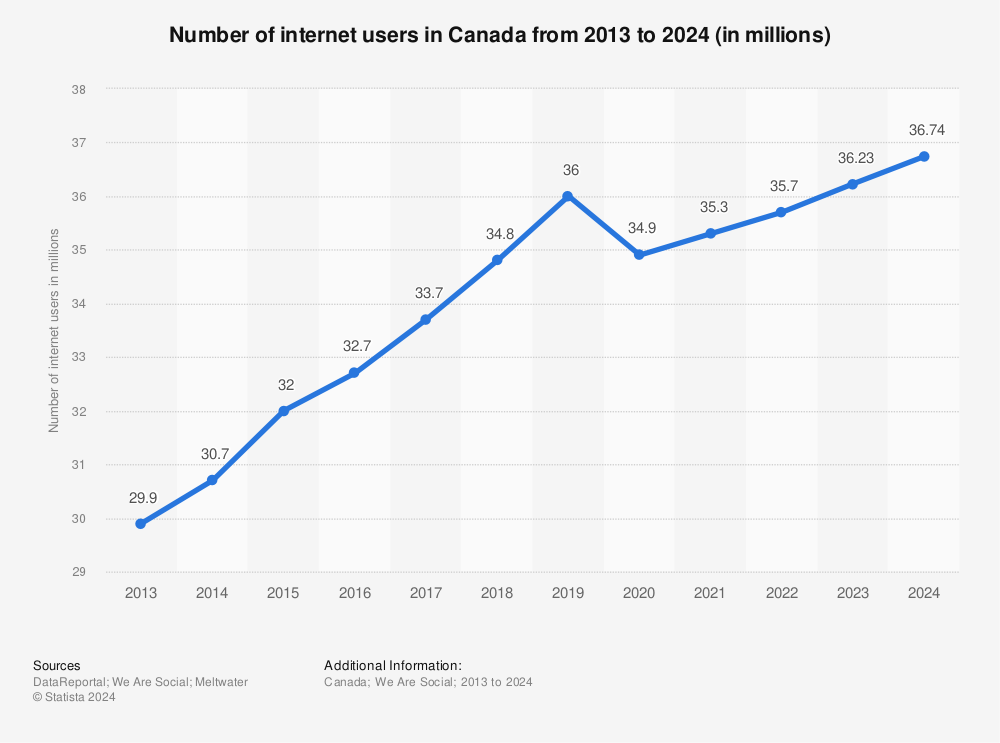
- In 2000, roughly 15 million of population of 30 million in Canada had internet access - 50%.
- For 2019, the total is roughly 96% of all Canadians have internet access (34.5 of 38 million). (1)
- Today, 78 % of those people are using a smart phone to access the internet. (2)

But, increasingly, it has become clear that more and more (younger) adults are using tiny cell phone screens as their portal to the internet. And that tiny portal is coming to dominate their entire view of the wider world in all aspects. (3)


 Especially over the last (2019) year, I increasingly receive, if not the majority, of e-mails about the training programs I offer, that look like this :

 ‘ what courses do u offer and what r dates ‘ 
sent from my iPhone 

 Now, if you only used your phone for the internet, what you would get is the intentionally, greatly reduced, for tiny phone screens, short, overview. Which would look like this (4) :
 First View - ‘Training’
Scrolling down - ‘Go on for Details’ section
Hard to read? Turn the screen sideways. 

 Eventually, if you keep scrolling even further down, you will get to a hot link that allows you to send an e-mail to me. This ‘mobile’ version is purposefully mainly composed of images - each image has another hot link available to a specific course description on the main (larger format) web site.
 See all the hot links at the bottom? Same thing (goes to details on that course on the main site). You have to pass a total of SEVENTEEN hot links to the main site, all of which would provide detailed information, to get to the spot where you see my e-mail address - when your portal is a phone.


 Here is the analysis - the second point :

 I’m going to suggest, at this point in time (2020), calling that thing many of you are carrying around a ‘phone’ is disingenuous. (5)


 Remember these? It was half the size of a loaf of bread in 1966.
Ok, your Apple iPhone 11 (current model) does not provide remote scanning for life forms, or more than limited scientific sample analysis. It does however fit in your pocket.
 It does do the following that the Original Series Tricorder did :
- GPS
- three-axis gyro
- Accelerometer
- Proximity sensor
- ambient light sensor
- barometer
- view video (via a 5.8 inch screen, the tricorder has about a 2 1/2 inch)
- audio (no stereo or headphone jack on the tricorder)
- remote connection (although the tricorder was limited to computer interface)

 What your phone has that the tricorder did not :
- touch activated screen
- WiFi (no internet in the 1960’s!)
- Bluetooth system (large number of possible connected devices)
- Siri AI assistant - still camera (12 mpx)
- video camera (HD @ 60 fps, stereo sound)
- camera / video lighting
- water resistance (to 4 m)
- video calling
- And then there are all those applications. Which can add thousands of individual functions that the tricorder never dreamed of.

oh - yea, you also have a mobile phone.

 Ok - wonderful. All that power in your pocket (for a mere $1000 US).
What are you actually using it for?
 - Endless, almost constant (basically meaningless) ’small talk’
- Text Messaging
- more of the same drivel.
- Snap chat - see above via another pipeline
- Instagram, taking endless photographs of yourself doing … well, pretty much the visual form of the same mindless activities. (Your lunch. You getting on the bus…) - - playing games

Yes - you can cruise the internet!
Attempting to view information, presented for viewing on a full sized (typically a 15 inch or more) screen. Next time you use a computer, lay your phone up against the monitor. See the problem?

A generation where the ‘Medium is the Message’.
And the Message is reduced to 140 characters. Someone else’s heavily modified image, taken completely without any context.

A 3 x 5 inch window into a full sized 360 degree world.


 1) Statistic: Number of internet users in Canada from 2000 to 2019 (in millions) | Statista
Find more statistics at Statista

 2) Importantly to this commentary : Among adult users, 88 % are also using desk / lap top portals. (honestly, I suspect this reflects ‘work’ vs ‘home’ use). The main Wareham Forge web site pages also have an ‘e-mail me’ hot link. Again well below all the details are provided. But I’ve built in a way to tell which comes just from phones.
 3) I have commented about this before : ‘About a Phone’ - December 28, 2018
 4) Set up to use an iPhone screen - shown life sized. Those screen shots captured using the Mobile Phone Emulator by Cowemo
 5) There is definite irony here. If you are actually reading this, I am almost certain you will be using a full sized screen, at the least a 13 - 15 inch lap top. As a blog posting, I suspect this commentary would be almost impossible to read on a tiny phone screen. The fact that this is appearing via a ‘blog’ itself, represents what is certainly moving to a ‘dated’ communications method. As a system, blogs started roughly 2000 (This blog dates to 2006).
Statistics in 2019 (from the USA, unfortunately):
- there are 31 million active blogs (at least one post per month)
- 70% of blog owners give $$ as the reason they actively blog
- The current ‘ideal’ length for a blog is given as 2500 words, with a reading time of 7 minutes. (This commentary comes in at roughly 1500 words btw)
- Significantly, this attention span is seen as sharply dropping, year by year.
Source : https://firstsiteguide.com/blogging-stats/ 
Note that the balance there leans to economic performance data
  
Images mostly stolen outright from internet sources - without any author citations. 

Some images are selected to reflect my own Life Frame :
 a) 1955, the year I was born. The DUCE ‘commercial’ computer, used for science and engineering, of which a total of 30 were built. It had 1.5 KILO-byte RAM https://en.wikipedia.org/wiki/English_Electric_DEUCE (Note that Sputnik 1 was launched on Oct 4 that year, I was born one month later, on November 3.)
 b) 1960, The Nixon / Kennedy Debate, on black and white television. As a young kid, my family had a floor console tv from about that date, about the size of a contemporary dish washer. Colour tv was not introduced into Canada until 1966. My parents divorced in 1967, and the family fell on hard economic times for the rest of the years after. We actually only would have tv at home on and off - as individual vacuum tubes failed in what was increasingly an ‘antique’, it often was my paper route earnings that purchased replacements. (One of my earliest ‘events’ memories is the death of John F. Kennedy - but not the Cuban Missile Crisis.)
 c) Apple Macintosh - 1985, 512 KILO-byte RAM, the first ‘all in one’ home computer with the graphic interface now standard for all computers. My first computer, purchased second hand, about 1988. This had an external 20 MB hard drive. (I still have this working machine, with all the original software - on 3.5 floppy disks.)

I currently own :
- Desk Top - Mac Mini / 8 GB RAM / 120 GB drive / 2014 (to OS 10.10.5) Lap Top
- MacBook Pro 3.1 - 15” / 2 GB RAM / 120 GB / 2007 (OS 10.6.8) purchased second hand. Tablet
- iPad Mini / 1 GB RAM / 16 GB drive / 2013 (iOS 9.3.5)
- Cell Phone - Alcatel 460T / 0.5 GB RAM / 2 GB drive / 2016 (Android 4.4.2) This my first ’smart’ phone, although I have the internet data features turned OFF. (BTW : My cell phone is almost always OFF - unless I am traveling.)

Friday, December 28, 2018

About a Phone (part 1)

"  The site doesn’t scale to mobile. Unfortunately with over 50% of internet users moving to phones and tablets, google feels like it is priority number 1 to have a website built for mobile.  "
from a recent e-mail - name withheld


Well, maybe not.
And from the look of it, certainly not those seriously interested in the Wareham Forge (or reading this right now, for that matter).

First Statistic : Population of Canada
December 2017 = 36.7 million (1)

Reported number of ‘mobile device internet users’ (so smart phones and tablets)
December 2017 = 24.4 million
December 2018 = 25.7 million (2)

Something to watch here.
1) The number of ‘subscriptions’ is reported at over 30 million.
Other reports indicated that Canada has one of the highest mobile device ownership world wide. But indicated at roughly ‘3 out of 4 people’. Which would put the number of ‘unique owners’ at closer to 27.5 million.
2) A good percentage of these would actually own more than one device - but would count twice here. (I own both a cell phone and a tablet, for example.)
3) A significant number of those would children or teens. The teens clearly show as major users, and warp some of the numbers as this goes along.

But just what are those ‘users’ actually doing?
By the data at Statista.com :
  • text message / e-mail
  • watching videos
  • finding locations (maps)
  • games
  • mobile banking
https://www.statista.com/statistics/686890/canada-leading-mobile-activities/
You can see general information searching on the internet does not even make up one of the top five uses. (Appears to be less than 1/3 of 'user time')

Ok - and quite importantly here - just what machines are Canadians using to actually ‘surf the web’?
As it turns out, still primarily using actual computer screens :
January 2018 = 55%

https://www.statista.com/statistics/505773/canada-online-traffic-device-share/

The table indicates that only 33 % of unique users are using the internet on small smart phone screens.

Combine that with the reduced fraction (not indicated, but obviously some amount less than 38%) who would be attempting general internet searches.
That makes at best roughly 1/3 of 1/3 of all web site views =
11 % of all viewers.


A double check off my own main web site portals. Stats for operating systems accessing :
’Hammered Out Bits’ - my blog / month of December (2018)
  • Android = 14%
  • iPhone = 4%
‘the Wareham Forge - main web site / month of December
  • Google Android = 3.8% (3)
full site on an iPad mini *
full site on an iPhone *
Now, I had created a separate ‘mobile’ version of the Wareham Forge web site (about a year ago) :
  • (should) automatically load when a mobile device is used
  • sized to fit the smaller iPhone screen
  • stripped to single images and limited text
  • links back to the main web site if viewers want any details
view direct at www.warehamforge.ca/mobile

mobile version on iPad mini *
mobile version on iPhone *
Over the entire Wareham Forge web site however / month of December :
Total page views = 24,908
‘Mobile’ page views = 646 (2.5%)
These two sets of numbers seem to work against each other. I may be incorrect on either end :
  • Android operating system may not just be on phones ?
  • Some mobile users may not be moved to the special mobile versions as intended.

Over the past year especially, from younger (less than 30 year old) people specifically, I have had many suggest I should re-work the entire Wareham Forge web site (!!) so it views 'easier' on those tiny smart phone screens.

(Next : 'Viewing the Universe through a Tiny Hole' )


* Made with use of the Mobile Phone Emulator (by COWEMO)
I made an attempt to match these images to the actual sizes of the devices indicated. I suspect the size of these images will be altered by your own viewing screen.
  • iPhone : continues to increase in size, older ones = 13 cm (diagonal)
  • iPad mini : (mine is iPad 2) = 20 cm (diagonal)
These also show the vertical arrangement, which is what the mobile site version of the Wareham Forge was designed for. The images used there actually are a size that fills a horizontal view on the iPhone screen.

1) Statistics Canada
https://www150.statcan.gc.ca/n1/pub/12-581-x/2018000/pop-eng.htm
An estimate of the current (end December 2018) = 37.1 million
http://www.worldometers.info/world-population/canada-population/

2) Statista
https://www.statista.com/topics/3529/mobile-usage-in-canada/

3) The separate statistics sheets for these two sites record and track different information.
The main Wareham Forge site does not track  macOSi  individually

Wednesday, August 15, 2018

WARNING - Blog being spammed

Readers here may be diverted to a spam advertising site.

I have messages out to both my ISP/ Support Guru and Blogger itself in the hopes of fixing this. (Both front and back door to Google, but given the mass?)

Curiously (?) this does NOT seem to be happening to me using Firefox as the browser access. My own tests using Safari or SeaMonkey also divert. I have had reports of Chrome also diverting (I work off Mac). This does not seem consistent however, some people report no problems.

A paid advertising site : Widget Server (dot) com is somehow grabbing visitors from Hammered Out Bits and shoving them over to some spam styled advertising site. Widget Server obviously 'sells' different spam pages (if you examine the actual URL used, you will see a randomly applied number to different advertising).

I am attempting to fix this - but please bear with me for just now.
I believe the problem lies inside Google Blogger itself.

Wednesday, July 11, 2018

Into a new MILENNIUM

This marks the 1000 th posting to this blog. (1)

I started 'Hammered Out Bits' back in March of 2006.

One of the primary reason I started this all was to make use of materials I was generating through answering e-mails. As frequent readers well know, I'm not (ever?) able to make a one word answer - to anything. Even if the actual answer to a question is 'NO', I feel the *reasons* are just as important as the negative response. I also feel that any statement needs some background to be correctly understood. (2) So I end up spending a lot of time on long detailed e-mails, which would end up only having a single reader. You may notice on any number of pieces here, the initial start is a quote from an email. (3)
At the time this blog was started, one of the mechanisms in play was author's intending to collect up all the (often random) segments from their blog into a published volume. Some people early into this method, and those with particularly 'hot' topics, where able to undertake this to financial success. I had some hopes along those lines, especially within the highly specialised topics of 'Viking Age blacksmithing' and 'bloomery iron smelting'. With time however, I can see that at best that volume of raw articles are far too chaotic to form into a concise whole. It would be easier to use the segments as very raw draft - and just write again from scratch.

When I started this blog, I got some very good advice from my old friend Steve Muhlburger :
'Keep to a narrow topic range'
'Try to avoid broadcasting your personal opinions (unless politics is your topic).'
I have mainly attempted to do this here. You will find the primary topic areas given through the 'Lables' list near the bottom of the left side bar (with their numbers) :

Blacksmithing = 328
Viking Age = 278
Iron Smelting = 269
Contemporary Arts = 168
Experimental Archaeology = 141 

Most the other topic labels show less than 50 attributed.
(Yes - those add up to more than 1000. Often an individual post might collect more than one topic label.)
First image published here - June 12, 2006. The 26 posts before this were text only!

Greatest Hits?

This blog, perhaps exactly because of its limited and specialised topic focus, does not have a massive readership:

Regular Reader / 'Followers' = 28
Typical Views on a new posting = 300
Average Views of any posting any day = 150

Total Views Overall = 724,400
USA Viewers (overall) = 340,000 
Russian Viewers (overall) = 71,000
Canadian Viewers (overall) = 62,000

Not overly surprising, given the use of English (although Russian numbers a surprise). Given that Canada is roughly 1/10th the population of the USA, there is a strong showing here. (But again maybe not too surprising, given that I live in Ontario - and do have a 30 + year visibility here!)

Curiously, it has been when I have stepped * outside * the normal topic framework here that I have generated the highest reader numbers.

29 May 2017, 24 comments
67276


8421


31 Oct 2015
3958


3844
 (so combined = 7802 )


1 May 2017, 6 comments
6097

After that, any individual posting averages roughly 3000 views (overall)

You can see that my very, very political entry (on being declared an 'Illegal Immigrant Without Proper Documentation') has received fully * twenty * times more views than any other single posting. Actually almost 10% of the overall total!

The next two high volume postings (over two times the average) are the result of 'hot' popular culture topics. The film 'Avatar' first, the TV 'Forged in Fire' second.
It might be safe to say the fourth high volume entry is also a result of pop culture, in this case various 'documentaries' about what proved to be a totally false Norse 'occupation' site.


So - what is my take away from all this?
I consider publishing on the internet as * real * publishing. For the Independent Researcher (my bloomery iron smelting work for example), access to academic publications is extremely limited, and very difficult. The 'self published' aspect of the internet does provide a clear alternative. (4)
I have information published on the internet in three formats:

the Book = my formal web site (www.warehamforge.ca)
the Magazine = this blog
Snap Comments (at a cocktail party) = Facebook

As an individual, I consider the sharing of knowledge ethically required.
So expect many more entries here into the Second Millennium...


(1) But well over 1000 blog postings created - all combined.
•  I also contribute to the Dark Ages Re-Creation Company blog
About 50 or so pieces there (roughly half). A number are cross posted back to this blog however.
•  I set up a separate blog to document my 2012 Ontario Arts Council grant funded project Iron Blooms to Bars.
There are over 40 pieces there, again a number are cross posted back to this blog.

(2) Hence my increasing aggravation over the development of 'personalities' / 'sound bites' / 'Fake News' over the last decade particularly. Most events and issues can not possibly be understood in 140 characters.

(3) Warning there:
If you send me an email, there is chance my own reply may be converted / expanded into a blog posting.
My standard practise is to remove identifiers, reducing the initial email to a shorter quote, usually only attributed to a first name (for sender's security)

(4) I have had many conversations with academics about the value (or lack thereof) of the internet. 
The easy access to virtually anyone who can find a computer and has even basic computer skills is clear.
With at least simple writing skills, anyone can self publish.
There are two commonly pointed out flaws to information on the internet :
1) Self published means absolutely no editing or checks for accuracy. In this the internet requires the * reader * to provide the required critical evaluation of materials found.
2) The medium is very ethereal. Often web sites disappear without a trace - that content lost forever. 
(Consider here the length of duration of this blog (2006). The main Wareham Forge web site has been stable since the late 1990's.)

Monday, September 07, 2015

Lost (& Found!) Commentaries on BLACKSMITHING!

One problem with the internet is that is is subject to variations, modifications, take-overs and other random losses of published materials.
In preparing to  answer an e-mail query this morning, I ended up (spending several hours) replacing 'lost' materials I had written and published as much as decade earlier.

These are the descriptive commentaries now back available on the 'On Blacksmithing' area of the main Wareham Forge web site:
Defining the Artist Blacksmith

A commentary on Terminology and Tradition
Originally on the Ontario Artist Blacksmith Association web site.
"Will you take an Apprentice?"

A commentary on the reality of the single person studio
Originally Seen on my blog Hammered Out Bits
A Career as an Artist Blacksmith?

Considering a Life as an Artist
A short article originally published on the Squido web series .
Teens as Students?

Some wisdom on the physical demands - and hazards, of working in as a blacksmith.
Wrought Iron Work?

What it really is - and what it really means!
On Buying an Anvil
Some information on what to look for
From my original GeoCities blog

If readers are not familure - I highly recommend (and thank!) the Internet WayBack Machine :

http://archive.org/web/

Sunday, May 03, 2015

Message ? or the Medium ??

On 02/05/15 8:24 PM, Jason wrote:
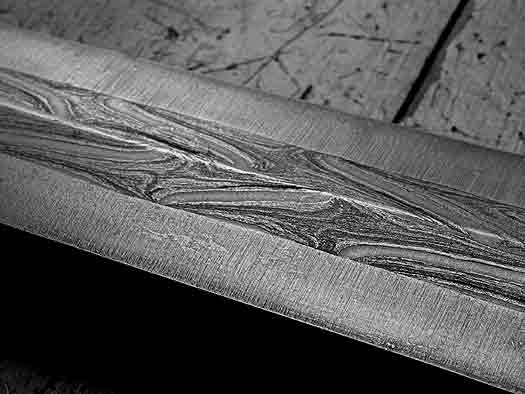
Your site is amazing and something that has always interested me. I really wish you would put up better high resolution images that can be expanded to a much greater size. My vision is not what it used to be and I really like to look at the detail. Most of the images are just too small to really get an idea of the beauty of the creation, such as the Damascus steel.

Please understand that although I enjoy bladesmithing, I am not primarily a specialist blade maker. Any given year I might undertake 2 - 4 blade projects, usually only half as paid commissions, the others 'just cause I want to'. Don't be fooled by the large number of objects illustrated. You are looking (at this point) virtually a life time's worth of work. Obviously the most effort in communications has to go to the work that actually pays my bills.

A point to remember is that I personally think the distortions that comes from the effect of the hand hammer on a layered billet is important. Because of this, each individual object is quite distinctive. Although I appreciate the technical skills involved in creating uniform, regular, predictable patterns (Middle Eastern styles), as an artist, I chose deliberately not to do this.
My own work style is more based on the Northern European 'pattern welding' style (twisted multiple cores).


'Sword of Heroes' - 2000

Lack of high resolution (huge file) images?

A combination of reasons:

Largest being connection speeds. Only urban dwellers have access to high speed. I most certainly do not.
I have problems uploading larger images from my location (via an expensive direct satellite uplink dish).
On the download end - I also have problems viewing sites that insist on using giant files. (As this pisses me off personally, I intentionally have chosen not to restrict the viewing of my own web site in that fashion.)

Image processing. My best quality camera is an older (2008) 5 mega pixel. Any images before 2008 are on colour slides! Although I do have a full version of Photoshop (v. 7.0 - 2002) I am working primarily on a Mac G5 (1.8 speed ) using OS 10.4.6 (about 2003).

By far the biggest limit = Time. The Wareham Forge web site dates to the early to mid 1990's. It is huge. Guess who does all the coding, formatting, writing, image crunching? Attempting to keep up with the latest trends in internet use is a huge problem. Since its original inception, there is not almost constantly being new materials added, but the entire site has been re-designed at least three times. For the last several years, I have barely been able to keep up with just re-designing the site  for function and general appearance. Much less finding and re-formatting images from the original source copies.
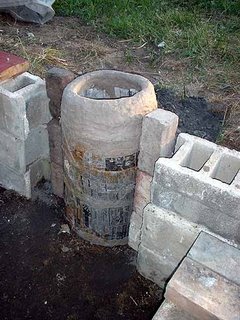
The entire site itself is immense. It currently totals almost an entire gigabite of storage space. I really don't have an exact count of the contents, but there are about 200 + individual 'pages' - including over 2000 individual images.  Consider it 20 years worth of contributions.
At core the site is more a grand portfolio of work, more informational than sales oriented.

The internet is increasingly trend driven. The amount of raw labour required to keep up with this stuff is almost always not worth the time invested.
Although I do think I have certain skills in layout, writing, photography, and certainly do have the base knowledge of web site creation - it is * not * what I do.
I make stuff -
Documenting it and presenting it are two entirely different skill sets.


Too few people appreciate the vast amount of work that surrounds being an artisan - maker
. I typically work 10 hours a day (plus), over a 6 1/2 day week. Of that a 'good shop day' is 2 1/2 - 3 hours worth...


PS : Readers here should also consider the work invovled in preparing, writing, formatting this blog. This post makes 845 individual segments. Each typically takes roughly one hour to prepare and install....
 

February 15 - May 15, 2012 : Supported by a Crafts Projects - Creation and Development Grant

COPYRIGHT NOTICE - All posted text and images @ Darrell Markewitz.
No duplication, in whole or in part, is permitted without the author's expressed written permission.
For a detailed copyright statement : go HERE