Showing posts with label education / training. Show all posts

Monday, August 10, 2026

Blacksmith's Gloves for a Museum?


this came to me recently :
"The Canadian Glove Museum in Point Leamington, Newfoundland recently contacted OABA requesting a set of bona-fide blacksmith gloves to add to their collection as they are expanding the collection to include more gloves connected to traditional
trades and skilled craftsmanship. They are requesting "a retired pair connected to a Canadian blacksmith, demonstration, major commission, long career, or teaching story.
A well-used pair with visible wear and a short explanation of how the gloves were used would be especially meaningful."
(This is my response to this request)
 
 I have a pair of gauntlet style gloves, retired due to left hand wear and shrinking, which might well fit your description - and although I am based in Ontario, these have a direct connection to Newfoundland.
 

I had added a few short sections, as direct responses to the details requested :

A Canadian Blacksmith...
Scope of Work...
As a Teacher...
As a Demonstrator...


A Commission - in Newfoundland...
From the mid 1990's I have had a direct association with Parks Canada at L'Anse aux Meadows NHSC. I would be commissioned by Parks to design, construct and implement the 'Norse Encampment' living history program now seen at the site. This would include both the initial staff training and many follow up visits over the years (the most recent in 2023). The original presentation required the creation of roughly 150 detailed objects, and dozens more have been made by myself since. 
In 2000 year I designed and delivered the college level program 'Interpreting the Viking Age' in association with the College of the North Atlantic and the Viking Trails Tourism Assn. at St Anthony. This six week course for adult students would provide the background training for the 'Norstead' attraction.

In 2008 I was commissioned by Parks Canada to create a set of working replica Viking Age ship building tools, This included axes, adzes, chisels, a saw and drills. As research, I would travel to Denmark to the Viking Ship Museum in Roskilde and the Nation Museum in Copenhagen to view artifact prototypes. 
As part of that trip, I would be the only North American invited to participate in the 'Iron Making at Thy' symposium, a practical workshop in bloomery iron smelting. These specific gloves were purchased originally for the needed hand protection working with these furnaces.
Back in Canada, the creation of the axes for this commission would require repeated forge / hammer welding. This process, often seen in images for the dramatic sparks produced, again requires hand protection, particularly for the left, holding, hand. Again this pair of gloves was used. 

 In 2010, I would return again to L'Anse aux Meadows, this time to undertake a full re-creation iron smelt (meaning using all Norse equipment and clothing). Working with the local staff interpreters, it is worth noting that this was the first time iron had been successfully made at L'Anse aux Meadows in 1000 years! This pair of gloves was again employed, not being that much different from a potential Viking Age type.


Looking at the Wear...
Normal practice (for me at least) is to leave the right hand bare, to ensure proper control of the hammer. For that reason there is often more wear to the left, as it is more frequently used, and this is seen in this pair. A split seam on the left thumb was covered with a loop of common hockey tape while welding axes (and yes - I discovered this hole when I got a burn!). A second spit (not covered) is seen on the left index finger. 
As the left hand can be exposed to the extreme heat of the forge - especially during forge welding, this will both harden and shrink the leather. Eventually this will result in a lack of flexibility in the grip which becomes a problem while working. Comparing the two gloves, this shows as both discolouration and the condition of the leather on the left hand.
I would 'retire' this pair of gloves from normal working after the 2010 smelting event. I've kept them to have an additional pair available, even if not in perfect condition, for workshop events. As I have fairly small hands, getting gloves that fit correctly is sometimes a problem. Typically I replace my working gloves about every two / three years - normally due to damage to the left side. (Meaning a lot of mis-matched right hands kicking around the workshop!)
It might be of some interest that right glove has the original price sticker still in place = $33.99. That would have been in 2008 for comparison. I had considered these gloves, which had a good fit for me, well worth the price.
The cuff of each has my 'three lines & three dots' maker's mark inside. This primarily from wanting to keep them sorted at the Danish smelting event.

I appreciate that this pair of blacksmith's used gloves may not show the most extremes of wear. Honestly (and speaking from 45 years experience), a pair of gloves that are over worn may actually not perform the function they are intended for - protection of the hand. I normally only wear gloves when undertaking techniques using the most extremes of heat; forge welding, casting, smelting. Experience has shown that people are too quick to pick up a bar at 'black' heat, (still up too 600+ C) in a gloved hand. This effectively sets the glove on fire, they drop the bar but it is the hot leather than is burning them! Because you can feel the radiant heat with bare skin, merely slowing done before touching generally will keep the experienced smith safe. This combines with the fact that any work in gloves is more clumsy than manipulation with your bare hands.
The main exception here is when forge welding. Proper grip with tongs will leave the triangle between thumb and index finger sitting upwards - and flat. As correct forge welding modern steels requires use of a flux (those sparks seen), not only will extremely hot debris potentially land on that flat surface - it will (painfully!) stick there.


I'm hoping you will consider this pair of gloves, not as much for damage, but as the clear history of use that links directly back to Newfoundland.

(Message to the Canadian Glove Museum was sent on August 10, 2026 - too early yet to know what the response may be.)

Sunday, March 29, 2026

Canadian IRON Symposium

Canadian Iron Smelting Symposium

Labour Day

September 4 – 7 (Friday to Monday) 2026

Sanctuary Armoury

1504 Cameron Line
Hastings, Ontario

(about 20 minutes East of Peterborough, just south of highway 7)

This will be a practical workshop style event, individual teams of 3 – 4 persons building, repairing, then firing their own 'short shaft' bloomery furnace. Using 25 kg of ore, each team will create a bloom in the 3 – 5 kg range, which will be divided between that team.


The focus of this event will be on ores, with four different ore bodies provided, assigned one to each team :

- 'Lexington Brown' – Limonite rock ore from south Virginia

- Granular Hematite – a fine, high elemental iron content material used for sand blasting

- Red 'Bog Ore Analog – an Fe2O3 material well proven in past tests

- Black Analog – an Fe3O4 material similar to the red, but with higher elemental iron

    - Any formed teams who wish to bring there own local iron ores to test smelt are very welcome to do so!

    - Additional amounts of Limonite will be available for those who want to double up or aim for a large ore amount bloom!


Event cost : $ 310 CDN per working participant

This covers ore, furnace materials and the 50 kg charcoal per team.

All a the basic tools needed for the build and smelt will be provided.

Registration limited to 20 individuals

There is no prerequisite for smelting or metal working experience !

Paid Registration Deadline is August 1, 2026


'Primitive' Camping spaces available on site (see detail below)

This event takes place rain or shine!

(Overhead covers will be provided in the smelting area)


Proposed Schedule :

Friday : Arrive and set your camp

Welcome BBQ

Discussion of the basic furnace design and method

Saturday : Roast and crush ores (only required for Limonite)

Crush and screen charcoal

Prepare clay / sand / organics mixture

Build the furnace

Cut tapping and extraction arches, mount tuyere

Gentle drying fire into the evening

Sunday : Workspace preparation

Initial pre-warming fire

Full ore to bloom smelting sequence (typically 5 – 6 hours)

Extraction and initial compaction

Monday : General workspace clean up

There will be limited opportunity to render bloom pieces down into working bars. One equipped coal forge on site, possibility to construct simple ground mounted charcoal trough forges. (anvils may be in short supply however).

Pack camp and depart as travel requires.


Primitive Camping?

The Sanctuary Armoury site has roughly 100 acres of rolling fields.

- There will be adequate space for parking. Space will be set aside for those who bring Rvs.

- Individuals should provide their own tents and general camping equipment.

    - There will be one large communal fire pit, but generally you should provide your own cooking stoves. (At this point it is unlikely any on site food will be available).

    - The camping area will be separate from the smelting area

    - Potable water will be available at both areas

    - Portable Toilets will be set at both the camp and the smelting areas

    - There will be no provision for electric power in the camping area


Personal equipment?

Iron smelting is both dirty and has the presence of charcoal sparks :

    - Older working clothes are wise. A cap is a good idea! Long sleeves strongly recommended.

    - Boots : all participants are required to wear leather boots that come up above the ankle (and under the pant leg).

    - Safety Glasses : Minimum polycarbonate to be worn at all times in the smelting area. Those with there own safety glasses are recommended, especially for those who use prescription lenses. A limited quantity of simple safety glasses will be on hand

    - Leather Gloves : Those who have their own work gloves are asked to bring these.

    - Leather Aprons : Not absolutely required, but it is suggested those who have these do bring them.

- Extraction Safety : There will be two very basic sets of fire resistant gear (jacket / body plus greaves, gauntlets, full face shields). These will need to be quickly shared between the teams as extraction time arrives.


'Non Participant Observers'


There is no particular reason family members or partners should not be able to attend if desired :
- registration of individuals will be required (mainly so I can track numbers).

- any children must be under direct adult supervision at all times.
- within the smelting area in general, the same requirements for dress and safety eyeware will apply.
- No unsupervised general access to the individual furnaces (the same 3 meter circle we insist on at public demos)
-  Minimal fee will be charged to adults (+18). This to cover the cost of the Friday BBQ, and the probable renting of a third port-a-john. Likely to be $30 for the full 4 days, but this will depend on numbers.
There is no current consideration of this being an 'open to the public' event.

At this point the payment method has not been established.

Those interested should contact Darrell Markewitz (below) to express their intent.

A minimum paid registration of 12 individuals is required for this event to proceed.


Your Hosts for this Event ?

Sanctuary Armoury

the Wareham Forge

Darrell Markewitz

info@warehamforge.ca

519-923-9219

www.warehamforge.ca/Canadian-Iron

(web site has location via Google Maps)

Monday, February 09, 2026

CAMELOT Conference - Sept. 26


Exploring The Road to CAMELOT!

Dear Darrell,


I hope the New Year has treated you well. In preparation for CAMELOT 2026, the CAMELOT Team is preparing to send out the Call for Presentations to the general public. Before we do so, we wanted to reach out to you to invite you and DARC to CAMELOT 2026 which will be held on September 26th. 

Last year you helped us bring back CAMELOT after a five year hiatus. Your booth was a highlight of our 2025 conference and many attendees have asked whether DARC would be returning to the 2026 conference. Last year’s conference included amazing research presentations and hands-on learning opportunities for over one hundred and fifty students, academics, and members of the public. We have an Experimental Archaeologist travelling from North Yorkshire, UK for our keynote lecture, and intend on having several highly esteemed colleagues in different areas of Archaeology for a round table panel. This year, the theme for CAMELOT is experiential learning. With this theme in mind, we are hoping to significantly expand the conference for its 2026 iteration, and we would love it if you could help with our goal.

If you are interested in running a workshop or doing a research presentation, the Call for Presentations is linked here.


https://forms.gle/hRKaUvdysc8Fj8yz8


Thanks,


The CAMELOT Team


At this early date, I am considering a paper loosely titled 'Presenting the Norse'. 

This would be an update on two early papers, at ALHFAM - 1998, and the Viking Millennium Conference - 2000. Now with over 30 years since the original 'Norse Encampment' demonstration at Orangeville in 1993, there is some value in reflecting on all the experiences presenting via living history.

"Lessons from the Viking Age' - 1998


Friday, January 23, 2026

Lectures : Saturday Jan 24

Lectures at SCA Blue Dragon tomorrow
 
Equipping the Viking Age (1-2 pm)
 

So, you are thinking of going Norse! (or have already done so?) Beyond clothing, it is the personal accessories and objects that you surround yourself with that define your character. But what should you be equipping yourself with? The great news is that the Norse left lots of examples behind in burials and excavated town sites. Join Darrell Markewitz (aka Kettil Einarsson of DARC) for a look through his own extensive collection of replicas, to compare what is available, and what you can make (!), to the original artefacts. Lecture format, illustrated with photographs and physical examples. 
 
Beginning Blacksmithing (2-3 pm)
 

Welcome to the forge! There is a bewildering amount of 'information' out there about this craft (much of it not so very good). What about the difference between modern, 'traditional', and historic tools, materials, even methods? Looking from the perspective of lifetime as an artisan blacksmith, there is a lot of 'I wish someone had told ME that'. This illustrated lecture will cover aspects like: picking the *right* hammer (and how to correctly modify one); how to judge an anvil; forges and fuels; iron, steel and alloys; proper safety in the workshop; historic blacksmith shops. Not so much what or how to make objects, but advice on getting *correctly* prepared to explore blacksmithing.
 

Tuesday, April 30, 2024

Weekend with Matt Jenkins

Organized by Lloyd Johnston, at Upper Canada Village, Morrisburg, over April 26-28.


I have to admit here that I signed up largely to support this ongoing series of experienced blacksmith demonstration events that have been orchestrated by Lloyd, who I have known since my earliest days at the forge (the late 1970's). The featured artisan blacksmiths have been drawn from a wide regional circle, individuals that Lloyd knows and felt would have something to offer. Fellow participants come from not only Ontario, but due to the location at the far east, also from Quebec and into New York. 

Matt Jenkins is generally known from his '366 Hooks', a project he undertook which was then formalized into a traveling exhibit by his business partner (and wife) Karen Rudolph. He had traveled from his own Cloverdale Forge located 'north of Winnipeg', Manitoba, part of a larger round of demonstrations through into the western USA then back home again from what he mentioned. 

Matt proved to be both a good technical demonstrator, but also an engaging one. His past as an artisan interpreter at the Fort Gary historic site certainly shows in his delivery method. Places where some would have gaps (heating a bar for example) were easily filled with stories, both entertaining and insightful. Matt also has the skill of being able to talk while he works, providing additional description to the processes. He has a very 'folksy' manner, which covers over a keen mind, his background training (in engineering) and considerable working experience. 

Overall I was pleasantly surprised.

Given how long I have been at the forge myself, I was more expecting perhaps a different approach to things I already knew. One clear difference worth watching (for me) is that Matt works consistently with mass (where I tend to favor line). My friend David Robertson says that if he gets one new insight or working method in a demonstration, he feels it worth the time spent. The observations from the engineering side often provided just that. Matt certainly gave me a few new things to take home and consider adding to my own work. 

Some of the decorative elements Matt demonstrated that caught my eye:

'Basket Weave' element, square punches linked with butcher tool lines.

'Leaf' element, using 'Deer Hoof' punch.
 
Unnamed element ('Thumbprint'??), using a dished end punch.


Thursday, April 18, 2024

Beginning Blacksmith - Book now published!


Beginning Blacksmithing: 

or

'I wish someone had told ME that!'

Paperback – March 17, 2024


Have you wondered exactly how to get started as a hobby blacksmith?
This book offers valuable advice on how to get started the RIGHT way, and may both keep you working safely - and save you money on those first tool purchases!

Topics include :
• Getting the right HAMMER
• Firing the FORGE
• Picking an ANVIL
• Working SAFE
• Tools and workshop
• Motion Dynamics
• Picking a Course

This book is based on over 45 years personal experience working at the forge, since 1992 as a professional artisan blacksmith at the Wareham Forge in Ontario, Canada.
Darrell Markewitz has guided hundreds of first time blacksmiths through an ‘Introduction to Blacksmithing’.

6 x 9" format

160 pages

black & white


Monday, February 05, 2024

Upcoming Lectures - SCA Practicum

Practicum 2024: Back to Basics

When : Saturday, Feb 24, 2024
Where : Rideau Park United Church, 2203 Alta Vista Dr, Ottawa, K1H 7L9 (map)


Practicum 2024 – Back to Basics (ealdormere.ca)

Site opens: 9:30am  Site closes 8:30pm

(At point of this post, class schedules have not been published) 


DARC round table on the Viking Age

60 minute round table style discussion
best suits teens through adults

 
DARC Round Table on the Viking Age

How do you approach re-creating daily life in the Viking Age? Drawing on decades of practical experience presenting this period before (literally) tens of thousands of the general public, as well as individual lifetimes as working artisans, four prominent members of the Dark Ages Re-creation Company will discuss aspects and issues related to not only this historic period, but undertaking living history in general. Topics will range from the general (Viking vs Norse?), the practical (balancing historic vs modern tools and materials), to the topical (perceptions and representations of gender). Opinions are likely to differ, and discussion with the audience is expected!

Norse Iron 

60 minute illustrated lecture / discussion
best suits teens through adults 
 

The 'Dark Ages' are known partially through a number of truly impressive objects made from forged iron, Sutton Hoo (Anglo-Saxon) and Oseburg (Norse) being the best known examples. During the Viking Age, iron was used for domestic objects, tools and weapons. Illustrated with artifact images and physical replicas, this session will look at how iron itself was made, the work of the blacksmith, and objects of special interest to re-enactors.
http://www.warehamforge.ca/ENCAMPMENT/artifact.html

Note there is a slight change here, due to my own mix up with lectures at the Blue Dragon event in January! 


Starting in Blacksmithing for Re-enactors (some practical advice) 

60 minute illustrated lecture / discussion
best suits teens through adults 


As popular culture exploits an interest in blacksmithing, more and more people are drawn to a first attempt to pick up a hammer. Forget what you see on 'Forged in Fire'! Drawing from a lifetime at the forge and decades of teaching experience, this combination illustrated lecture and Q & A, will look at contemporary blacksmithing equipment and processes, with an eye to the differences between modern, traditional and historic methods. A particular focus will be important practical advice for the beginning smith.


Instructor Bio 


Darrell Markewitz first picked up the hammer in the late 1970's, and has worked professionally as an artisan blacksmith since the late 1980's. He found the Wareham Forge in 1992, specializing in 'Historic Reproductions in Metals', with work for both major museums and individual re-enactors, as well as private commissions for his Art Nouveau based designs. Most significant museum work is his creation of the living history program for Parks Canada at L'Anse aux Meadows NHSC, he has provided staff training, physical presentations and object replicas for museums throughout North American, in Great Britain and Europe. Since 2001, he has undertaken personal research via experimental archaeology into bloomery iron smelting, which has included numerous conference presentations and academic papers.
As Sylard of Eagleshaven, he is 'Ancient of Days', holds a Laurel for decorative metalwork, and is the original 'bastard Viking' of song and story. He founded the Dark Ages Re-creation Company in 2000, and remains it's driving force.

Sunday, March 20, 2022

'Fury of Northmen' - Fakes via the Internet

 Anyone who has gone beyond the wild imaginings of recent video programs like 'Vikings' on what passes as the 'History' Channel has seen the 'quote' :

'From the Fury of the Northmen, oh Lord, deliver us!'

Such a great line.

You can imagine some whimpering Irish monk, huddled in a cold stone monastery built on a bleak and remote storm tossed island, muttering this in the early 800's. 

Only problem is that this statement is not actually recorded anywhere in surviving manuscripts.  


You see, gentle readers, I'm now working up the lectures required for my current project for Parks Canada, delivering an 8 day training program for interpretive staff at L'Anse aux Meadows NHSC. This is intended to be a crash course in material culture of the Viking Age, living history presentation methods, basic working skills in iron and wood working and textiles. Two other well experienced members of DARC will be assisting.

Now my normal method when pulling together a lecture presentation is to work inside PowerPoint. Note that this is a lot different than writing an actual paper. (Or the 'stream of consciousness' babbling of these blog posts!). I will frame up major statements, then include 2 - 4 bullet points. Once the primary elements are written, I expand to a series of individual 'one point per slide, inserting suitable (attention nailing) images.

When you start building lectures to train working museum staff, you also start considering 'how do I know this?. A lot. 

This all came clear yesterday, as I was working up a lecture 'Resources and Prototypes' :

Look at available references, some suggestions for further knowledge. Aspects of artifact preservation. Consideration of ‘critical evaluation’ of sources. Discussion of Popular Culture depictions and public misconceptions.

I was considering how to frame up 'Problems with Historic Documents', with the bullet point 'beware bias of writer'. I had already used a quote from the Anglo Saxon Chronicle (sacking of Lindisfarne) in another (earlier in sequence) lecture. I was pretty sure I remembered that the 'Fury of the Northmen' quote was not actually contained in any historic documents. But after 40 years of studying the Viking Age - just where did I find that 'fact'?

Also attempting to find an image to place on the presentation slide, plugging the actual quote into my search engine got me this :


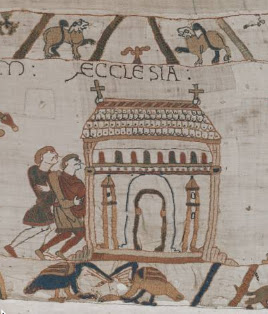
Now, I'm roughly familiar with the Bayeux Tapestry, commissioned roughly 1070 + to commemorate the Invasion of England by William of Normandy in 1066. (1). The text on the Tapestry is in Latin for one thing. 

Hmm - so where did this depiction come from? It certainly appeared to be a photograph of an actual embroidery (or an extremely careful illustration crafted to duplicate embroidery).


The image was placed on Pinterest by this person. 

Now I really HATE Pinterest. This is a perfect example. The image had NO source credit. 'Wild Eyed Southern Celt' had none of the supplied links actually functioning. (2)

Ok - add another 30 minutes of digging. 

Taking a look at the folio copy of the actual Bayeux Tapestry available from the museum that houses it :


 This is obviously the source reference used for the creation of the illustration seen above. (This is from section 3 of the Tapestry). 

After a LOT of dead ends, I was able to find a 2001 article by Shirley Ann Brown, The Bayeux Tapestry and the Viking Age. Here the image in question is specifically attributed to the opening sequence of the 1958 film 'The Vikings' with Kirk Douglas and Tony Curtis.

I found one suggestion that the quote comes from the English 'Book of Common Prayer'. But given that that volume dates to 1545 - this seems unlikely as the origin. 

I've got some individual requests out to some academic researchers I know...


PS - writing, formatting and importantly researching the various links for this short piece took me 2 hours and 45 minutes. (In case you might be wondering what a semi-retired artisan blacksmith with a heavy research arm does with 'free time')


1) Unlike many historic 'documents' the Tapestry was undertaken both shortly after, and by hands at least local to, the events depicted. 

For comparison, the raid in Lindisfarne was recorded roughly 100 years after the event, by an Saxon monk, who most certainly inserted both his (and his patron, Alfred of Wessex's) point of view.

2) In preparing this piece, I did search 'Wild Eyed Southern Celt'. A page on Facebook, Tumblr, Pinterest plus a commerical shop via 'Cafepress'. NONE of these provide any indentification on who or even where (USA?) this individual is. Draw your own conclusions...

Friday, February 18, 2022

Courses into 2022

 February 2022

This is a general reply to those who have contacted me about the possibility of undertaking blacksmithing and related courses at the Wareham Forge.


• First General Reminder :

I do not offer any courses over the winter months (mid November to end March). There is no heat in the workshop!

Into 2022, I have a major project for Parks Canada which will require the majority of April through June.
So I will only be available (at point of writing) for potential dates beyond July 1, 2022.


• Second :

I normally frame up my year's course schedule in February.
Please refer to the information kept (reasonably) current on the main web site :

http://www.warehamforge.ca/TRAINING/train.html

Please be advised that there are going to be changes to the indicated fees and details on content / student numbers.
The final costs must be quoted directly via a current e-mail, those on the web site only serve as a guideline.

The general guideline on pricing will be :
- If two individuals book a session together
    Use the quoted rate for each student (no price reductions)
- If a single student books a two day session
    I will be offering discount from the posted $300 per day, to $250 (x 2 = $500+)

Note that these are not hard quotes, as some courses do have additional materials related costs which will remain in effect.

Heading into 2022, I expect I will be primarily setting courses as based on request / interest - for the majority NOT to a fixed schedule. This may allow more flexibility for available weekend dates?
This may result in the creation of more 'private session' courses.


• Third Consideration

I have never offered 'fast start' or 'make a thing' = 'experiences'.
(And those interested in blacksmithing are strongly advised NOT to mistake such offerings as actual instruction!)

I hit 65 in November of 2020. Primarily for that reason, I am not intending to continue with the basic level programs (Introduction to Blacksmithing / Basic Bladesmithing, as open registration weekends
I will continue to offer the higher level and special interest programs, for most of these, I remain the only available instructor, certainly in Ontario (in many cases the only in Canada).
My hope is that my own desire for teaching will set the pace and selection of courses offered (not mere income reasons).
If you are interested in starting level courses, refer to the other quality instructors given at the bottom of this note.

    Three B

BEWARE 'FORGED IN FIRE'
This is an entertainment - NOT any depiction of reality.
See my commentaries on this blog :

Saturday, October 31, 2015
Saturday, March 18, 2017

• Fourth

The situation with COVID-19 continues.

No individual is allowed access to the Wareham Forge unless they have received two vaccines plus booster
Period.
No discussion.


I personally will be remaining in effective lock down, here at (rural) Wareham, with full expectations to continue this (with Omicron) into at least early 2022 and beyond into the foreseeable future . Since this all started, we have been keeping to a roughly three to four week cycle for supplies, with only trips into our local village for bank / groceries / hardware. We have completely avoided urban centres, with only Owen Sound on a roughly 3 - 4 month cycle.

I was (finally) able to secure my third, booster shot on January 16. This combines to make me at least somewhat protected. However, as I have existing lung damage (and age) as contributing risk factors, I remain cautious.

There are two published commentaries available - it is highly recommended that you read these:
On the main web site : http://www.warehamforge.ca/TRAINING/COVID.html
I keep this general information current on a monthly basis
On the blog : https://warehamforgeblog.blogspot.com/2020/06/distancing-at-wareham-forge.html
This is a general commentary about distancing and teaching at the Wareham Forge.

the main elements determining the situation for courses are these :

1) Reduced benefit to students : correct social distancing, although (barely) possible, do NOT make for effective instruction.

2) All the risk is carried by the instructor : I have been pretty much isolated since March 14, 2020 - have you?

Expect at best extremely limited selection and availability for enrollment in courses here at the Wareham Forge until an effective vaccine protection and reduced infection rates related to COVID - and its developing variants, is certain.


General Advice :

I do recommend anyone interested in blacksmithing training carefully examine the past experience of those offering courses. A large number of what can only be considered 'entry' level workers have been, frankly, 'cashing in' on the current popularity of blacksmithing and mounting short duration 'experiences'. Teaching is also a skill. The recent trend to 'giving people what they want' is foolishness in my opinion (against some 40 years teaching experience). My recommendation is that you examine closely the workshop facilities, quality of past work and teaching experience of the instructor before booking any kind of metalworking program.


February 15 - May 15, 2012 : Supported by a Crafts Projects - Creation and Development Grant

COPYRIGHT NOTICE - All posted text and images @ Darrell Markewitz.
No duplication, in whole or in part, is permitted without the author's expressed written permission.
For a detailed copyright statement : go HERE