Brenda Roy and Brigitte Wolf
The Carnegie Gallery
10 King St W. Dundas ON
October 2 - 25, 2009
www.carnegiegallery.org

# | MATERIAL | STOCK | WIDTH | LENGTH | BLADE | SPINE | TANG | SIZE | WEIGHT |
G | mild steel | 3 X 25 (1/8 X 1) | 31 | 130 | 80 | 3 | 50 | 8 x 3 (straight taper) | 35 |
H | mild steel | 3 X 19 (1/8 X 3/4) | 24 | 115 | 75 | 3 | 40 | 7 x 3 (straight taper) | 21 |
I | mild steel | 7 x 12 (1/4 x 1/2) | 22 | 90 | 55 | 4 | 35 | 6 x 4 (straight taper) | 17 |
J | mild steel | 5 x 12 (3/16 x 1/2 ) | 20 | 90 | 55 | 3 | 35 | 10 x 3 (flare & taper) | 16 |
K | mild steel | 3 x 12 (1/8 x 1/2) | 17 | 85 | 45 | 3 | 35 | 3 x 7 (flare & taper) | 12 |
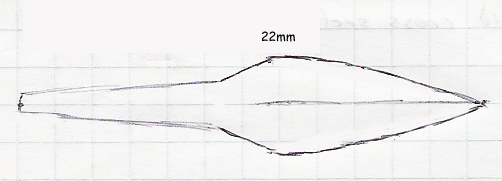 | Provenience: Kjølstad, Sør-Odal, Hedmark, Norway, c. 10th c. Museum: Universitetets Oldsaksamling, C37550 f,g,h Length: 12.5 cm |
The replica, forged from antique wrought iron. |  |
 |  |
| Drawing out one end of wrought iron billet. | Bar is cut off, its end pointed, the first rough bevel. |
 |  |
| Shoulder in. | Cut from bar, start on tang. |
 |  |
| Tang is drawn and tapered. | Finish profiling bevel, straighten. |
| Neil Peterson is an archer of some skill. It was natural for him thus to be interested in archery equipment from the Viking Age. There is one tiny problem - outside of arrow heads, there just is not much artifact evidence to go on. Bows and arrow shafts are wooden, and any wooden object is extremely unlikely to survive 1000 years in the ground. Worse still, an old bow is liable to end up as fire wood, old or broken arrow shafts re-used as useful sized pegs. None the less, Neil has taken a look at the range of arrow heads available as artifacts. The drawings at the left are from his summary, which is posted with details on the artifact sources on the main DARC web site : Viking Era Arrow Heads. The smaller sample seen here are variations on the basic hunting broad head style. It should be noted that most often there was not any information in the quoted sources on the cross section or the thickness of the various heads. Considering the majority ofthe hunting points are forged from softer wrought iron, this thickness is critical to strength. Of course without the thickness being known, its hard to estimate the probable weights of the heads. |  |
 | Now, Neil has been after me for some time to make replicas of ALL the various styles he has found in his research. As it turns out, one of my ongoing commissions is to make a batch of five arrows for the Encampment program at L'Anse aux Meadows NHSC. The various points seen to the left are the result of a couple of sessions in the workshop. I used a bit of an unusual starting point - that being the available standard mild steel bars. The order of production is reverse of the illustration, I started with # F at the bottom of the page, working first with 1 inch wide by 1/4 then 3/16 flat stock. The next pair started with 3/4 wide, again by 1/4 then 3/16. The last pair are experimenting with differing metal types. At the top (last made) is a point forged from antique wrought iron. This required forging down heavy (1 x 2 inch) to the starting 3/4 by 3/16 bar. The second point seen was forged from a scrap of low carbon steel (so called 'French' or 'Electric' iron). All the points were simply air cooled after forging. Then each was given a fast profile on the grinder. Next each was roughly smoothed to a diamond cross section, using an electric sander with a 60 grit belt. The edges have been reduced down to roughly 1.5 mm ( about 3/32 "). This is where I normally would water harden any of the steel points, then use a fine belt sander to put the actual short bevel for the sharp edge on each. |
# | MATERIAL | STOCK | WIDTH | LENGTH | BLADE | SPINE | TANG | SIZE | WEIGHT |
A | wrought iron | 5 x 19 | 25 | 125 | 65 | 4 | 60 | 10 x 4 (double taper) | 34 |
B | 'french iron' / 1005 | 4 x 21 | 25 | 100 | 65 | 3 | 35 | 6 (round taper) | 23 |
C | mild steel | 5 x 20 (3/16 x 3/4) | 27 | 130 | 80 | 4 | 50 | 8 x 4 (flare & taper) | 41 |
D | mild steel | 7 x 20 (1/4 x 3/4) | 29 | 140 | 70 | 5 | 70 | 10 x 5 (flat taper) | 49 |
E | mild steel | 5 x 25 (3/16 x 1 ) | 32 | 130 | 85 | 4 | 45 | 9 x 4 (flat taper) | 50 |
F | mild steel | 7 x 25 (1/4 x 1) | 35 | 155 | 85 | 6 | 70 | 10 x 5 (flare & taper) | 81 |


 Posts
All Comments
Posts
All Comments