This is a re-posting from this morning's contribution to the NORSEFOLK discussion group:
With full intention or not, there is an awful lot of meat in those lines. Much that bears further consideration / discussion.
A couple of people active in this specific thread have made reference to their interest in actual VA methods. To those, I would certainly refer you to:
Dan Carlson's /'
Viking Knives from the island of Gotland Sweden'
/
Also
Anglo-Scandinavian Ironwork from Coppergate by Patrick Ottaway
The 'Knives and Scabbards' volume from the Museum of London
- is also of general interest, but as it focused primarily on post Conquest materials, there are fewer direct examples of Norse objects.
As far as I am aware (please! correct me) there is no single volume available that is an overview of all Viking Age knives. (I had some vague idea about working on that project,
Knives from the Viking Age, but got absorbed into iron smelting!)

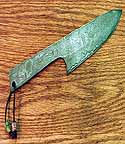
Zane is most certainly correct when he refers to full pattern welded blades being high status items. (Here I'm referring directly to what these days are called 'composite twisted core'.) So specific creation of low layer count, twisted for effect, multiple rods, in knives laid along the back of the blade. There are two very nice examples from Coppergate at York (one seen above). Those still stuck in the 'size matters' argument should note that both of these blades are only 5 inches long.
Those with direct experience working with actual
VA tools and methods (ie charcoal, small double chamber bellows, Norse anvils) will be the first to tell you of the raw difficulty of the multiple welds, long draws and folds, not to forget twisting rods without use of a bench vice.
One consideration: Are the knife sized blades pieces of 'failed' sword billets?
*I* certainly have ended up with a number of short blades when the long travelling welds required for full sized swords have ended up failing on me!
On any consideration of historical accuracy should also include a serious look at the raw metals used in the blades.
First (and most importantly) the standard metal used in the VA is
*bloomery iron*. This metal is soft, has a stringy texture with slag inclusions. Individual pieces would vary considerably in physical consistency. Carbon content would vary not only from piece to piece, but also
*within an individual bar*. We modern smiths are completely dependant on mass produced, scientifically refined, industrially consistent (cheap!) metal alloys.
(I get very aggravated by contemporary bladesmiths who have adopted bloomery iron making, building on the work of those who developed the current methods being used - and obviously not understanding them. Making bloom iron is
*not* about alloy control, it is about creating a physical texture in the metal.)
I expect that Charles uses the term 'ritually' in place of a better description 'based on experience'. The Norse were nothing if not extremely practical, and I doubt he is implying 'magic'. Our concept of 'ritual' is most certainly far different than their concept. 'What you do if you want things to work' - in our world we would call this science.
An experienced smith knows that when you quench different pieces of iron metals from orange in water, there can be changes in how it breaks when cold hammered. The exposed surfaces can have different colours and textures. Metal that is thus treated, then found to be brittle, have a surface of small crystals, and a bright, light grey colour - that material also makes for a hard / durable cutting edge. (This selection of materials based on physical appearance is the core of the Japanese traditional method.)
This wide variation in the quality of the starting metal is vastly important when creating cutting edges. Examination of a large number of individual blades from the Roman to full Medieval periods has shown that the processes of quench hardening and drawing back temper were
*not* universally applied by bladesmiths during the VA. Although this fact seems counter intuitive to a modern blacksmith, my interpretation is that the variation in metal characteristics is the reason. (Consider - How do you spark test for carbon content, a standard modern practice, in a world with no high speed grinding?)
I'm not sure that the reference to differences in late Roman bloomery furnace construction and methods is meaningful here. Even a small VA short shaft furnace is easily capable of producing raw iron blooms much lager than those typical of the few artifact blooms we have from the VA. Norse smelters were creating blooms in the 5 - 8 kg range,
*limiting* potential size. This just because of the great difficulty of attempting to work larger masses of metal down to useful bars, with only stone anvils and hand powered hammers for tools.
One thing I will remark on - that runs underneath much of what has been commented on:
Remember a modern frame of reference may not be the best one to apply to a historic object.
Why do so many small sharpening stones turn up in burials? Because cutting edges were composed of
*soft* iron - which required constant sharpening. This is obvious when you look at the condition of so many of the artifact blades - which show a distinctive 'half coke bottle' curvature, the result of repeated sharpening.
How tight
*were* those small tang knives on their handles? The truth may not be that there was some lost method used to secure the handle, but just that the handles were never 'tight' the way modern users would expect.
Darrell
PS - If you are wondering why I droned on (yet again) on this topic? I'm starting day two of a three month research and development project working to convert some 10 years of accumulated iron blooms into working bars. I am hoping for some insights into exactly some of the questions posed in this discussion.






 Posts
Posts


