Monday, December 31, 2012

Demonstrating Aristotle at CanIRON 9


I was quite honoured to be asked by Antoine Marcal * to be one of the feature demonstrators for CanIRON 9:

CANIRON IX - 2013
SCHEDULED FOR JUNE 29TH THROUGH JULY 1ST, 2013
(note corrected dates!)


TO BE HELD AT « LES FORGES DU ST-MAURICE » HISTORICAL SITE 
  Trois Rivieres, Quebec

Demonstration : The Aristotle Furnace 

The Aristotle is a small sized re-melting furnace based on historic descriptions and developed by the 'Early Iron' group. It is built of clay and about the size of a standard water pail. This furnace will covert almost any iron material into 500 - 750 gram 'puck' of carbon steel in roughly 30 minutes. This makes the system ideal for those wanting to work with a bloomery type metal, especially suited to blade making. This demonstration will cover the history of the furnace and how it is built, and illustrate several operation cycles. If time permits, at least one of the pucks will be forged to a working bar.


 Workshop : Build and Run the Aristotle Furnace
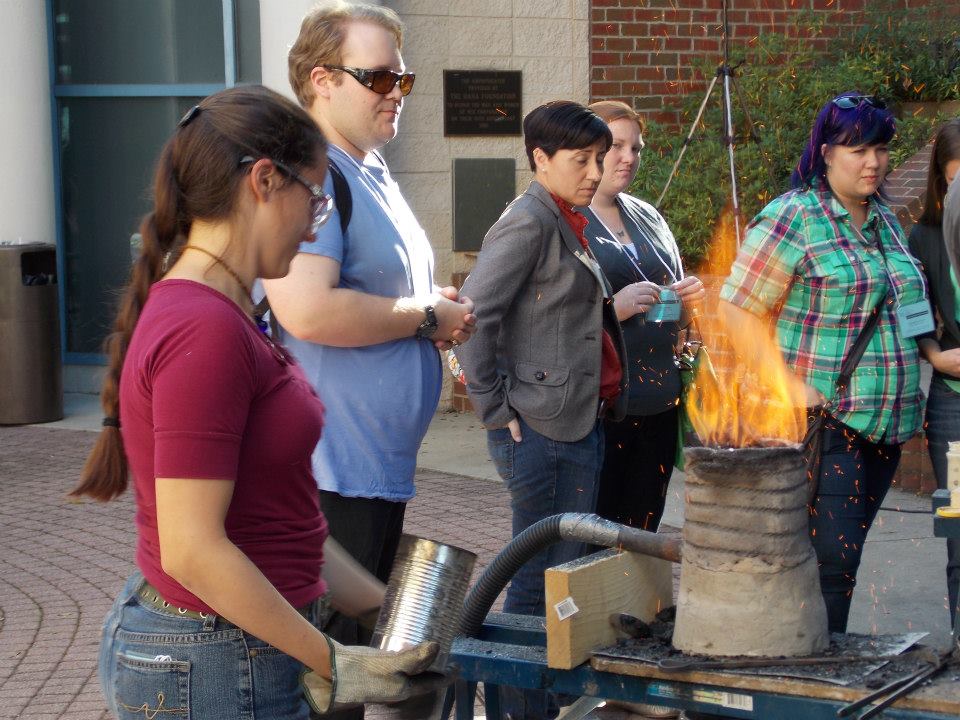

Participants in this full day hands on session will each build and then operate their own Aristotle furnace, which they then can take home.
 In the morning session, clay will be prepared, and the body of the furnace will be constructed. Into late morning to early afternoon, the furnace will be fire dried. In the afternoon session, each person will run their furnace through several cycles, each producing a carbon steel bloomery 'puck' of metal. If time and equipment permits, these can be forged down (under supervision) into working bars.

This workshop is limited to six participants (adults only please). There may be an additional materials cost. No specific blacksmithing experience is required to build and operate the furnace, but working a puck into bar requires the ability to forge weld. Participants are required to provide correct eye protection (including welding lenses), and should bring their personal forging tools. Those wanting to keep their furnaces should bring a milk crate or 5 gallon plastic pail for safe transport.


 Biography : Darrell Markewitz 

'Hector's Bane' : Bloom iron with spring steel core : 2012
The very first time Darrell picked up the blacksmith's hammer was a direct result of his interest in ancient artifact and process, while a student at Ontario College of Art in the late 1970's. Objects from the Celtic Iron Age and Scandinavian Early Medieval periods continue to influence his distinctive 'Rivendale' style.

'Celts at the Gate' : Mild Steel with decorative paint : 2008
During the 1980's he worked as an artisan interpreter at Black Creek Pioneer Village in Toronto, establishing the Wareham Forge in 1992. Along with replicas for major museum exhibits, custom designs for architectural, home and garden make the bulk of his work.

'Segmented Funeral Urn' : Wrought Iron and Copper plate : 2008'Bloom Bowl 2' : Bloomery iron : 2011

As well as decades of teaching workshops, Darrell was a feature demonstrator at CanIRON 5 and Quad State 2008. He was the organization team leader for the 2011 CanIRON 8 at Fergus Ontario. He writes extensively, through on-line blogs, web site, journal articles and formal papers.
His interest in bloomery iron smelting started in 2001, having undertaken 50 smelts since. All with a focus on experimental archaeology as a means to understand historic processes. Darrell continues as a founding and core member of the 'Early Iron' movement in North America.


* Antoine is the only other Canadian seriously undertaking bloomery iron smelting. His work tends primarily to be focused on bladesmithing

NOTE TO THOSE INTERESTED: 

Lee Sauder, leader of the Early Iron movement, will be demonstrating with an bloomery iron smelt!

Saturday, December 29, 2012

Metal Spindles?

 Or a parable about too little information - and working from photographs on the web

 The following from NORSEFOLK

1.1. Re: spindle hooks?

Posted by: "KAREN"
I have seen a photo of 3 spindles in the Dublin Museum that are from the Viking Era. They are VERY rare as the spindle shafts are made of metal, the whorls are also metal. They are so corroded I can't say if they were made by pounding or by being molded, nor can I tell if they were made in one piece or were made in 2 pieces and then fitted together.
________________________________________________________________________

Posted by: torran   Are these the spindles? http://tinyurl.com/bmkoqsw
that was from The National Museum of Ireland.
________________________________________________________________________

Posted by: "KAREN"
My memory was a color photo, one of the spindles was green as if it was aged copper or bronze.

A couple of things: the image quoted is from a blog.
The blog is at : http://playingwithfibre.blogspot.ca/2011/05/spinning-artefacts-at-national-museum.html

 For the computer unskilled, if you search via google images, use the image name, you get a link over to the larger scale image - on the source blog.
If you check the profile of writer 'eimearee', you will see she lives in Dublin Ireland. I'd suggest that maybe one of you might just e-mail her via either her profile or as a direct comment on the piece. (odds are good that finding kindred souls might be of great interest to her!)

The image by eimearee
Right off the start, eimearee does not specifically say the spindles seen are metal:

 " The following photos are from the 'Viking' display, mostly found around the Wood Quay / Fishamble St area in Dublin. "
" These teeny tiny spindles are about the same length as a crochet hook; the whorls were tiny..."

 The Woods Quay site is one of those rare waterlogged locations. This results in the preservation of organics, especially at this site both wood and leather. The same conditions are extremely poor for metals preservation, especially iron.

The larger scaled image on the blog shows more details. All the images have been reduced to black and white (I suspect for file size). This may be critical for several reasons:
1) Size? You could speculate that the key numbers are the standard 1 cm tall plastic letters many museums use.
2) Material? Extremely important! If metal (at all) are they Bronze or Iron??
This will effect the overall weight of the spindles - which directly effects the thread diameter produced.
The speculation that they are metal is based on the hooks. (They might actually be wooden??) My WAG is that if these are metal at all, they are cast bronze, not iron (based on the state of preservation). The shape of #11 especially, suggests a cast, rather than forged, object. But without a wee bit more information, that is just blind speculation.

The truly serious could just contact the museum?

Thursday, December 27, 2012

5 for 'A Holding Place'


Holding Place: A Repository of Containers and Vessels by Metalsmiths Around the World

One of the axioms of mathematics is that the container must be greater than the contained. 

" The exhibition is open to all metalsmiths, professional and amateur, advanced and beginner, around the world. All metal containers and vessels are eligible for entry. Examples include, but are not limited to, pill boxes, vases, bowls, pitchers, lockets, prayer boxes and memento mori.
As this is an online exhibition the work will only be seen via the photographs metalsmiths submit. ...
The exhibition will be curated by Beth Wicker, Co-President of the North Carolina Society of Goldsmiths in the United States, and Adjunct Instructor at Northeastern Technical College in South Carolina. Director of the exhibition is Hanuman Aspler, owner and founder of the Ganoksin project, the world's largest internet jewelry site. "


Artist's Statement:
Since the late 1970's, I have been blending experience at the forge with research into the artifacts of the ancient Norse and Celts. The result is my signature 'Rivendale' design style. My work places a strong emphasis on hand forged techniques into distinctive designs, creating one of a kind objects that are both beautiful and yet functional.
For 'Holding Place', I have selected a series of bowls that use the widest possible range of iron materials, from modern steels, antique wrought iron to my own unique bloomery iron. Coupled with a range of hot forming techniques, ancient, traditional and modern, I believe this range of work may stand apart from other submitted objects.


1) Segmented Funeral Urn (2008)

38 cm x 23 (17 kg)

The body of the urn is composed of a number of individually hand forged strips of antique wrought iron. I saw samples of a related technique employed by the Japanese blacksmith Takayoshi Komine at a workshop / demonstration two summers past. (Taka uses the method to make subtle oil lamps employed in the Tea Ceremony.) Actual historic wrought iron has been chosen for the construction because of its excellent forging characteristics and special durability. Individual scrap bars were selected for their tendency to fragment under aggressive forging. The metal itself is already some 150 years old — and should easily endure for centuries more. A fitting resting place for the memories of one past beyond us.
(see more)


2) Segmented Bowl 2 (2011)

22 cm x 18 x 9 H

The individual segments are pieces left over from torch cutting 1/8 inch thick plate used for another sculptural form. Taking a clue from a method used by Japanese artisan Takayoshi Komine, the individual segments were MIG welded together on the back. One of these weld lines was reversed, folding forward to make the central rib.  The resulting flat form was then worked hot to dish it. To finish, the piece was sealed with a spray matte varathane.


3) Bloom Bowl 2 (2011)

(roughly) 25 cm x 15 x 15 H

Unique in Canada, this metal itself was made from raw ore smelted using a direct reduction furnace based on those from the Viking Age.
The original bloom mass was quartered by hot cutting. This section was flattened under the air hammer, working at welding temperature. Only one compaction series was undertaken, intentionally to allow cracks and fissures to develop along the margins of the plate. The roughly rectangular plate was then dished hot to create the bowl's shape. The inner surface was roughly polished with a flap sanding disk. The outer surface was given a fast wire brush to remove any loose scale. To finish, the piece was sealed with a spray matte varathane.


4) Offcut Bowl (2011)

25 cm x 25 x 15 T

Offcut Bowl was created for the 'Shadowbox' show to benefit the South Grey-Bruce Literacy Council.  The individual segments are in fact off cuts left over when I was cutting up some 1/8 inch thick plate I acquired as commercial scrap. The individual segments were MIG welded together on the back, then the weld beads ground smooth. The resulting flat form was then worked hot to dish it.


5) Segmented Bowl 3 (2011)

16 cm x 12 x 9

Here a set of individual strips of flat stock were forged out from heavier bar. This hand working process results in variations in thickness and width between the individual pieces. Once forged and cut, the strips are MIG welded along one side only, which is then ground smooth. The resulting plate is then dished hot to create the bowl form. The stretching of this dishing separates the lines between the individual strips, which are still held tightly by the welds.


Full descriptions of my past work on bowl forms : 
Can be found on the Wareham Forge

Wednesday, December 19, 2012

'Stretching Hammers' - Viking Age

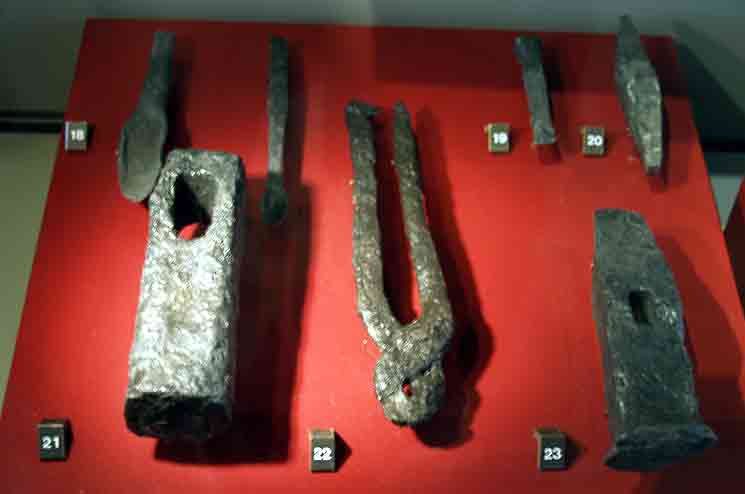
On 21/11/12 6:54 PM, Richard Furrer wrote:

What are the dates on these tools?

number 21 in particular.

(Ric pulled the image off an earlier blog posting. There is a more detailed image, with a bit more information, on my disk 'Exploring the Viking Age in Denmark'.)

The labels at the Roskilde Museum were fragmentary at best. What was there was also in (surprise) Danish.

The case section was labelled 'Lejre 900 BC - 1000 AD'
My only notes on that group say 'Hammer head on left 3 x 3 cm by 10 cm long'
Lejre, by the way, is just to the west of Roskilde. There is a very excellent  archaeological research and living history site there.

One of the things to remember is that in Scandinavia, there is not the same definition of 'Viking Age' as is used in the English speaking side. To Danes, there is an 'Iron Age' - then 'Medieval', with the break at 1000 AD.

About life size - from "the Mastermyr Find' Arwidsson & Berg 

There is a similar hammer found in the Mastermyr Tool Box (Gotland)
Number 68, described as a 'stretching hammer' (and I would agree, having made and used a replica).
3.0 x 2.1 cm by 14.8 cm long - weight at 481 gms
Note that the Mastermyr set has been recently re-dated to closer to 1150 AD.

As this puts the two tools in roughly the same weight class - and that at the very bottom end weight for forging iron, I would suggest the Roskilde Museum sample is also intended as a tool for deep dishing - maybe for bronze cauldrons.


PS: Frequent Readers may notice the pattern here. I often try to respond to e-mails with rather long replies. These however often get modified and turned into blog postings. Just a word to the wise...

PPS: It has been a month since I prepared this piece, for some reason I have not been able to get it actually published to the blog (???)
 

February 15 - May 15, 2012 : Supported by a Crafts Projects - Creation and Development Grant

COPYRIGHT NOTICE - All posted text and images @ Darrell Markewitz.
No duplication, in whole or in part, is permitted without the author's expressed written permission.
For a detailed copyright statement : go HERE