Sunday, March 05, 2023

Seeking a GRANT ?


I am undertaking a major, multi-event trip to Ireland and Scotland for the later part of this summer.
With air fares, local transportation (car hire), lodgings, meals and materials - this is going to be an expensive undertaking. At this point I am committed to the project, since I have already paid for air and booked lodgings in Ireland.
So in aid of this, I have applied to the Canada Council for the Arts, most significantly under The Jean A Chalmers Fund for the Crafts - Project Development and Research. 

There are two primary and two secondary elements :
Caherconnell Furnace Festival, Ireland
Turf to Tools 3, Scotland
and
European Archaeology Assn Conference, Ireland
Ratho Byres Forge, Scotland  

 
• I have missed the Woodford / Caherconnell event every year since it's inception in 2019. First because of a conflicting project (that was cancelled at the very last minute), following years due to COVID travel restrictions / concerns.
• Turf to Tools was started in 2014, continued in 2016, originally at the Scottish Sculpture Workshop. Due to the current situation at SSW, the final stage (object to deposit) will be mounted on Skye, still working with Eden Jolly.
• I have submitted a paper / presentation for EAA-13, which due to the raw costs of 5 days in Belfast, will be as a video / ZOOM remote.
• Since I will have to fly out of Edinburgh, I want to make a workshop / studio visit to Shona Johnson & Pete Hill, who I have worked with on other projects (notably Ypres 1919-2019)

The following is the submitted project description and supporting images :


Project Description

- Travel from rural Grey County to Toronto - air to Dublin, Ireland, public transport to rural Co. Clare.
a) Caherconnell Furnace Festival,
(lodgings and meals provided)
b) European Archaeology Assn Conference.
 required lodgings with internet for presentation day, meals
- Travel to Dublin, required overnight hotel, air to Edinburgh, car hire to rural Portree on Skye, meals.
c) Turf 2 Tools 3
 materials, lodgings and meals.
- Return to Edinburgh, required lodgings, meals
d) Workshop visit to Ratho Byres Forge in Edinburgh
- Connecting air - Dublin to Toronto, return to home.

Event Descriptions

a) Caherconnell
A gathering of Irish, UK, and European artisan blacksmiths working with bloomery iron. The direct objective is to share and further develop working skills with self made bloomery iron with other artisans. Includes demonstration / public involvement aspect.
b) EAA23
A presentation describing the interface within the ongoing Turf to Tools’ project between traditional skills, contemporary crafts, public demonstration, with archaeological research (confirms March 24).
c) Turf to Tools 3, originally conceived as a collaborative project between international artists, writers and archaeologists, ‘from the land - return to the land’, at the Scottish Sculpture Workshop (2014, 2016). This last phase undertakes the creation of a replica historic object from bloomery iron made earlier, then ceremonially depositing it into a peat bog. (Negotiations with local arts organizations ongoing.)
d) Ratho Byres Forge is one of the few architectural blacksmith’s shops in Scotland, specializing in public artwork installations.

Impact - Personal

a) Caherconnell
Direct experience with distinctively Irish traditional bloomery iron smelting methods. Introduce Canadian perspective on process, extended to finished objects. I will be the first Canadian to attend this event.
b) EAA23
Further enhance the contribution of experienced artisans to archaeological research, particularly via public demonstration of ancient / traditional techniques. I consider myself a bridge between the maker and the researcher related to bloomery iron.
c) Turf 2 Tools 3
Completion of this project, where I was the team lead.
Continue and further develop the association between Canadian and Scottish artisan metalworkers.
d) Ratho Byres
I had worked with Shonna Johnson and Pete Hill as part of the build team for their panel for the Ypres 1916-2016 (Belgium) memorial, one of about a dozen Canadians participating. Over the last decade I have increasingly been creating public sculptures, so observation of their working methods and insights will be invaluable.

Impact - Canada

- Bloomery Iron is a unique material, with properties quite different from modern industrial alloys. I remain only of only three working artisans exploring the possibilities, certainly the one with the longest direct experience. As one of the instigators of the ‘Early Iron’ movement in North America, I was instrumental in re-discovering predictable methods allowing the creation of bloomery iron, techniques which now have become widely used.
- All elements increase the international recognition of the work and contribution of Canadian artisan blacksmiths. The three main elements include work before larger public audiences.
- I continue to hold workshop sessions from my home studio, transferring hard won knowledge and experience to a new generation of artisan blacksmiths.
- I remain one of the very few bloomery iron makers who publishes working guides, ongoing research and general commentaries on their work. This continues via web site and regular blog postings, journal articles, book chapters and formal lectures.
- Specifically for this project, I intend to document all elements via a dedicated series of illustrated blog postings.
- At the conclusion of Turf to Tools, the formal description started during the earlier elements will be completed, ideally to be submitted as a journal article.

Final Note

Bloomery Iron Smelting has a place in the early history of Canada (Newfoundland c 1000 / Nova Scotia c 1650’s / Quebec c 1650’s + / Ontario c 1812 +) The earliest large commercial operations almost always started with the use of smaller test furnaces similar to the ones illustrated here. Bloomery iron was the primary metal used through the Settlement period, declining with technical innovations after 1855. Although hand forging techniques continue in use by contemporary artisan blacksmiths, all modern work is undertaken using industrial steel alloys.
The question of just how ancient to traditional iron makers created bloomery iron was uncertain at the point I started my own personal research in 2001. There are only three Canadians working consistently with these methods and metal, of which I certainly have the most overall experience. I continue to stress the importance of exploring the methods, and through object, the unique properties of this material, well beyond the principle of ‘sole authorship’.

Images

The images presented here are grouped to show differing aspects both the creation and artistic expression of bloomery iron. As stress is seen on the public demonstration aspect.
01 - 06 : Illustrating the steps of creating ‘bloom to bar’
07 - 09 : Past work showing development of textures, use of antique wrought iron
10 - 12 : Work with bloomery iron, emphasizing the unique textures.
13 : Illustrating work with students (and within the USA)
14 : The first iron smelt in Canada, the Norse circa 1000 AD (where my interest began).
15 – 16 : Work at the Turf to Tools project.

click on any of the images for a larger view
Freeing a Bloom (11/2009)
Extraction - Goderich Celtic (8/2012)
Consolidation - Quad State, Ohio (9/2008)
Splitting - ARTEfakty, Poland (9/2016)
Welding - Bloom 2 Bar (4/2012)
Working Bar - Turf to Tools - Scotland (8/2014)
Segmented Funeral Urn - antique wrought iron, copper / 38 x 23 cm (2008)
Pattern Weld detail - antique wrought iron, steel alloys / about 6 cm wide (2000)
Segmented Bowl #2 - mild steel / 24 x 16 cm (2011)
Bloom Bowl #2 - bloomery iron / 20 x 14 cm (2011)
Bloom Bowl #4 - bloomery iron / 15 x 12 cm (2014)
Hector's Bane - bloomery iron, carbon steel / 26 cm long (2012)
Student Extracts - Brown University, Rhode Island (4/2011)
Norse Iron Smelt at Vinland - L'Anse aux Meadows NHSC, Newfoundland (8/2010)

Compaction, Turf to Tools 2 - Scotland (9/2016)
Turf to Tools Bowl - bloomery iron / about 14 cm (2014)


I had been told by a friend who had served on a jury for the Ontario Arts Council that the first and last images were especially important to be striking. The first to grab their attention (on reviewing so many applications) and the last because it remained on the screen while they discussed your submission. 

This obviously was good advice - as I am two grants out of three past applications at OAC. This is the first time I have attempted a Canada Council / Chalmers submission.

Wish me Luck!

PS: No thanks at all to Blogger / Google for the huge difficulty imposed by their 'simplified' coding system. It took four complete attempts over many hours to end up with the formatting you see here.

Wednesday, March 01, 2023

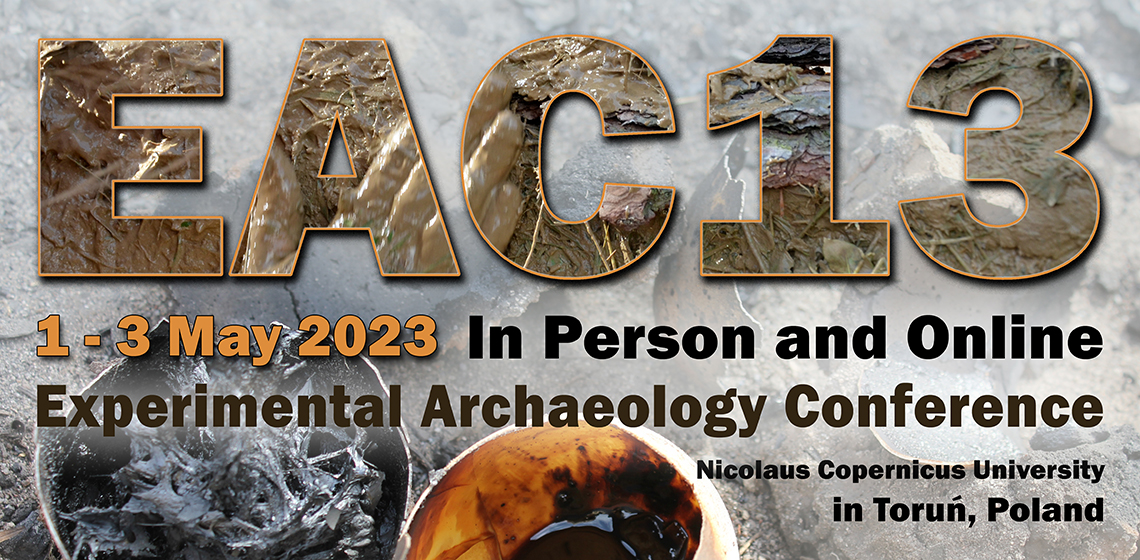
"Look at the BONES!' - presentation at EAC-13


I have submitted and had accepted a presentation (with formal paper to follow) 

for this year's Experimental Archaeology conference, EAC-13

For more information :  https://exarc.net/meetings/eac13/
 
On line viewing of the sessions is FREE
Conference organizers do ask that you do register (also free)


“Look at the Bones!” - Adding bone in a 

bloomery iron smelt

A case study of a practical experimental test.


Through 2019, much was made in the popular press suggesting that during the Viking Age, exhumed human bone had been used in the chain of production from iron ore through to finished swords. Contradicting this, considerable experience with small scale direct reduction process bloomery iron smelting furnaces indicated that at least while creating the iron itself, the effect of adding bone would be minimal, if any. To establish what kind of physical traces that might remain if quantities of bone were added during smelting, in June 2020 a full furnace build and firing was undertaken with a range of animal bones added, then the resulting debris field recorded.

The concept, design and implementation of this experiment is discussed, and how limits on methods, instrumentation and analyzing results shaped the final conclusions. This discussion suggests how even a simple experiment, if carefully recorded, can add to the body of available knowledge, and may prove insightful both educators and other investigators.

Paper – presented as video of narrated slides (prepared for internet, Q & A via ZOOM)

Tuesday May 2

Session 9 B 1

16:00 (local) = 10 am EST (Ontario)

Q & A (via Zoom)

17:30 – 18:00 (local) = 11:30 – noon EST


This will be a more formal version of the descriptions posted earlier about this June 2020 experiment - seen on the iron smelting documentation : 

Build and Smelt

Exploration


Saturday, January 14, 2023

'What Dreams They Had' - ESP 2023

 How does Canadian popular culture hope to fix it’s fantasies in place, and what confounds the current imagination?

Materials : industrial mild steel, steel cable, copper / aluminum tube (to be determined), ‘found’ objects (primarily plastic), glass
Construction : primarily fabricated & welded, limited forged elements, some small wind driven moving parts


This sculpture superficially takes the form of an Ojibwe Dream Catcher, here a circle four feet in diameter. Quite deliberately, as a refection on Cultural Appropriation, every one of the traditional First Nations concepts behind their objects are rendered incorrectly, specifically to indicate ‘European’ based contemporary Canadian distortions, forms, and concerns. Following the 'Western' concept of ‘everything has to have a function’ the piece also incorporates an equatorial sun dial.

- The scale is enormous, at four feet diameter, where the Ojibwe objects are small enough (3 - 5”) to hang from a baby’s cradle
- The overall layout and all materials are distinctively modern industrial types, where the Ojibwe objects use carefully selected natural materials.
- The external framing is made of braided steel cable.
- The framing uses 12 attachment points, being the 12 Georgian calendar months (not the Ojibwe 13 for the lunar cycle, although there are variations between individual Nations).
- The internal web is made of industrial wire grid material, not strung from flexible lacing as the Ojibwe.
- Half of this is made of perforated stamped sheeting, not actually a web at all.
- The arrangement of the interior is symmetrical and mechanical, not a reflection of a natural spider’s web as in the Ojibwa myth.
- The opening is both placed off centre, and is a geometric star pattern, not the central, perfect, circle, as called for in Ojibwe tradition.
- A large glass rendition of the planet Earth, as viewed from the Moon, and set slightly off centre, replacing  ‘One glass bead for the Creator’ placed in the exact centre (although Ojibwa tradition, this itself is Post Contact - because of the use of glass). Custom hotworked glass bead by Shannon Scollard.
- Four metal ‘spinners’ are placed at the lower frame edge, replacing a single bird’s feather (traditionally owl for girls, eagle for boys) tied to the end of the web lacing, at the centre.
(For a commentary on the background research conducted see: https://warehamforgeblog.blogspot.com/2022/12/what-dreams-they-had-background-research.html)

Specific ‘Dreams’ are represented as caught in the web. (Never depicted in First Nations objects!)
 - A cluster made of of a female and male pair of clothed ‘fashion dolls’, surrounded by plastic dollar signs and coins. This all representing the dream of Wealth and Celebrity.
- An industrial form disk containing a ring of glass tubes - directed inwards to a bundle of four glass bubbles. This a representation of the dream of Fusion Power (and by extension, the dream that somehow Technology can save us from impending Climate Change.
- A toy pick up truck, wrapped in an electrical cord, it’s end hanging down. This representing the compelling dream of the Electric Vehicle, now blunted by the American auto maker’s insistence in producing large sized vehicles (at huge costs).
- A possible fourth representation (applied to the bottom quadrant) would be a plastic doll’s house. This representing the current greed fueled dream of the Monster House as a profit taking scheme.  (Once the framing is created, a decision will be made on including this element against how cluttered the piece may look.)


The equatorial sun dial slants forward from the circular main frame.
- The wide steel band to mark the passing of time is scribed (hot punching) with hours running from 5 AM to 9 PM - sun rise to sun set on the Summer Solstice (June 20). This band would be made from 1/4 thick by 3 inch wide steel. If the exposed top edges (at roughly 24 + inches above ground level) are considered a safety problem, the ends can be capped with a short length of horizontal steel pipe.
- The material for the gnomon rod will be determined by tests of available materials. The ideal would be a rod of coloured glass or plexiglass (this second less susceptible to vandalism). The intent is to mount a small solar powered LED in the upper socket, so providing glowing illumination at night. Should this not prove feasible, the rod will be replaced with copper or brass.
-This whole element is set at the 44 degree angle required for the latitude of Elora.

As the exact position of the installed sculpture is unknown, the base mount needs to be able to be adjustable to account for the E-W alignment required for the sun dial to function. The bottom base is a flat plate welded in place above the low framing (2 inch wide angle) required to allow the sculpture to be bolted to the existing plinth. A second steel plate is welded to the sculpture framing itself. These two plates are flush mounted, secured primarily by a thick central bolt to allow rotation. Additional holes will be pre-drilled in this top plate. Once the correct compass setting is determined, an additional set of holes and securing bolts will be made through the bottom plate. Drilling these 1/4’ diameter holes represents the main work involved in mounting the sculpture.

As with past years this sculpture is presented as a design rough. It is unlikely to be actually constructed unless selected for inclusion.

Friday, January 13, 2023

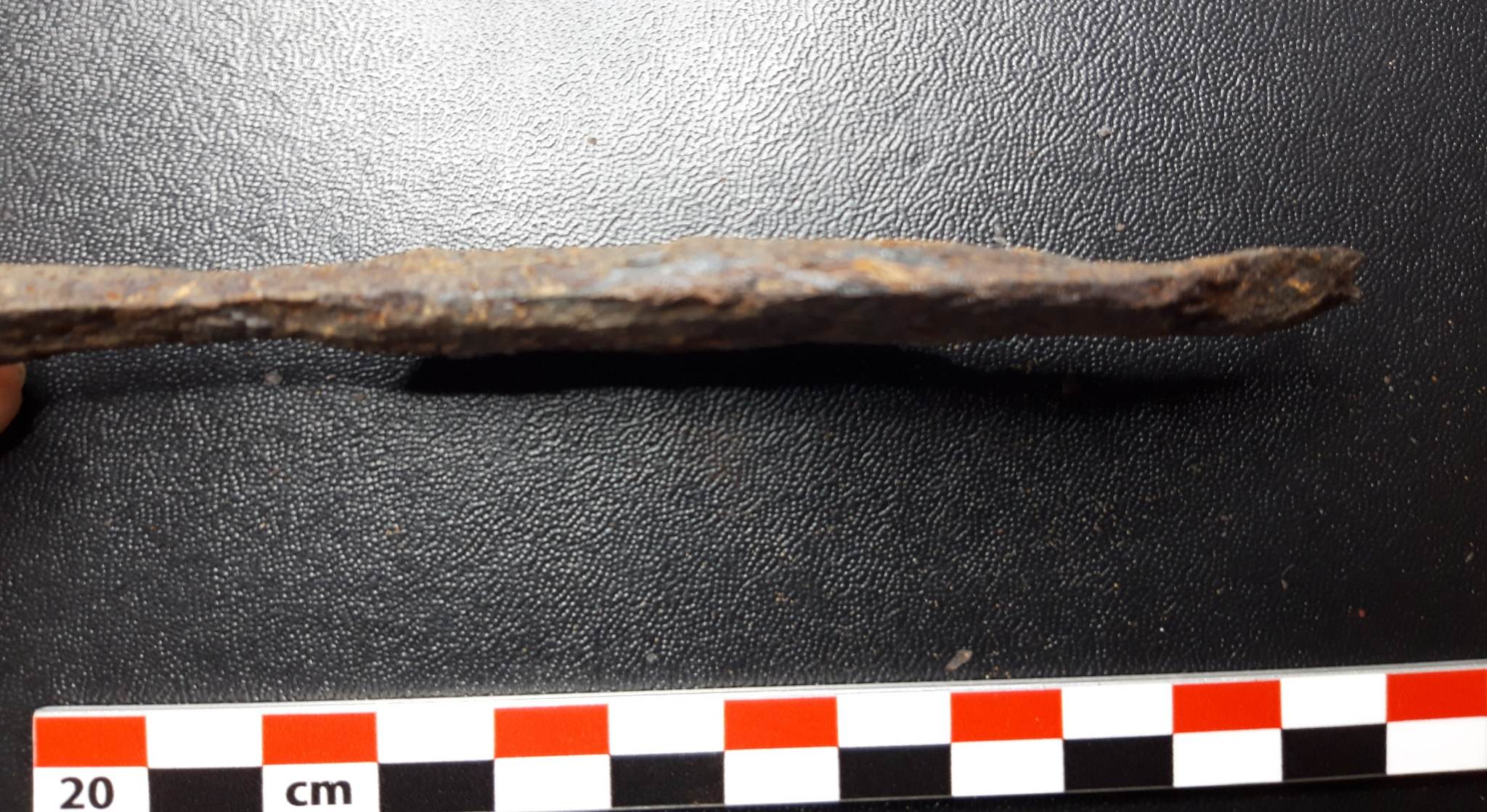
Blade find from Belgium??


On 2023-01-13 6:36 AM, "C..." * wrote:

 I am a metal detectorist based in Belgium. I stumbled across your website and hoped maybe you can help me?
I recently found an iron blade, which from my own experience looks very old. It looks like forged iron, feels like it weighs a lot for a small object.
I was wondering if you can advise me of an approximate period it might be from and its use? I have been trying to research it online, it reminds me of a small Viking period knife from the examples I have found. Maybe from the 9th -10th century, so I was thinking maybe mid to late Medieval. I could be completely incorrect though. When I found it a part of the end crumbled off, I believe it was a bit more pointed.

The blade has an interesting slight curve. The area I found it in has human history dating back thousands of years.

I thank you in advance for any help you can provide. Please find some photographs attached.

The original request e-mail, highlighted in bold are the elements that I flagged when I first read it.
Below is my reply, with images provided by "C..." inserted as considered.

Well - a lot to unpack here. Sorry to say I may not prove that helpful. I warn you that you may know much of the following already!


Belgium?
That is likely your first problem. Two World wars that chewed up most the ground, and left so much stuff buried. Very small country, intensively populated and farmed - for like forever...

Find location may provide you with some clues - my advice is first to check the history on the piece of ground where you uncovered the object. If the result is 'too much history to narrow occupation' that pretty much ensures that unless there are significant marks or design to the object, you are just not going to narrow it down.


Iron?
Ok - not copper alloy, but...
One possible narrowing would be distinguishing between post Industrial (c 1855) mild steel, and earlier forms of wrought iron as the material.
Wrought iron - especially very old wrought iron, corrodes in a different and distinctive way. The slag inclusions from its creation in bloomery furnaces often causes it to erode to display a linear grain. Steel on the other hand, more typically erodes with flake like patterns.
Looking at the object, it *appears* more like a 'modern' steel.
You could check this using a destructive spark test - or better still via a (costly) lab test, both for carbon content. Wrought iron has basically no carbon. 


One warning is that the level of corrosion to the object appears limited, not what I would expect from centuries buried. As you surely know, the condition of the ground at location of discovery is a big clue there.

Profile?

First thing that jumps out is the cross section. This is a 'sabre' grind - with a rectangular back, then the angled bevel to the cutting edge. Viking Age blades are basically all V profile grind. This to get the most function out of the least amount of metal. A sabre grind requires more material, but does result in a stiffer blade.This remains the case through the Medieval period - again shifting into the 'early Industrial = 1600's'.

One of the things I do to help me understand photographs is reduce one down to 'size as' and print it off. To help visualize what the original object shape was, I then will extend the lines into what seems a logical profile. 
 
Reduced to life size @ 13.5 cm / 8 cm blade

 The object has an extremely wide and thick back compared to a sharp taper to the cutting edge. There does not seem excessive amount of material missing on the blade side (ie - corrosion or wear effects). Attempting to pull measurements off the images, the back is about 5 mm thick and about 10 mm wide, with the bevel about 15 mm wide. As you mentioned, there is a clear blade side concave curve. (Which has to be intentional, the forging process naturally flexes the blade to a convex curve!) This curve has to relate to the function of the tool. The point, extending the existing lines forward, is very thick and blunt - again obviously for strength. 
 
(showing cutting edge)

All this would intentionally create a tool that was extremely strong, but a relatively blunt cutting edge. The curve would suggest use in a sliding cut action - not a straight chopping direction. Given the total blade length at about 8 - 9 cm, the overall result is an extremely rugged tool - far more than is required for the length. But also one that would not have a very effective cutting edge. (Yes - even with some of the edge material obviously corroded away).

The tang is very short, remains at about 4.5 cm. Good chance it just has been corroded or broken away however, so need to be a bit careful about applying too much to this. That said, it does not taper very much down it's length, which may suggest most of the original remains. Not much (remaining?) for secure mounting into a handle. It does appear thicker at the extreme end than at the joint to the blade however, and is clearly rectangular (close to) rather than circular in cross section. This all may indicate something about the original mounting method. A lot of Norse knives have rounded tangs - which passed through a hole drilled or burned into the hilt material, then secured with a metal disk as the end of the tang was peened over like a rivet.


Overall, I see a short, very strong but blunt blade, more likely to be made from a steel alloy.
My first guess would be part of an agricultural tool - like a tooth from a drag harrow.
Although I admit I am not familiar with the design requirements, another possibility could be some kind of pruning or hand harvesting tool (apples?).

If you can find someone (university?) who has a hand held XRF analyzer, this is basically micro destructive and would give you the relative elemental composition of the material. That might be the easiest way to determine relative technology of the metal itself.

Sorry - this from my computer desk and working from such limited information. May not be the commentary you were hoping for?

Good luck with this - and keep looking! Here in Ontario, our history is so relatively shallow (any iron object around my area will be no older than about 1615) - and in comparison so thin. My own home at Wareham was settled (by Europeans) about 1840 - 50. The First Nations just avoided this area, as other than deer and small game, there were no resources available that made the area worth exploiting.


* The images included here are "C..."s. I have intentionally omitted his last name. 

(Note the provision included on the bottom of any longer e-mail replies from me : " To those receiving long detailed replies to specific questions : My own written response may be edited and re-used as a blog posting."


February 15 - May 15, 2012 : Supported by a Crafts Projects - Creation and Development Grant

COPYRIGHT NOTICE - All posted text and images @ Darrell Markewitz.
No duplication, in whole or in part, is permitted without the author's expressed written permission.
For a detailed copyright statement : go HERE