(with assistance by Neil Peterson)
It turns out there was a major error on my earlier postings on the DARK Dirt One ore analog. This was suggested by Jesus (on Early Iron Group), who also had worked with the Spanish Red iron oxide material. He questioned (correctly) my published figure of 96.5 % Fe2O3 content.
It turns out this was the result of the typical transfer of lab test into full sized production. When Gus did his initial bench tests, he was focusing on material availability and on gross physical properties. What we could purchase, and how easy it was to mix and handle the resulting mixed material. He had purchased a number of iron oxides from a local pottery supply company (Pottery Supply House).
The company sells :
Black Iron Oxide - Fe3O4 = 99.3 % (as Fe2O3 103.5 %) / SiO2 = .2 % (@ $5 / kg)
Yellow Iron Oxide - Fe(OH3) = (typical as Fe2O3 86 % ) / SiO2 = ? (@ $12.25 / kg)
Red Iron Oxide - Fe2O3 = 96.5 % / SiO2 = 2 % (@ $12.50 / kg)
It had been decided at the test stage to use the red oxide as it most closely resembled the iron chemical form created after roasting a natural ore.
These are typically much finer powders ( listed as average 1.5 microns) than are really useful in the smelter. Others who have attempted to use oxide powders have reported the venting of gas out of the smelter tends to blow this fine material right back out again. Our solution was to mix a small amount of whole wheat flour (regular baking flour) as an organic binder. The decision to add a small amount of silica was based on the almost total lack of that component in the sample material. (Required for generating the required slag bath).
DARK Dirt One:
Oxide - 80%
Silica - 10%
Flour - 10%
When it came to purchasing full sized lots (as 25 kg bags), the raw cost of the material became a major factor. Gus had also supplied the first materials for a full scale test The error was in not checking that the cheaper 'Spanish Red'
had the same chemical composition as the 'red oxide' used for the bench tests:
'Spanish' Red Iron Oxide - = 81 % / SiO2 = 5 % (@ $5 / kg)
The dry powders were mixed roughly by hand, then enough water added to make a dough like paste. This required the addition of about 50 % by weight of water. The paste was dried before it was then broken up for addition to the smelter.
As added to smelter:
Solids - 90%
Water - 10%
So in correcting the composition at the various stages of mixing DARK Dirt One, we need to refer back to the specifications of the 'Spanish Red' source material (product number - MIOR) :
Fe203 - 81 %
SiO2 (silica) - 5 %
Al2O3 (alumina) - 2.6 %
CaO (calcium oxide) - 2.3 %
MgO (magnesium Oxide) - 2 %
LOI * ('loss on ignition' - water & C02) - 7 %
At the mixing phase (not considering water) :
Fe203 - 64.8 % (81 % of 80 %)
SiO2 (silica) - 14 % (10 % plus 5 % of 80%)
Al2O3 (alumina) - 2.1 % (2.6 % of 80 %)
CaO (calcium oxide) - 1.84 % (2.3 % of 80 %)
MgO (magnesium Oxide) - 1.6% (2 % of 80 %)
That suggests the Fe total is on the low side. With only 64.8 % Fe2O3, that means only 45.4 % Fe available.
Our original samples of primary bog ore (from L'Anse aux Meadows and St Lunaire) were tested :
St Lunaire (by M. Burnham):
Fe203 - 64.04 % (80.7)
SiO2 (silica) - 2.24 % (2.8)
Al2O3 (alumina) - 3.35 % (4.2)
CaO (calcium oxide) - .69 % (.9)
MgO (magnesium oxide) - .08 % (.1)
Mn0 (manganese oxide) - .62 (.8)
On this sample, there was LOI of some 26 %. That suggests for easy comparison, the numbers should be really be adjusted upwards (the second figures). If considering the LOI potential in the analog (about 20 % in flour and water) the DARC Dirt One is a very close mimic of the St Lunaire material.
L'Anse aux Meadows (by R. Hansen)
Fe203 - 89.5 %
SiO2 (silica) - 1.24 %
Al2O3 (alumina) - 2.45 %
CaO (calcium oxide) - .47%
MgO (magnesium oxide) - .05 %
Mn0 (manganese oxide) - 5.33
There is another variable to be considered when comparing total ore additions to a furnace and comparing the use of DARC Dirt One with other ore types. As the material is not roasted before use, there is a significant amount of the recorded weight contained in volatiles - in this case water and the flour binder. I would suggest we should be at least subtracting the water weight (about 10 %) from our yield calculations. So we really only are putting in 90 % of the 20 kg as actual 'ore' - and of that only 81% was actually the Fe2O3.
From the working (charge) weight of ore - the total iron oxide content is only 64.8 %.
We should be amazed we got anything, as this is right at the bottom limit on Fe concentration normally considered suitable for our type of smelting equipment and process.
From our last test (June 14, 2008) thats:
(Chemistry less water)
Fe2O3 = 64.8/.9 = 72% (Fe = 50.4%)
SiO2 = 14/.9 = 15.5%
Al2O3 = 2.1/.9 = 2.3%
CaO = 1.84/.9 = 2%
MgO = 1.6/.9 = 1.8%
(90 % of 20 kg) = 18 kg (removing weight of water)
(80% of 18 kg) = 14.4 kg (working weight of Spanish Red)
(81 % of 14.4 kg) = 11.7 kg total Fe203 added
(70 % of 11.7 kg) = 8.2 kg as actual iron added
Of which we got back 1.8 kg as bloom.
We normally compare ore weight against bloom, so our 'relative' yield would be 1.8 bloom from 16 kg working ore = 11 %.
If we wanted to spin this, we could compare Fe in against Fe out - 1.8 bloom from 8.2 available iron = 22 %
I am quite happy, that even despite this error in record keeping, the analog is a splendid success. It has done exactly what we wanted - provided a material which mimics primary bog ore in field tests, and which at the same time can be easily changed to duplicate specific chemical contents. The cost is relatively cheap (about $50 per smelt), and the source materials widely and easily available.
* (Thanks to Tim for gently pointing out what 'LOI' means to me - thats 'loss on ignition'.)
Special thanks to Gus Gissing of Harder-Gissing Machining for doing the initial materials samples and donating the first raw materials.
Wednesday, June 25, 2008


Tuesday, June 24, 2008
Report on June 08 Smelt
I have formatted up the smelt data report and re-worked my initial report seen here (now with images) on to the main Wareham Iron Smelting site.
Go on to see the reports
HERE
Note that I still have to put together a version of the report on the slags and post it to the web site (those specific links will not work yet)

Go on to see the reports
HERE
Note that I still have to put together a version of the report on the slags and post it to the web site (those specific links will not work yet)

Saturday, June 21, 2008
Meteors in Forge and History
Do you typically find meteors containing pure iron ore? How pure
typically?
Can a meteor be worked without much further smelting, or does the
metal still need to be pulled out of the rock to work it?
Could you cold hammer meteoric metal into a tool / dagger without
actually heating it in a forge, or would it be practically useless?
Just some questions from an enquiring mind!
Scott
(I had this question forwarded to me, originally posed on the Eldormere discussion group. I don't actually get this discussion group directly (volume interfering with business communications). My wife this been forwarding this topic thread to me however. The original request from Scott was directly about working a found meteor into some kind of object.)
Unlike the other people who made comments, I have actually forged meteor iron myself.
Objects made from meteors are easy to distinguish in the archaeological record, from the per centage content of nickel. Typical meteor nickel contents will range from 7 - 15 %. It was not possible to make 'artificial' alloys with this high a nickel content until the late 1800's. Some of the earliest iron objects in existence (the dagger in King Tutankhamun circa 1300 BC tomb a striking example) are in fact made from this non terrestrial source of metal. Cold worked meteor iron is found in Inuit contexts as well. One surprise in the sample of knives in the collection of the London Museum is that roughly 15 % show some traces of nickel content (hence most likely the inclusion of meteor source materials)
Metallic iron does not naturally occur on the earth's surface - period. There are two exceptions, the significant case being masses of various sizes that are the remains of meteors. The first human smelted iron objects date back to roughly 2500 BC (+ / -), but iron does not become a major material till much closer to the 500 BC time frame. The earliest iron production appears to be centered out of what is modern day Turkey. There is considerable debate currently on just how humans ever figured out how to convert iron oxide ores (essentially rust) into useable metal. The Greeks made only limited use of iron, it was the Celts (about the same time frame) who were about the first culture to be based on iron, especially as weapons. In any case, the creation of a workable iron bloom from iron ore was (and still remains) a challenging and resource intensive effort. Iron was 'expensive' on many levels, and not the wide spread material it has become in the modern era. During the Viking Age, the average 'load per person' was closer to 2 kg each (one axe, one knife, plus your share of the household cookware or boat rivets).
First - the metal in nickel iron meteors will vary considerably in both metal content and more importantly in physical structure. Nickel in an iron alloy serves to toughen the metal, making it more resistant to changing shape. This applies even at the hot forging stage, so considerably more effort is required to hammer form even modern low nickel alloys. (A typical modern stainless steel is likely to have between .5 to maybe 2 per cent nickel.) This means there is a potential problem forging meteor metals using early blacksmithing equipment, using these smaller and lower heat charcoal fires and on extremely small anvils. (The two typical ways to deal with rigid metals is to either increase the forging temperature - or use a bigger hammer.)
The second problem is the physical structure of the meteor itself. A small piece is going to be full of stress cracks after its passage through the atmosphere and the impact with the earth. On the two occasions I have attempted to forge small meteors (roughly half walnut sized) the material almost instantly started to fragment apart. I had no solution to this problem, as the small pieces were too hard to manipulate. If they had been larger, it might have been possible to forge weld the material back into a solid mass. This process might have proved easier in charcoal, despite the lower heat available. The technical reason is that nickel has a serious problem absorbing sulfur - a typical impurity in coal. My solution to the fragmentation of the small pieces was to incorporate them inside a layered steel billet. This is illustrative, as most nickel alloys found in an Early Medieval context are in fact found as part of the layers in pattern welded blades.
If the meteor is large enough, the centre of the mass has no time to overheat during its short passage through the atmosphere (even though the exterior may be burning off and then subjected to huge energies on impact). These larger masses could - and historically were - broken up into chunks small enough to be worked by the smith. I have a slab of a huge (many tons) meteor that impacted in Kenya, eons ago. This piece is roughly 3 / 16 inch thick by 2 x 3 inches, and is clear solid metal. (I had a chance to purchase a 'short sword' sized billet of the same material, and still kick myself for not making the investment.) Such pieces are sold by the gram - and are considered a specialized jewelry material to modern artisans. (That smaller piece cost me about $100.)
So - getting back to Scott's original question:
If you were an Saxon farmer, and you dragged out a head sized mass of iron under your plow (which by elimination would have to be of non terrestrial origin) - you would suddenly be a RICH farmer. Working the metal would be extremely challenging for the local blacksmith, given the nature of the material and the limitations of the equipment of the times. Given the inherent rigidity of the metal (and its curious resistance to rusting) the most likely use of the metal would be for weapons making.
Oh - I should note that the whole 'streaks in the sky to rocks on the ground' connection was actually NOT made until the middle 1800's. The whole concept of a 'sky stone' would have been completely unknown (and unthinkable) to the Medieval mind. This is a fiction created by modern fantasy writers.
Friday, June 20, 2008
June 08 - On Slag Balances
Please also refer to the June 25 Post - ERROR CORRECTION for changes to some of the basic data reported below.
At the Heltborg symposium, metallurgist Arne Espelund stressed several times that he considered measurements of the slags produced during an iron smelt to be be critical to evaluating the process. We rarely actually do this, as the raw mechanics (and general chaos) of an experimental smelt in the field make exact measurements difficult, if not totally impossible.
That being said, I was presented with a unique opportunity with the last smelt here in Wareham. This smelt was inside our standard clay cobb 'Norse short shaft' style smelter, and was a full scale test of the 'DARC Dirt 1' bog ore analog material. (See Monday's entry)
In brief:
Charcoal consumption - average of 10 minutes per 1.85 +/- kg
Air rate - 90 - 95 KpH = 750 - 800 LpM
Ore charges - roughly 1 : 1 to charcoal (2 kg per charcoal bucket)
Total ore added - 20 kg
This then represents most of the input numbers. The most important is the total ore addition. This needs to be modified by the water content of the ore. That was determined by taking a 500 gm sample and baking it in a propane gas forge at roughly 950 C (by colour) for about 10 minutes. The sample was then again weighed - the result was a net loss of 47 gms, or the sample being roughly 10% water.
The ore analog itself is made up of a mix of 80% 'Spanish Red' iron oxide, combined with 10 % silica sand and 10% flour. The Spanish Red itself is roughly 96.5 % Fe2O3 with 2 % SiO2 (no data on the balance)
So of the 20 kg ore added, 2 kg was water, leaving 18 kg remaining.
Of that 18 kg, a further 1.8 kg was the ( inert ) flour, leaving 16.2 kg material.
Of this, 15.6 kg is the iron oxide, and there is .3 kg of silica.

Now this smelt was quite unusual, in that there was extremely little effect on the structure of the smelter itself. The image above shows the inside surface of the smelter, with the area around the tuyere in the upper right.
First, there is very little erosion of the wall material. The area above the tuyere, normally sustains damage, but in this case you can see that the wall has hardly been effected. Curiously, what erosion that took place was just bellow the tuyere. The tuyere itself was also only slightly effected, and other than a slight rounding of the square tip, still remains the same distance proud of the wall surface as at the start of the smelt.
Second, very little material, either slag or partially sintered ore, can be seen remaining attached to the inner wall surface. In many past smelts, a considerable build up of these two materials can be seen.
As this was a newly constructed furnace, it proved possible to gather, sort and record the various slag types produced over the smelting process. The furnace was constructed on a relatively clean base of course sand, allowing any related debris to be easily distinguished. After the smelt, the largest pieces were gathered, and sorted by eye into types. All the remaining debris, including ash and unburned charcoal, where then passed through a 3/16 inch (about 4 mm) screen. Next a magnet was passed through the remainder, extracting any pieces containing enough iron to allow attraction. These were measured separately. The remaining larger pieces were then sorted by eye, using the same skills used to daily clean clinker from my forge fires. Any pieces of slag much larger than about 1.5 cm were sorted by type. (So there will be some loss of smaller particles)

This smelt had a major 'self tapping' event occur late in the sequence, during the last stages of the burn down phase. This slag was fluid, dark olive / black and proved to have no magnetic quality.

As the bloom was extracted, a mass of hard slag remained attached. This material (we call 'mother') cools much more quickly than the iron bloom. It is also brittle, and is shattered off the bloom under the effect of hammering on a wooden stub during the initial consolidation step. Generally this material is quite dense, and a medium matte grey in colour. Some portions of it may prove magnetic (fragments broken off the bloom). Most of the pieces are walnut to fist sized. As this work station is a grassed area just to the side of the smelter platform, any fragments smaller than about 3 cm were surely not recovered.

Considerable slag material remained both inside and scattered around the smelter after the bottom extraction of the bloom through the tap arch. This material would have formed the bulk of the slag bowl. These pieces are also a dull medium grey, and often include some imbedded charcoal and ash. Generally the pieces are quite irregular and range around 'walnut' sized.
The total weights of the collected slags:
Magnetic 'Gromps' - .5 kg
Tap slag - 3.2 kg
'Mother' - 2.3 kg
Bowl pieces - 6.6 kg
TOTAL COLLECTED - 12.6 kg
The bloom itself for this experiment is somewhat smaller than our usual. One factor here is that the weight was taken at a later step in the consolidation process than what is normally the case. (Standard practice is to make a single consolidation heat, striking off the majority of slag 'mother'. In this case, the bloom was subjected to two additional heat / hammer sequences.) The bloom reacted well to hammering, but was somewhat 'lumpy' in texture. Through spark testing, it appears to have some low carbon content (roughly equal to a mild steel).
Weight of Bloom - 1.9 kg
TOTAL INPUT - 16.2 KG (oxide 15.6 / silica .3)
TOTAL OUTPUT - 15.5 kg (slag 12.6 / bloom 1.9)
This looks pretty close to matching, assuming a reasonable amount of slag material lost in collection and the rough sorting process used.
At the Heltborg symposium, metallurgist Arne Espelund stressed several times that he considered measurements of the slags produced during an iron smelt to be be critical to evaluating the process. We rarely actually do this, as the raw mechanics (and general chaos) of an experimental smelt in the field make exact measurements difficult, if not totally impossible.
That being said, I was presented with a unique opportunity with the last smelt here in Wareham. This smelt was inside our standard clay cobb 'Norse short shaft' style smelter, and was a full scale test of the 'DARC Dirt 1' bog ore analog material. (See Monday's entry)
In brief:
Charcoal consumption - average of 10 minutes per 1.85 +/- kg
Air rate - 90 - 95 KpH = 750 - 800 LpM
Ore charges - roughly 1 : 1 to charcoal (2 kg per charcoal bucket)
Total ore added - 20 kg
This then represents most of the input numbers. The most important is the total ore addition. This needs to be modified by the water content of the ore. That was determined by taking a 500 gm sample and baking it in a propane gas forge at roughly 950 C (by colour) for about 10 minutes. The sample was then again weighed - the result was a net loss of 47 gms, or the sample being roughly 10% water.
The ore analog itself is made up of a mix of 80% 'Spanish Red' iron oxide, combined with 10 % silica sand and 10% flour. The Spanish Red itself is roughly 96.5 % Fe2O3 with 2 % SiO2 (no data on the balance)
So of the 20 kg ore added, 2 kg was water, leaving 18 kg remaining.
Of that 18 kg, a further 1.8 kg was the ( inert ) flour, leaving 16.2 kg material.
Of this, 15.6 kg is the iron oxide, and there is .3 kg of silica.

Now this smelt was quite unusual, in that there was extremely little effect on the structure of the smelter itself. The image above shows the inside surface of the smelter, with the area around the tuyere in the upper right.
First, there is very little erosion of the wall material. The area above the tuyere, normally sustains damage, but in this case you can see that the wall has hardly been effected. Curiously, what erosion that took place was just bellow the tuyere. The tuyere itself was also only slightly effected, and other than a slight rounding of the square tip, still remains the same distance proud of the wall surface as at the start of the smelt.
Second, very little material, either slag or partially sintered ore, can be seen remaining attached to the inner wall surface. In many past smelts, a considerable build up of these two materials can be seen.
As this was a newly constructed furnace, it proved possible to gather, sort and record the various slag types produced over the smelting process. The furnace was constructed on a relatively clean base of course sand, allowing any related debris to be easily distinguished. After the smelt, the largest pieces were gathered, and sorted by eye into types. All the remaining debris, including ash and unburned charcoal, where then passed through a 3/16 inch (about 4 mm) screen. Next a magnet was passed through the remainder, extracting any pieces containing enough iron to allow attraction. These were measured separately. The remaining larger pieces were then sorted by eye, using the same skills used to daily clean clinker from my forge fires. Any pieces of slag much larger than about 1.5 cm were sorted by type. (So there will be some loss of smaller particles)

This smelt had a major 'self tapping' event occur late in the sequence, during the last stages of the burn down phase. This slag was fluid, dark olive / black and proved to have no magnetic quality.
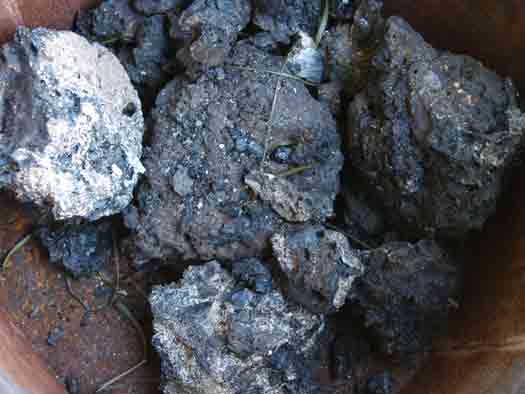
As the bloom was extracted, a mass of hard slag remained attached. This material (we call 'mother') cools much more quickly than the iron bloom. It is also brittle, and is shattered off the bloom under the effect of hammering on a wooden stub during the initial consolidation step. Generally this material is quite dense, and a medium matte grey in colour. Some portions of it may prove magnetic (fragments broken off the bloom). Most of the pieces are walnut to fist sized. As this work station is a grassed area just to the side of the smelter platform, any fragments smaller than about 3 cm were surely not recovered.

Considerable slag material remained both inside and scattered around the smelter after the bottom extraction of the bloom through the tap arch. This material would have formed the bulk of the slag bowl. These pieces are also a dull medium grey, and often include some imbedded charcoal and ash. Generally the pieces are quite irregular and range around 'walnut' sized.
The total weights of the collected slags:
Magnetic 'Gromps' - .5 kg
Tap slag - 3.2 kg
'Mother' - 2.3 kg
Bowl pieces - 6.6 kg
TOTAL COLLECTED - 12.6 kg
The bloom itself for this experiment is somewhat smaller than our usual. One factor here is that the weight was taken at a later step in the consolidation process than what is normally the case. (Standard practice is to make a single consolidation heat, striking off the majority of slag 'mother'. In this case, the bloom was subjected to two additional heat / hammer sequences.) The bloom reacted well to hammering, but was somewhat 'lumpy' in texture. Through spark testing, it appears to have some low carbon content (roughly equal to a mild steel).
Weight of Bloom - 1.9 kg
TOTAL INPUT - 16.2 KG (oxide 15.6 / silica .3)
TOTAL OUTPUT - 15.5 kg (slag 12.6 / bloom 1.9)
This looks pretty close to matching, assuming a reasonable amount of slag material lost in collection and the rough sorting process used.
Subscribe to:
Posts (Atom)




 Posts
Posts


