"The Canadian Glove Museum in Point Leamington, Newfoundland recently contacted OABA requesting a set of bona-fide blacksmith gloves to add to their collection as they are expanding the collection to include more gloves connected to traditionaltrades and skilled craftsmanship. They are requesting "a retired pair connected to a Canadian blacksmith, demonstration, major commission, long career, or teaching story.A well-used pair with visible wear and a short explanation of how the gloves were used would be especially meaningful."

A Canadian Blacksmith...
Scope of Work...
As a Teacher...
As a Demonstrator...
A Commission - in Newfoundland...
From the mid 1990's I have had a direct association with Parks
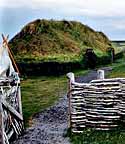
Canada at L'Anse aux Meadows NHSC. I would be commissioned by Parks
to design, construct and implement the 'Norse Encampment' living
history program now seen at the site. This would include both the
initial staff training and many follow up visits over the years (the
most recent in 2023). The original presentation required the
creation of roughly 150 detailed objects, and dozens more have been
made by myself since.
In 2000 year I designed and delivered the college level program
'Interpreting the Viking Age' in association with the College of the
North Atlantic and the Viking Trails Tourism Assn. at St Anthony.
This six week course for adult students would provide the background
training for the 'Norstead' attraction.
In 2008 I was commissioned by Parks Canada to create a set of
working replica Viking Age ship building tools, This included axes,
adzes, chisels, a saw and drills. As research, I would travel to
Denmark to the Viking Ship Museum in Roskilde and the Nation Museum
in Copenhagen to view artifact prototypes.
As part of that trip, I would be the only North American invited to
participate in the 'Iron Making at Thy' symposium, a practical
workshop in bloomery iron smelting. These specific gloves were
purchased originally for the needed hand protection working with
these furnaces.
Back in Canada, the creation of the axes for this commission would
require repeated forge / hammer welding. This process, often seen in
images for the dramatic sparks produced, again requires hand
protection, particularly for the left, holding, hand. Again this
pair of gloves was used.

In 2010, I would return again to L'Anse aux Meadows, this time to undertake a full re-creation iron smelt (meaning using all Norse equipment and clothing). Working with the local staff interpreters, it is worth noting that this was the first time iron had been successfully made at L'Anse aux Meadows in 1000 years! This pair of gloves was again employed, not being that much different from a potential Viking Age type.
Looking at the Wear...
Normal practice (for me at least) is to leave the right hand bare,
to ensure proper control of the hammer. For that reason there is
often more wear to the left, as it is more frequently used, and this
is seen in this pair. A split seam on the left thumb was covered
with a loop of common hockey tape while welding axes (and yes - I
discovered this hole when I got a burn!). A second spit (not
covered) is seen on the left index finger.
As the left hand can be exposed to the extreme heat of the forge -
especially during forge welding, this will both harden and shrink
the leather. Eventually this will result in a lack of flexibility in
the grip which becomes a problem while working. Comparing the two
gloves, this shows as both discolouration and the condition of the
leather on the left hand.
I would 'retire' this pair of gloves from normal working after the
2010 smelting event. I've kept them to have an additional pair
available, even if not in perfect condition, for workshop events. As
I have fairly small hands, getting gloves that fit correctly is
sometimes a problem. Typically I replace my working gloves about
every two / three years - normally due to damage to the left side.
(Meaning a lot of mis-matched right hands kicking around the
workshop!)
It might be of some interest that right glove has the original price
sticker still in place = $33.99. That would have been in 2008 for
comparison. I had considered these gloves, which had a good fit for
me, well worth the price.
The cuff of each has my 'three lines & three dots' maker's mark
inside. This primarily from wanting to keep them sorted at the
Danish smelting event.
I appreciate that this pair of blacksmith's used gloves may not show
the most extremes of wear. Honestly (and speaking from 45 years
experience), a pair of gloves that are over worn may actually not
perform the function they are intended for - protection of the hand.
I normally only wear gloves when undertaking techniques using the
most extremes of heat; forge welding, casting, smelting. Experience
has shown that people are too quick to pick up a bar at 'black'
heat, (still up too 600+ C) in a gloved hand. This effectively sets
the glove on fire, they drop the bar but it is the hot leather than
is burning them! Because you can feel the radiant heat with bare
skin, merely slowing done before touching generally will keep the
experienced smith safe. This combines with the fact that any work in
gloves is more clumsy than manipulation with your bare hands.
The main exception here is when forge welding. Proper grip with
tongs will leave the triangle between thumb and index finger sitting
upwards - and flat. As correct forge welding modern steels requires
use of a flux (those sparks seen), not only will extremely hot
debris potentially land on that flat surface - it will (painfully!)
stick there.

I'm hoping you will consider this pair of gloves, not as much for damage, but as the clear history of use that links directly back to Newfoundland.(Message to the Canadian Glove Museum was sent on August 10, 2026 - too early yet to know what the response may be.)





 Posts
Posts



No comments:
Post a Comment