Friday, November 16, 2012

Is there IRON? - Part Two

(You are encouraged to first read the background article 'Is there IRON in these hills?')

First, remember the physical size of the Niagara Escarpment:

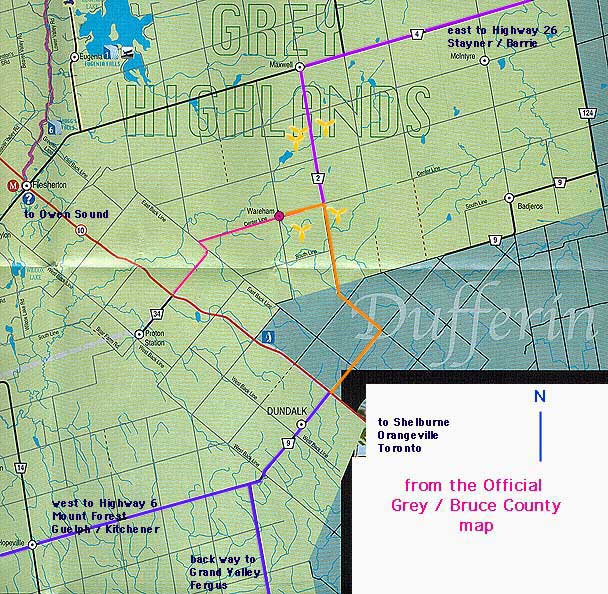
Now, take a look at the Ontario Roads map of the region around my home base in Wareham:
West Central Ontario, range circles (10 km) centred on Wareham

Did I say FLAT? What the ground around here looks like!
Over the late Fall, I have made a couple of trips that have included looking for possible iron ore sources. As I explained in the earlier posting, I really had no expectation of finding anything. But as my friend Lee Sauder (wisely) told me 'You ain't going to find anything - if you never look.'
I felt the only hope of finding anything at all would be at one of the rare places where erosion had exposed the base limestone of the Escarpment.

Four locations are indicated (yellow circles) on the map above, in the order I looked at them. For each I was looking for places where the under laying rock was exposed.

ONE - Belfountain

This point, just south of Orangeville and west of Highway 10. is where an ancient river had cut through the loose gravel cover to expose the limestone. There was enough water moving originally to both cut the rock, but also to throw refrigerator sized blocks around. Today there is a waterfall down one exposed face of this cut.

From the waterfall, we travelled about 200 m down the path that runs along the top of the cut on the north side. Eventually this trail runs down to the bottom of the cut. 
One feature there is a pile of larger stones, obviously cut from further upstream at some point in the distant past. These have been tossed into a pile along the south bank, in a fairly localized area. It looks like the force of water could carry them this far, but no further. These blocks are of a different limestone than those in the rock cut at the same area.

Showing the limestone face, part way up the pile of jumbled rocks (to the right here)

Kelly standing beside one of the large rocks showing iron staining
Iron staining on rock surface - bag is 4 1/2 inches
Iron staining appearing to form a line through the pile (?)
I was greatly encouraged by this - but this was not a source for ore!
On closer examination, what was happening was that these rocks had a smaller amount of iron contained within the matrix. As the water seeped into the stones, then later evaporated from the surface, there was a small amount of iron forming like a scale on the very surface. Although I did flake off a couple of fragments as samples, it was clear that the 'iron' was only a thin film on the surface. At best only one or two mm thick. More like pulling off a surface layer of rust flakes.

(Stay tuned for part Three)

Sunday, November 11, 2012

Some always Remember


I normally wax philosophical for Remembrance Day. Although I have less 'time on the ground' than some who will read this , I do know my soul understands what my body had not experienced. That balance between the high ideals that drive and in the end preserve you, against the futility and raw terror of the action. All those statements of truths we knew, even young, but never really understood as now perhaps we now do. Of seeing the cycle endlessly repeated of 'Rich old man's war, Poor young man's fight'. Yet another generation of cannon fodder shoved into the meat grinder, only for the benefit of a mere handful of the Powerful. I don't think I have become wiser, but it seems more extreme and more obvious to me every conflict.

And so the Boys come Home. For a while.
We all know, in the darkness of the night, that this is just a pause in the endless cycle. This War will pass, like those before it. Certainly soon to be replaced with another Conflict. Those that sat behind desks will thump their chests and speak of Glory. Broken down veterans with empty eyes will be disreguarded on the street. Civilians will speak of the horrors, never considering the cost others paid for the soft lives they possess. Ever more Citizenship will be equated with Rights - never Responsibility.  Another generation will forget or disreguard the lessons so bloodily bought by the few.

I will raise a glass here, at that agreed upon time.
But this year, darkly...

Thursday, November 08, 2012

African IRON - on YouTube

There are some available documentries of the last traditional iron smelting in Africa. These were recorded back in the late 1960s - early 1970's. Preview clips have recently shown up on YouTube:

Inagina: The Last House of Iron

Swiss archaeologist Eric Huysecom and cameraman Bernard Augustoni work with 13 master smelters to recreate the building of a traditional furnace for smelting iron in Mali. There has not been any traditional iron smelting in Africa since the 1960's, in part due to the importing of cheaper substitutes. The building of the furnaces and the work involved in the actual production is deeply entwined with ritual, symbolism and gender. This film describes in great detail every aspect of the event, from the selection of the site of the reconstruction - which is the oldest remaining furnace site in the region, last active in 1961 - to the final result. This is an important film for African Studies, Archaeology, Religion, Ritual, Technology and Gender.

a film by Eric Huysecom, (Geneva) and Bernard Augustoni
distributed by Documentary Educational Resources. Purchase: http://www.der.org/films/inagina.html


The Blooms Of Banjeli

The Blooms of Banjeli documents research in Banjeli, Togo on iron-smelting technology, its rituals, and the sexual prohibitions surrounding it. Including rare historical footage from the same village in 1914, it provides a unique technological record of the traditional method of preparing a furnace to smelt iron. This documentary offers an interesting approach to our understanding of the relationship between conceptions of gender and technology in traditional African society. The people of Banjeli liken the furnace to a woman's body, which is 'impregnated' by the smelter. The process of smelting is compared to that of giving birth, the furnace being the womb and the iron bloom, the newborn. a film by Carlyn Saltman with Candice Gaucher and Eugenia Herbert distributed by Documentary Educational Resources. Purchase: http://www.der.org/films/blooms-of-banjeli.html

Tuesday, November 06, 2012

Is there IRON....

... In them thar HILLS??

Or maybe not.


Although Iron, as iron oxide minerals, is one of the most common found on the earth, as anyone actually LOOKING for the stuff knows, it is really not that easy to find as usable ore.

An added complication is that those looking for iron ores for use in direct process bloomery furnaces need to have ores in concentrations far in excess of that which modern industrial processes can utilize. Ideally, the small Early Medieval furnaces that I am interested in require iron concentrations in the order of plus 50% for effective bloom creation.

- After centuries of human activities, many of the best ancient deposits of suitable iron ores have been already used up.
- Although primary bog iron ores have a continuous deposit process, the sad truth is that the exact chain of geology and geography needed to create concentrated deposits is very specific. Even small amounts of human activities can completely disrupt this formation chain.
- In many cases the reason ores may still remain in areas once exploited in the past is simply that those individual pieces of ore are not of high enough quality to have been utilized the first time around.

Obviously my first question would be 'Is there any usable iron ore locally?'

I live close to Dundalk Ontario, abut 2 1/2 hours drive NW of Toronto. On top of what is called the 'Dundalk Plateau', an area about as flat as a pancake:
The Niagara Escarpment is recognized as one of the world's unique natural wonders. Essentially, it is a landform -- a ridge of rock several hundred metres high in some locations -- stretching 725 kilometres (450 miles) from Queenston on the Niagara River to Tobermory at the tip of the Bruce Peninsula. Today, in Ontario, the Escarpment contains more than 100 sites of geological significance including some of the best exposures of rocks and fossils of the Silurian and Ordovician Periods (405 to 500 million years old) to be found anywhere in the world. 
from the Niagara Escarpment Commission web site 
Range of the Escarpment - Altered from Wikipedia
So - lets consider the ground around Wareham - my base in Central Ontario:

What this all means is that Wareham sits near the top edge of a gigantic, flat, thick, slab of solid limestone - a block a hundred metres thick. This was buried under plies of loose sand, clay and rock in later ages. About ten thousand years go, a wall of glaciers bulldozed off most of this loose stuff, filling in most of the cracks and pretty much scrapping the top off - leaving the landscape even flatter. There are some places around the edges that in the centuries since, rivers have washed out the loose materials, sometimes even exposing the top edges of the under laying limestone slab.
One feature of the remaining top cover over the solid stone plate is a bank of clay, roughly 10 - 30 metres thick. This is a fine red clay, those that remember 'Blue Mountain Pottery', popular in the 1960's and 70's, know the stuff. This layer effectively seals the aquifer inside the limestone from the surface collected water above. 

There are no exposed rock faces close to me. There are large valleys which cut into the plate of the Escarpment, to the east and north of Wareham. There are very few places the rock of the Escarpment are actually exposed however. Those valleys have sides covered with massive piles of loose sand and gravel. (Of course the flat areas around have farm fields on them, the contours of the valleys covered with combination maple and pine forests.) Getting to those valleys is a roughly 50 km / half hour drive north, closer to 30 km / 20 minutes to the east. Spotting any place where there is exposed rock is extremely difficult.


Now, our well at Wareham is a deep one (175 feet) down through the clay layer and into the aquifer of the Escarpment limestone. There certainly is iron dissolved in that water. It cloggs our coffee makers and even settles out as a thin film of fine red iron oxide if you left a container to stand overnight. Remember however the *surface* water is sealed off, entirely separated by that thick clay cap over the limestone. (Its why you pay for a deep well to begin with, as the surface water level fluctuates hugely over the course of the seasons!) So if there is elemental iron oxide in the deep water - it is only going to come close to the surface at locations where the base limestone is exposed. 

I certainly have wandered along the margins of creeks and swamps around Wareham, looking for possible primary bog iron ore deposits. A couple of places, I have spotted very marginal signs of a red iron ochre in the water. Never anything like an amount that could be collected, much less a deposit of actual bog iron itself. This is suggestive however, at least of the possibility.  
There are a couple of operations in the area that dig 'peat' - which in this case is really the organic rich sediments from the bottom of the swamps. These are not true peat bogs, with their chemistry of tannic acid. As these swamps are basically water filled pits into the under laying clay, there is no ability to leach elemental iron out of the rock underneath (this even assuming there is available iron in the rock itself).

Maybe along the slopes of some of the valleys?

(stay tuned for part two..)

 ,


February 15 - May 15, 2012 : Supported by a Crafts Projects - Creation and Development Grant

COPYRIGHT NOTICE - All posted text and images @ Darrell Markewitz.
No duplication, in whole or in part, is permitted without the author's expressed written permission.
For a detailed copyright statement : go HERE