Saturday, December 14, 2013

Knifemaker Interview - Part 3

I had written a long spin off from Zeb's comment - which the Sprites of the Internet ate on me. (Maybe my own 'fault' for not composing this on a word program and then pasting the completed text to the board.) I got a bit defeated from loosing about two hours of work, and put off an entry for another day. This may be a blessing, as although the intent was good, the first content got bogged down into a lot of historic / technical stuff.

As this is a *bladesmithing* forum, I want to try to warp back towards some thoughts on cutting edges.

The very first things I forged out were knives. I (thankfully?) don't have images of most of those. Honestly, they were mostly pretty pathetic! The shapes were determined as much by the way I managed to butcher the steel with the hammer, as any prior intent to design.  I still actually have one of my early pieces, about a 14 inch, very light weight double edge, forged from a large file.
'Gut Ripper' - about 1979 : all hand tools in the creation, file steel with walnut & brass
I have always *forged* my blades. (I think there was one commission that was cut, drilled and ground - this a replica of a movie sword out stainless. A kind of silly design consisting of a long triangle shape with a long series of large diameter holes through the riccasso area.)

So this is the first dynamic for me : Creating blades has always been about the *forging process*, not the grinding and polishing.

I did drop away from blacksmithing for about five years in the early 1980's, mainly out of a lack of any kind of working equipment. (I was living in rented places in down town Toronto at that point.) I was doing a lot of costume jewelry at the time. Quite literally, as a good amount of it were things for SCA costumes. I was working as a casting technician at a dental lab. Both gave me at least the basics of fine metalworking. I did a large amount of standard 'Russel Green River' blades with etched patterns in this period. Regardless of all this, I really have never been that interested in the *embellishment* of knife handles.
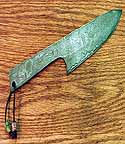
'Dea's Knife' - about 1982 : commercial blade blank, etched, german silver
For me, cutting edges are primarily working tools. I do strive to make objects with beautiful lines, but at core each one has to function first.

This might mark one classic definition between 'Art' and 'Craft'.


The link to the full series : Knifemaker Interview Series


Wednesday, December 11, 2013

Knifemaker Interview - Part 2 B

Some apologies for the double posting - I'm having some connection problems.
Direct satellite uplink system here. Maybe early into the internet, but the rest of the world caught up and passed us rural folk here in Ontario.
This reflects back on something a couple of you mentioned - about visibility on the internet. Although I hardly am located in the 'back of beyond' (two hours drive NW of Toronto), it is a good 14 hours drive from 'Smelt Central' (Lee Sauder's in Lexington Virginia). The great strength of the internet is it allows so many of us 'on the margins' to participate directly with many scattered other people who we might otherwise never personally meet. Glimpsing finished work through those carefully selected (photoshoped?) images is never quite the same as holding a blade in your own hands...

Part 2 - She said, He said...

As I hinted in the last entry, the standard interpretation of the available archaeology as published by AS Ingstad was this:
There was a major boat repair (number of rivets)
This was a single repair event (location of fragments)
Weight of needed rivets equals estimated iron production
Therefore - A major repair was needed, so the Norse 'simply' smelted the iron needed

This was the standard information communicated by Parks Canada at the site.
When I first started working on the living history program there, I had a number of (friendly, sometimes over drinks) discussions with Dr Wallace about this.
My main discussion points / objections:
- Leif Eirikson was a second generation, professional, expedition leader. I just could not imagine that he would even remotely consider heading out into the unknown without taking along a bag of boat repair rivets. (Note that it is almost as far to sail from the Greenland settlement to LAM - as it is to sail back to Norway!)
- The evidence points to only a small boat being repaired. (The width of that 'garage' is less than 2 metres.) NOT a full sized, ocean going 'knarr' hull. Given the lack of building timber in Greenland, certainly valuable - but not what is getting you home from Vinland.
- How easy is it *really* to make iron? Was this general or specialized knowledge and skill? Would the Norse realistically expect to be able to smelt iron 'just anywhere'?
- What about the metal tools required to effectively make iron? If you were stuck needing a ship repair to get back home, would you not give up a sledge hammer (needed for bloom compaction, weight 3 - 5 kg) to make an emergency supply of rivets?

Those last two points were always the critical ones for me.
Most of you have noticed that the archaeologist's reports make a direct link from the 'production' estimate of 3 kg with a known weight in discarded rivets at 3 kg.

One question as a metalworker:
Might it not be a lot easier just to attempt to re-weld up those rivet pieces into some new source bars?
Now, I certainly have never personally tried this kind of thing. The pieces would certainly be heavily corroded, and that likely would really complicate any attempt to do this. (Those reading who have welded up cycle chains to billets might have observations?)

Clearly, the archaeologists missed entirely that a bloom is *not* a working bar.
Again, I don't think there is any good published information on this process. I certainly do not feel I have accumulated enough experience (much less documentation in terms of measurements) to offer any solid numbers. I think the best I have ever managed has been about a 20 % loss from bloom to bar.*  (I will hope that some of you who work extensively with bloom iron will comment here!)
Any way you look at it, a 3 kg bloom does not equal 3 kg of finished rivets!

And just how good were those original Norse at the iron smelting process to begin with?
If you hold to the 3 kg bloom from that 18 kg of (good) ore - this is only a 17 % yield!
Not withstanding this is a small volume smelt and these usually produce lower yield numbers.

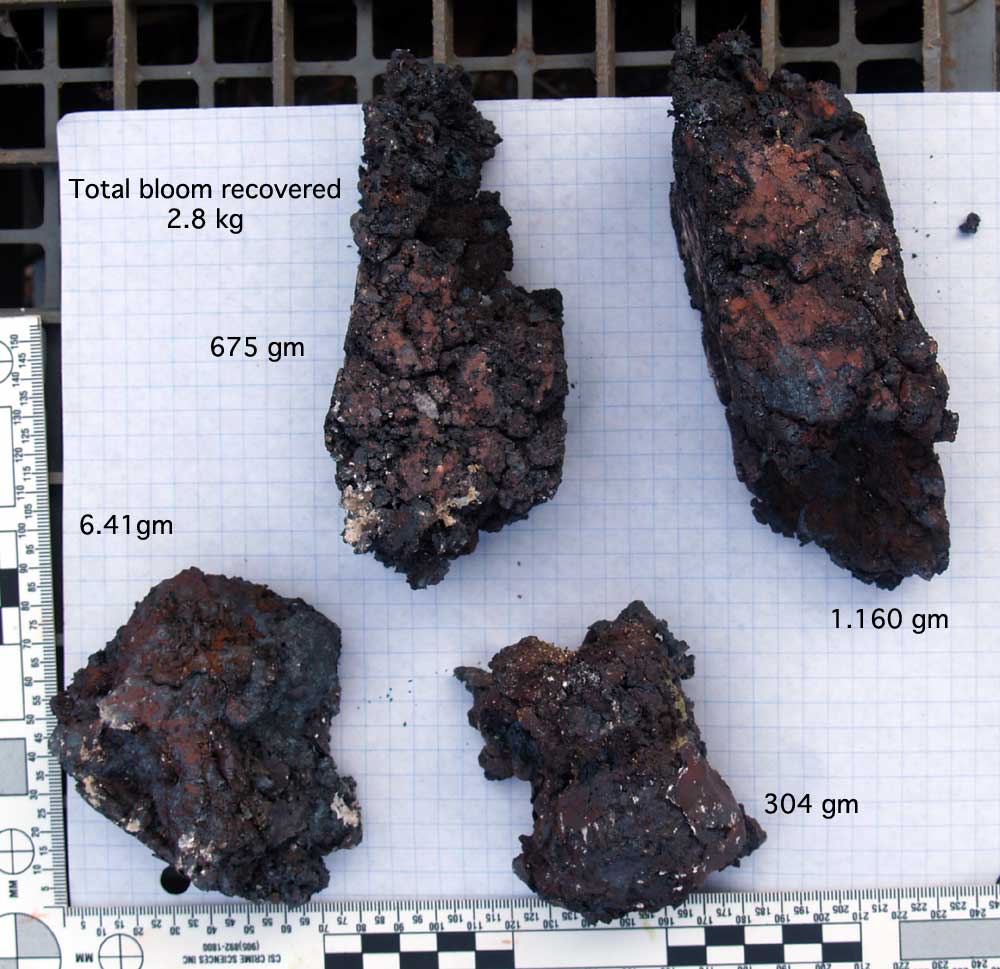
Honestly folks, when we undertook our demonstration smelt at LAM in 2010, I was kind of embarrassed by our own low return, at about 14%. (We got a fairly crumbly 2.8 kg bloom)
Mind you - after Birgitta had watched the amount of labour (all human powered air) and general rushing about (we had some burn through problems with the furnace) on that demonstration, she told me she had revised her opinions about just how 'simple' producing iron was for the Norse.

(for a more formal discussion of all this - go to my paper 'An Iron Smelt in Vinland - an experimental investigation')

I have always felt the iron smelting process was a specialist task. The general archaeology from the Viking Age places the iron smelting process as physically removed from the community in general. It is *ore* which is dictating the location of the production. Iron was (generally) smelted at remote locations, then either transported as compressed cakes or rendered down into fairly standard bars for sale to the actual blacksmiths. (So standard that these are known as 'currency bars'.)
The Norse are largely a society of reasonably isolated, large farmsteads. It is common for each to have at least a separate 'smithy' building. (Although how much and how often this might have been in operation is an open question. A well rounded 'occasional amateur'? Seasonal use by an intinerant professional smith?) The situation for iron smelting may be different in these locations.

But increasingly during the Viking Age, there is the development of trade based towns. (And this leads back to something you had mentioned Shel.) Here craftsmen are working in combination workshop / residences. Producing work for direct barter, or more and more, for sale against silver coins. (Just where all that 'Danegeld' was going!) These working blacksmiths are purchasing themselves the required raw materials for their trades. In this case the charcoal fuel for the forge and the iron working bars they need to produce objects.

So I guess that leads us (finally) back to the blacksmith - and bladesmith...

Tuesday, December 10, 2013

Knifemaker Interview - Part 2 A

Quote
I have to wonder how Dr. Wallace altered her perceptions and what
triggered that that change in her thinking. I've found the relationship
betwen smiths and archaeologists to be fruitful when both are open
minded. Seems that way with you and the folks at L'Anse au Meadows.

Thanks folks. This year has piled a lot of 'personal life' rocks on top of me, and hopefully into 2014 I will be starting to crawl back out from them.

Something Alan said about the interface between the archaeologist and the blacksmith.

Part A - what we got:

The original excavations at L'Anse aux Meadows, back in the 1960's, was a real mess in terms of who was involved and how things were carried out. Anne Stine Ingstad had been trained at university as an archaeologist, but actually at the time of the find was not *working* as an archaeologist. As word of the discovery got out, everyone internationally remotely interested at the time tried to get into the process. (I have seen film clips of 'ivory Tower' types, in suits, ties and dress shoes, being physically carried from small boats to shore on the backs of locals. At the time there was no road access to the site.)
At the very least, no one actually undertaking the first series of excavations had ever worked on a historic iron smelting site. At the time, no one had really undertaken a successful re-creation of a historic iron furnace either. (Near as I have been able to research, the first steps into experimental archaeology there look to be in the mid to late 1980's, and that pretty hit or miss as single attempts. Peter Crew from the UK mounted an extensive series in the early to late 1990's. Our own Sauder and Williams follow in the mid to late 1990's - but approaching from the 'working' direction.)
My friend (and mentor) Dr Birgitta Wallace was working on the original excavations as a graduate student. (So I have managed some inside information.)

One of the base problems with archaeology is that it is a destructive process. Typically you end up removing the very thing you are attempting to study in the process of recording it. So when you combine that with a group of people who don't know exactly what they are really looking at - things get lost or missed.

(I'm going to try to link over to a few images here - see it that works)

So this is what was recorded inside the Furnace Hut at LAM:


This is the remains of a high temperature fire base, indicated by burned charcoal. It is framed by several small stones and a partial ring of baked clay. The ground around it is dotted with primary bog iron ore (to the top right direction) and with small pieces of 'iron smelting slag' (mainly in a line towards the bottom).
The rough interior diameter of the fire base is 20 cm.
The clay crescent found is a mix of a local 'river' clay mixed with sand. (And no, Lee, there is no indication in any of the reports just what the mix might be.) There is a small clay bank exposed about 500 metres from the Furnace Hut. (I do have a small pail of this stuff from our 2012 trip out there, but have not done anything with it yet.)

You can clearly see that no actual structure of an iron smelting furnace itself actually remains. What was the height? Location or type of tuyere? Air system used?

The natural primary bog iron ore is under constant formation along the bog that sweeps upwards from the sea shore location of the occupation site, inland. Black Duck Brook cuts the bog, exposing beds of this ore here and there. The samples of ore from the excavations are quite rich in iron (range of 68 % Fe)

There was no differentiation made in the reports (or notes) for different *kinds* of slags. The total amount of slags (all kinds) recovered was "about 10 kg".
Now it is possible (theoretically) to estimate the yield from an individual iron smelt. You measure the various components of the starting ore. You measure the components in the slag formed. There will be a drop in iron content from the ore to the slag. You multiply the loss by the weight of slag = the 'missing' iron - so the bloom created.
First WAG : A loss factor of 5 kg was added to the amount of slag recovered (???) No actual slag bowl was recovered (The Furnace hut is about 10 feet from the edge of the brook - on the open side.)
Second WAG : Based on the photos (not the best, admittedly) I have seen, there was a quantity of both the green bubbly 'goo slag' as well as the later black liquid (iron rich) tap slag recovered. Only the iron rich slag is useful for the calculation. No separate record of the total amounts appears to have been made.
Running the math gave a WAG x WAG x % estimate of 3 kg for the bloom produced.

The most typical published estimate for the amount of ore used comes from adding the slag recovered, plus that error addition, plus the estimated bloom - to give an amount of 18 kg ore.

No specific consideration was made in any of the reports (confirmed by Birgitta Wallace) for the actual *bloom to bar* phase of the process.  (At this point all fellow blacksmiths will be shaking their heads!)
It has been my personal observation that the remains at LAM are most likely the torn down base of the actual iron furnace, converted into a kind of 'deep dish' forge for heating the bloom to compact it into a working bar.
The 'actual bar to object' phase might not have taken place in the Furnace Hut at all. One of the house buildings has a fire that has traces of iron 'forge scale' around it.

At least one iron object, a nail, was found to have the identical trace element fingerprint as found on the bog ore from this location. This indicates at least that one nail was made from iron produced at LAM.


Also recovered on the overall site:

One of the three building complexes had a side room attached to the main building (indicated by wall foundations). This was open on one end - the end facing the natural beach (as it existed in 1000 AD). Imagine a modern 'car port' on the side of your house. This room also had a side door - opening off into the yard. Found in a spray shape from the interior, fanning out from the door opening were about 100 fragments of iron rivets and their associated rectangular roves (washers). These rivets were used to hold together the planking of a small (to fit the 'garage') boat. This all most certainly represents a large single repair event. The total mass of the combined pieces was : 3 kg.

Three kilo bloom = three kilo rivets & roves
Right?

(mull that over a bit, I'll finish this part of the tale later)

Monday, December 09, 2013

Interview a Maker - Part One

 I was a bit surprised that I have been asked to contribute to a very good series underway over on Don Fogg's Bladesmith Forum. 

The series is entitled 'Knifemaker Interviews'. The idea was started by Christopher Price. Some of the best known and respected names have been included. The method is that Christopher asked a selected bladesmith (it was Allan Longmire) :

How this works: I will start by inviting a member here to an interview, where we'll discuss their history, views of the craft, their relevant background, and what makes them tick. They, then, will interview someone else, and so on as long as we have people willing to pour out their hearts and metalworking souls online for this community to share in.
 Individuals have given intensely personal observations on their work and purposes, on the Arts and sometimes world view in general. This is inspiring stuff!

I was extremely flattered to be asked by Sheldon Browder (retired master smith from Colonial Williamsburg and fellow member of the Early Iron Group) to take part :


Posted Today, 08:57 AM
Quote
Darrell, i think that Some discussion of your connection with Viking
iron making a t L' Anse au Meadows might be a good place to start. 

A fast start : I am especially honoured (and humbled) to be included in such august company. There are a great many names here from who's hands I have always seen spectacular work. (An awful lot of 'I wish *I* could have made that one'!) Some have come to be friends over the years, much to my surprise and gratification. I hope it proves I can add something to this quite wonderful (and informative) ongoing conversation.
At its best, this series reminds me a bit of an artist's round table at an extremely good conference...

To the Question:

You may personally find a curious circle here Sheldon.
(Cautionary note : This is how I remember this - maybe not the truth of what it really might have been!)

Second Cautionary note : I am not known for short answers!

I was working as the blacksmith / historic interpreter at Black Creek Pioneer Village (Toronto Ontario) in the mid to late 1980's. This is one of those synthetic historic villages, composed of buildings moved from their original locations and restored to the dates of construction. The span there is roughly 1816 - 1865. The blacksmith's shop was intended to be some vague 1850's time period. Individual interpreters came into the Village mostly self taught, and mostly spent their days working alone. (There was no internal training program such as exists at Colonial Williamsburg in Virginia.)

I had started my journey into living history through a deep interest in the Viking Age. I had literally fallen over the then fledgling Society for Creative Anachronism group at University of Toronto while a student at Ontario College of Art. (As many are sure to know, this is a very loosely Medieval themed organization.) As I was a young male, armoured combat (as it was developing in the SCA in those days) was something I was enthusiastically involved in. If you wanted armour back then (late 1970's) you pretty much had to build your own. A need for something at least vaguely approaching historic objects for costumes lead me to my first knives. (How I picked up a hammer for forging a longer tale!)

So that (roughly) sets the scene.
In general research, likely via the ALHFAM journal, I had seen an article describing a project undertaken by a team at Colonial Williamsburg. The name I * remember * is 'David Harvey'. (Shel, you might remember this - or have even been involved?) Anway, the project was an attempt to convert a local iron ore into a metallic mass. As I remember it, this was done using a deep built forge hearth, firing charcoal. The results were marginal, with enough metal produced to make a small chisel. (In retrospect, this all sounds like the variation on the Aristotle Furnace Tim Young had suggested to the Early Iron Group at Smeltfest a couple of years back, you certainly remember. Lee Sauder and Jesus Hernandez both took the lead on those experiments.)
Back to the thread - I had been 'offended' by the statement made in the published article : 'This process replicates the First Iron Production in North America.' Like all Canadians, this kind of thing gets the maple syrup in my veins just a boilin'. * We * all knew the very first iron produced in North America was at the hands of the Norse, at 'Leif's Houses' (northern Newfoundland) in Vinland - some time about 1000 AD.

So in the back of my head, as early as about 1990, was the idea of demonstrating the Viking Age iron smelting process.

Through a long chain of events (including a huge amount of mindless self promotion). I would develop a working relationship with Parks Canada, the L'Anse aux Meadows National Historic Site (LAM), and Dr Birgitta Wallace. This all over the 1990's, with many trips out to the site from my home base in central Ontario. (For those not familiar, that's a two and half day drive, an eight hour ferry, then another full day's drive.)

In 2001, Parks Canada received a corporate grant to re-create the small 'Furnace Hut' at LAM. The original was a roughly 3 x 3 metre structure, open on one side, dug into the bank of the Black Duck Brook. It appears to have been purpose built to contain a small clay walled iron smelting furnace. The furnace was either broken on bloom extraction (my best guess), or purposefully converted into a deep forge for the required compaction phase. The archaeology suggests only a single firing, a smaller furnace run with a fairly low yield. ( I can elaborate on all that if people ask about it.) I was part of small research group, intended to establish how best to equip the replica building and then interpret the historic event to the public. Dr Wallace represented the archaeological side. Archaeo-metallurgist Arne Esplund (from Norway) for Norse iron smelting. I was the interpretive / practical side. The working staff was represented by Mark Pilgram, one of the local people I had trained on a special six week program in 2000.

As part of the week long workshop, Marc and I, working from prototypes provided by Birgitta and Arne, * attempted * to smelt iron. Attempted being the key word here. As later experiments would prove, we did just about every single thing wrong!

I got back from that session determined to 'get this to work'. I wrangled (inspired / dragged kicking and screaming) my new group of Viking Age living history re-enactors, the Dark Ages Re-Creation Company (www.darkcompany.ca) into providing the required manpower.
Starting in 2002, we undertook a series of individual experimental iron smelts, concentrating on Norse type 'short shaft' bloomery furnaces. Our first attempts (also dismal failures) were using human powered Viking Age type blacksmith's bellows.
In 2003, a small group of us attended a demonstration by Lee and Skip Williams held at the American Museum of Frontier Culture in Staunton Virginia. Generous as always, Lee and Skip took us in and folded us into the demonstration. (Or at least let me badly explain what was going on to the general public - while they concentrated on the real work!) I certainly learned a huge amount that day.
Spring 2004 back at Wareham was another failure, but did gain us the friendship of Mike McCarthy. (Mike stopped by on his way back from a week with one of the Japanese iron masters.)
Fall of 2004 and a combination of pissy wet and cold weather, too late a start, beer for very late lunch - and a general WtF attitude... We not only stumbled on a easy and quick to build brick furnace design (what came to be known as the 'Econo-Norse') - we actually got iron!

By that point (what was my 5th / 6th iron smelt) I had realized that I had to pull back to basic principles. That *first* I had to learn how to effectively smelt iron, developing some standard methods and some kind of effective methods and base level understanding of the processes.
*Then* go back and attempt to remove individual modern elements, one by one, to work backwards towards a possible Viking Age method.

The direct process of this was a series of five experimental smelts DARC undertook from 2009 through 2010. This ended with a full scale re-creation of the historic smelt at Vinland, inside that same replica building at LAM. This public demonstration was undertaken using all Viking Age equipment (save modern safety gear). The end result was about the same as the archaeologists had estimated for the original event. About 20 kg of ore was converted to a roughly 3 kg iron bloom.
Dr Wallace was present for the demonstration, and confided to me after that she felt she would have to alter her earlier impressions of both Norse iron smelting, and more significantly, just what that ancient undertaking was really intended for. (I had always had big reservations about how the archaeologists had interpreted the artifact evidence - and its implications.)

I'm still wondering about the implications of air flow inside Norse type short shaft bloomery furnaces. More experiments to follow for sure. My team has also been working on a related system from Viking Age Iceland, working closely with Kevin Smith (Brown University).


The hard core knife makers here may notice this is straying a very far distance from bladesmithing.
Something Lee said once : 'You should kill what you eat'
The materials available to ancient blacksmiths are quite different compared to our modern metals. Further, how those materials were created in themselves alters the relationship ancient smiths had to their materials.
I will hardly claim to have that all figured out. But using historic methods to produce the source materials does alter my perceptions of the object itself...


(I think more than enough for one go round?)
 

February 15 - May 15, 2012 : Supported by a Crafts Projects - Creation and Development Grant

COPYRIGHT NOTICE - All posted text and images @ Darrell Markewitz.
No duplication, in whole or in part, is permitted without the author's expressed written permission.
For a detailed copyright statement : go HERE