www.warehamforge.ca/ironsmelting/double0607/
Includes a number of images and field drawings. Expanded from my earlier post here.
The smelt data sheets are missing at this point, but will be added as soon as I get the raw information and format it into the standard tables.
Saturday, June 23, 2007


Thursday, June 21, 2007
A Re-Enactor's Design...
Posted by: "Catherine Olanich Raymond"
>> Any one of the folks that smelt or forge recognize this from a grave
>> find or some other reference:
>> ...he looked at
>> Birka grave finds and saw no mention...whereas other sites selling
>> them seem to consider them somewhat authentic.

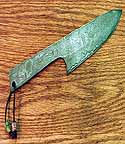
Sorry - that is a purely modern style. What I have seen made by both black powder and many a pre industrial re-enactor. Very commonly seen in the SCA.
It is extremely loosely based on the ** concept ** of Romano - British table or kitchen knives. The artifacts date to roughly 450, there are several samples in the Royal Ontario Musuem in Toronto.
However, the actual artifact blades are significantly different. They are forged of one piece of metal flat stock. One end is drawn to a point and then the edge is forged out for the blade - which slightly widens the blade portion. There are a couple of different blade profiles evidenced, but long triangle (standard kitchen parring knife) or some variation on clip point are most common. The material that forms the handle may be treated in a couple of different ways, generally thinned out or contoured to fit the hand a bit better. Many have a small loop on the very end to allow them to be hung on a wall peg.
What is seen in the sample is a very nice overall design. Its just not found in the artifact record.
Check:
www.warehamforge.ca/norse knives
(Start of a potential reference I am working on...)
>> Any one of the folks that smelt or forge recognize this from a grave
>> find or some other reference:
>> ...he looked at
>> Birka grave finds and saw no mention...whereas other sites selling
>> them seem to consider them somewhat authentic.
Sorry - that is a purely modern style. What I have seen made by both black powder and many a pre industrial re-enactor. Very commonly seen in the SCA.
It is extremely loosely based on the ** concept ** of Romano - British table or kitchen knives. The artifacts date to roughly 450, there are several samples in the Royal Ontario Musuem in Toronto.
However, the actual artifact blades are significantly different. They are forged of one piece of metal flat stock. One end is drawn to a point and then the edge is forged out for the blade - which slightly widens the blade portion. There are a couple of different blade profiles evidenced, but long triangle (standard kitchen parring knife) or some variation on clip point are most common. The material that forms the handle may be treated in a couple of different ways, generally thinned out or contoured to fit the hand a bit better. Many have a small loop on the very end to allow them to be hung on a wall peg.
What is seen in the sample is a very nice overall design. Its just not found in the artifact record.
Check:
www.warehamforge.ca/norse knives
(Start of a potential reference I am working on...)
Sunday, June 17, 2007
Ceramic Tuyeres for Smelting?
> I have been trying to run down the kiln shelf supports that we used for
> the air intake in the smelting furnace. However, I am told the round
> ones are not made any more and now they make triangular, square ones
> Do you know a source that makes and sells these round kiln posts?
I get the supports from a place in Kitchener ON. This is an outlet of a
larger company:
the Pottery Supply House
1120 Speers Road
Oakville ON, L6L 2X4
800-465-8544
mail@pshcanada.com
www.pshcanada.com
The units I purchase are:
FRP12 - 12" T175 Round Post (at $6 CDN plus taxes each)
The company does do mail order via phone or web site using credit cards.
These are supports for a PORCELIN kiln - higher temperature, I thnk
rated for 1150 C. You can contact the company direct and they may be
able to refer you to an American supplier (although these mail easy enough).
Now, I suspect that the interior diameter as round and at 1" size is the
critical thing. Likely the exterior shape does not matter. The artifact
samples are all cylinders or more commonly conical. This is mainly
because how they were made. You take a blob of clay and work it around a
stick with your hands and then either burn or more likely just pull out
the stick.
If you used a square or triangle shape, I'd suggest placing it so one of
the edges was uppermost - rather than one of the flats. Watch the
minimum wall thickness too. I can see a circle inside a triangle perhaps
leaving a thin side wall.
Ideally the air blast is cooling the tuyere material and keeping it from
melting. So with a constant blast from a mechanical blower the tube
shape may be of less importance.
> the air intake in the smelting furnace. However, I am told the round
> ones are not made any more and now they make triangular, square ones
> Do you know a source that makes and sells these round kiln posts?
I get the supports from a place in Kitchener ON. This is an outlet of a
larger company:
the Pottery Supply House
1120 Speers Road
Oakville ON, L6L 2X4
800-465-8544
mail@pshcanada.com
www.pshcanada.com
The units I purchase are:
FRP12 - 12" T175 Round Post (at $6 CDN plus taxes each)
The company does do mail order via phone or web site using credit cards.
These are supports for a PORCELIN kiln - higher temperature, I thnk
rated for 1150 C. You can contact the company direct and they may be
able to refer you to an American supplier (although these mail easy enough).
Now, I suspect that the interior diameter as round and at 1" size is the
critical thing. Likely the exterior shape does not matter. The artifact
samples are all cylinders or more commonly conical. This is mainly
because how they were made. You take a blob of clay and work it around a
stick with your hands and then either burn or more likely just pull out
the stick.
If you used a square or triangle shape, I'd suggest placing it so one of
the edges was uppermost - rather than one of the flats. Watch the
minimum wall thickness too. I can see a circle inside a triangle perhaps
leaving a thin side wall.
Ideally the air blast is cooling the tuyere material and keeping it from
melting. So with a constant blast from a mechanical blower the tube
shape may be of less importance.
Saturday, June 16, 2007
Historic Iron Smelting - Questions & Problems
Again a piece re-cycled from NORSEFOLK )
REVIEW - What it is: IRON SMELTING
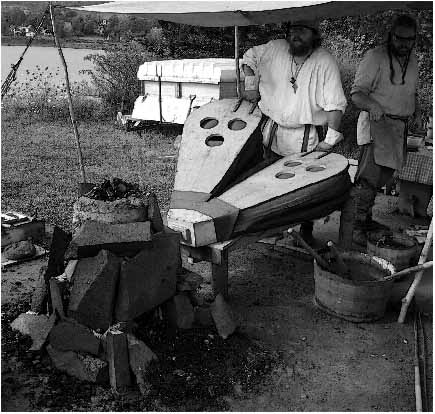
Smelting is the process of taking raw iron ore and converting via extremely high temperatures into a mass of workable metal. In the European 'Dark Ages' (post Roman through to the Crusades) the technology is roughly similar. A quick overview : The furnace used has heat resistant walls and is roughly the size of a 5 gallon pail on the inside (likely a bit taller). Inside this air is forced through a hole or pipe (the tuyere) to allow charcoal to burn. This not only produces the temperatures required (roughly 2400 F / 1100 C) but also produces the various gases required for the chemical changes. If everything goes EXACTLY right, after four to six hours the bottom of the furnace will have a bowl of glassy slag with a mass of metal (the bloom) resting inside of it. In Viking Age Scandinavia the ore type is almost always some variation on primary bog iron ore and smelters are located close to the source. Exact raw material preparation, charcoal used and smelter construction are then adjusted to relate all these locally available elements.
The bloom then needs to be extracted. It will have a lacy outside layer, which needs to be either hammered off or compressed into the bloom. Then the mass needs to be cut into pieces small enough to be worked by hand. Next the pieces are compressed to blocks, then worked into bars by repeated hammering, folding and welding. (Al this hammering is why the product is called 'wrought' iron )The end result is a 'currency bar' - typically about 2 cm square and about 30 - 40 cm long (say 3/4 x 12 - 18 inches). These bars are often seen flattened on one end and with a carry loop on the other. (This is how you blacksmith's purchase your metal buy the way - consider how this relates to producing that darn tripod.)
Problems:
The physical remains related to iron smelting from the Pre Conquest period are * extremely * limited:
- The furnaces themselves are relatively fragile, and so only the simplest remains are likely. With a clay furnace the upper sections (from just below the tuyere entry and up) will be baked to a simple ceramic. This is very porous, and water plus freeze and thaw quickly shatters it into a pile of small fragments. Only the very base of the cylindrical smelter is normally found. As this is not exposed to heat, what you find is a ring of mud.
So : what is the exact shape and layout of the furnace? It turns out that position of the tuyere and total height are quite important.
- Tuyere tubes or fragments are found. They almost all have a uniform interior diameter of 2.5 cm / 1 inch.
- The glassy bottom 'slag bowls' are found. Often located such that they are as they were formed at the base of a smelter. (Often the only indication of the size of the smelter or rough guide to the size of the bloom which was produced.) Problem here is that these are only the frozen remains formed at the very last stage of a complex series of chemical and physical reactions over a furnace use of several hours.
- Some finished blooms have been found. This does give us some idea of possible bloom sizes and quality. A range of roughly 5 - 8 kg seems to be common for the Viking Age.
So : why are these specific blooms recovered at all? Given the effort ("cost" in labour in materials) is there some specific reasons these blooms were retained or even discarded?
- No bellows remains from the Viking Age (at least after serious digging I have be unable to find a single artifact). There are two carved illustrations of * blacksmith * bellows. One is a side view with human figure for (possible) scale. The other a top view for proportions.
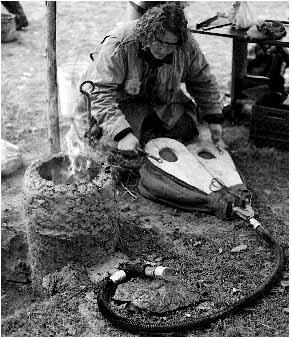
To mess this all up, modern experiments have demonstrated that the air volumes required for a successful smelt (producing an artifact type bloom) require something in the order of 5 times the volume of air possible from that blacksmith bellows.
So : are we looking for a different sized bellows? Are small bellows ganged together? Maybe an entirely different design? Maybe even an entirely different smelt sequence? All these have social implications as well, what evidence may there be of that aspect?
- There are no tools specific to the smelting process that have been found. (Again, I have not seen anything *** PLEASE !!!! *** if anyone knows of any, let me know!) We know from our own experiments that a number of specialized long handled probes, hooks, rakes - if not out and out necessary. Some of these need to be all metal to allow them to be driven by hammer blows. Add special oversize 'bloom tongs'. Heavy hammers are required, but at least other finds (like Mastermyr) show those. There are a number of wooden buckets and scoops that are either standard or would not leave any trace.

So : Are there any specialized 'smelt master' burials? Were ALL the large metal tools re-cycled? Is there some social reason why smelting tools were treated differently than blacksmithing tools? (Conversations with Dr. Kevin Smith suggest that this may be the case ?)
- There are no specific clothing items that have been found that relate to the very real protection problems quite specific to iron smelting
So : I'm going to put that into another post!
Darrell
A reference:
www.warehamforge.ca/ROMiron
REVIEW - What it is: IRON SMELTING
Smelting is the process of taking raw iron ore and converting via extremely high temperatures into a mass of workable metal. In the European 'Dark Ages' (post Roman through to the Crusades) the technology is roughly similar. A quick overview : The furnace used has heat resistant walls and is roughly the size of a 5 gallon pail on the inside (likely a bit taller). Inside this air is forced through a hole or pipe (the tuyere) to allow charcoal to burn. This not only produces the temperatures required (roughly 2400 F / 1100 C) but also produces the various gases required for the chemical changes. If everything goes EXACTLY right, after four to six hours the bottom of the furnace will have a bowl of glassy slag with a mass of metal (the bloom) resting inside of it. In Viking Age Scandinavia the ore type is almost always some variation on primary bog iron ore and smelters are located close to the source. Exact raw material preparation, charcoal used and smelter construction are then adjusted to relate all these locally available elements.
The bloom then needs to be extracted. It will have a lacy outside layer, which needs to be either hammered off or compressed into the bloom. Then the mass needs to be cut into pieces small enough to be worked by hand. Next the pieces are compressed to blocks, then worked into bars by repeated hammering, folding and welding. (Al this hammering is why the product is called 'wrought' iron )The end result is a 'currency bar' - typically about 2 cm square and about 30 - 40 cm long (say 3/4 x 12 - 18 inches). These bars are often seen flattened on one end and with a carry loop on the other. (This is how you blacksmith's purchase your metal buy the way - consider how this relates to producing that darn tripod.)
Problems:
The physical remains related to iron smelting from the Pre Conquest period are * extremely * limited:
- The furnaces themselves are relatively fragile, and so only the simplest remains are likely. With a clay furnace the upper sections (from just below the tuyere entry and up) will be baked to a simple ceramic. This is very porous, and water plus freeze and thaw quickly shatters it into a pile of small fragments. Only the very base of the cylindrical smelter is normally found. As this is not exposed to heat, what you find is a ring of mud.
So : what is the exact shape and layout of the furnace? It turns out that position of the tuyere and total height are quite important.
- Tuyere tubes or fragments are found. They almost all have a uniform interior diameter of 2.5 cm / 1 inch.
- The glassy bottom 'slag bowls' are found. Often located such that they are as they were formed at the base of a smelter. (Often the only indication of the size of the smelter or rough guide to the size of the bloom which was produced.) Problem here is that these are only the frozen remains formed at the very last stage of a complex series of chemical and physical reactions over a furnace use of several hours.
- Some finished blooms have been found. This does give us some idea of possible bloom sizes and quality. A range of roughly 5 - 8 kg seems to be common for the Viking Age.
So : why are these specific blooms recovered at all? Given the effort ("cost" in labour in materials) is there some specific reasons these blooms were retained or even discarded?
- No bellows remains from the Viking Age (at least after serious digging I have be unable to find a single artifact). There are two carved illustrations of * blacksmith * bellows. One is a side view with human figure for (possible) scale. The other a top view for proportions.
To mess this all up, modern experiments have demonstrated that the air volumes required for a successful smelt (producing an artifact type bloom) require something in the order of 5 times the volume of air possible from that blacksmith bellows.
So : are we looking for a different sized bellows? Are small bellows ganged together? Maybe an entirely different design? Maybe even an entirely different smelt sequence? All these have social implications as well, what evidence may there be of that aspect?
- There are no tools specific to the smelting process that have been found. (Again, I have not seen anything *** PLEASE !!!! *** if anyone knows of any, let me know!) We know from our own experiments that a number of specialized long handled probes, hooks, rakes - if not out and out necessary. Some of these need to be all metal to allow them to be driven by hammer blows. Add special oversize 'bloom tongs'. Heavy hammers are required, but at least other finds (like Mastermyr) show those. There are a number of wooden buckets and scoops that are either standard or would not leave any trace.
So : Are there any specialized 'smelt master' burials? Were ALL the large metal tools re-cycled? Is there some social reason why smelting tools were treated differently than blacksmithing tools? (Conversations with Dr. Kevin Smith suggest that this may be the case ?)
- There are no specific clothing items that have been found that relate to the very real protection problems quite specific to iron smelting
So : I'm going to put that into another post!
Darrell
A reference:
www.warehamforge.ca/ROMiron
Subscribe to:
Posts (Atom)



 Posts
Posts