Friday, November 28, 2008

Ongoing - 'Exploring Viking Age Denmark'

A Note to my Regular Readers:
I have been working for the last couple of weeks taking my huge image collection from my research trip to Denmark in the spring and turning it into some form of publication. From my travels and the various museums I visited, there are over 400 images, primarily of Viking Age artifacts. To these I have added commentary on each, based on the notes recorded at the time. The whole is formated up as html, the size is such that it needs to be recorded to a DVD data disk. I had originally hoped to have the publication 'Exploring Viking Age Denmark' ready for release on Dec 1. It now looks like I will be missing that deadline. This is another teaser segment from the publication:


The Ribe VikingeCenter
Lustrupholm
Lustrupvej 4, 6760 Ribe, Denmark
452-041-8022
www.ribevikingecenter.dk

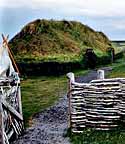
The Ribe Viking Centre is an impressive living history / open air museum located within about a half hours walk (cross country) to the south of the centre of Ribe. It supports a large number of educational programs, from the usual single day tours through to intensive live in programs. Along with staff interpreters, many artisans, they allow for guest Viking Age re-enactors to set up and interact with the general public. The site is roughly grouped into four main theme areas : educational centre and children's village / the Viking Market / an Iron Age settlement / a Norse farmstead. This is a working site, with artisans producing various products using period methods, crops grown and livestock raised for eating. The individual areas are separated by hedge rows and stream banks in a quite natural manner.

Unfortunately, the site marks its seasonal opening with a grand Market on May 1. I had to visit a full week before this, so missed the interpretive staff at work. Here again, previous contact from Canada paid off greatly, as I was generously offered a quick guided tour of the site by curator Bjarne Clement. On this we were accompanied by fellow iron maker Michael Nissen, who offered many insights into the working days of the interpreters. For the cost of a meal, I later enjoyed an evening with Michael and site glass artisan Trine Theut. I returned to the site the following day on my own, which is when many of these images were taken.

Because the site was still closed (although there was public access to the grounds) I was not able to get very many interior shots. As I was walking in from town (along the rail line and across a couple of fields) I actually started my visit at the rear of the site. I have re-ordered the images to better represent what you might expect with a paid admission.

Thursday, November 20, 2008

Exploring the Viking Age in Demark

Right now I am preparing for an upcoming lecture for the Peterborough SCA group. This is to be held at Trail College on Wednesday November 26 at 8 PM.

The topic is an overview of my recent research trip to Denmark. I will be showing some of the artifact images I collected, and talking about the museums I visited.

So, I figured I might as well kill two birds with one stone. As it turns out, the birds were a sparrow ( the lecture) and an emu (a new AV publication). I am sorting all my 400 plus images, adding commentaries from my notes and formating the whole pile into a reference I hope to have ready to sell in time for Yule. The contents will work via a large set of interlocked 'web pages' that will access through an standard web browser. As most of the images are the large format from my camera (mostly 5 MGP) the total content will have to go on to a DVD disk. This will also allow just the images to be viewed on a standard table top player and TV combination.

As a teaser, this is a short piece of one of the displays I saw at the Roskide Museum. The images here are just the thumbnails - you will have to wait for the publication to see the larger versions!

(This version was re-formated to fit the Blogger frame)

The display was a grave from Gerdup, dated to around 800 AD. The first thing that catches your attention is that one of the bodies has quite deliberately covered with several quite huge and heavy stones.A full body view of the left of the two bodies in the burial. It is shorter than the other, about 160 cm tall in life. The burial had been dug to fit this figure.Next you notice something odd about the right hand body. Obviously the skull has been crushed by an heavy blow.
The legs are splayed to fit the too short hole, and are crossed. The arms are in a strange position als well. The evidence is that this person had feet tied together and arms bound to the waist. As well, it turns out there are cut marks on the neck bones.There is a small knife laid under the left arm of the bound body. It has a single edged blade about 10 cm long, but is in extremely poor condition, worn down to a thin sliver of iron.Now on the other body is a similar sized blade, but this one in excellent condition. It is laid about in the correct location for being long thin single edge typical of Norse woman's knives.
Now the final twist is this long spear head, a type suitable for throwing for hunting. It is laid on the right side of the body under the stones.Now the piece of data not imeadiately appearent: the left hand body, under the stones, was female, the right hand, bound and murdered, was male.One conclusion being made about such unique burials is that they mark powerful women involved in Sie∂er, ritual magic. They are often found 'killed and held' by having their bodies secured by heavy stones.

Tuesday, November 18, 2008

Looks Great...

... On a post card:

Not so great as the view out my deck window in Mid November.

Monday, November 17, 2008

Iron Slags as Art


Slag from ancient iron smelting in Madagascar; image by David Killick, UA professor of anthropology

A metallurgical slag from ancient iron smelting in Madagascar. A thin
slice was glued to a glass slide and polished to a thickness of only
0.03 mm. It is photographed here at a magnification of 200x in cross
polarized transmitted light. All of the brightly colored crystals are
of the same mineral (an iron silicate calledfayalite ) but display
different colors because the lattices of each crystal are at different
angles to the plane of the section. The black network within thefayalite crystals is of a second mineral, an iron-aluminium spinel called hercynite, that crystallized at the same time as the fayalite, giving rise to complex intergrowths of the two minerals.


Beyond the Naked Eye: Science Reveals Nature's Art
November 8, 2008–January 9, 2009

Art and science have always been connected—from alchemists' experiments producing artist materials to Renaissance explorations of anatomy. Contemporary art includes many modern technologies as processes, and the avant-garde has seen science as a subject for artistic exploration for over a century. This exhibition aims to reverse the traditional roles by presenting the science as the art.


I got wind of this through the ArchMetals discussion group. David Killick is also involved in our own Early Iron discussion as well.

Quoted sections and images from the Arizona State Museum web site.
 

February 15 - May 15, 2012 : Supported by a Crafts Projects - Creation and Development Grant

COPYRIGHT NOTICE - All posted text and images @ Darrell Markewitz.
No duplication, in whole or in part, is permitted without the author's expressed written permission.
For a detailed copyright statement : go HERE