Sunday, March 31, 2013


Saturday, March 30, 2013
Spring comes to Wareham (?)
 |
| Charv Soaking up Sun - first time this year. |
 |
| River at the rear over the lot line - looking roughly NW |
 |
| School of Coy in the pond - largest about 6 inches, obviously expanding to about 3 dozen total. |
Ok, April Fools Day is still coming on Monday. And yes I have taken the winter storm tarping down. Second day here of mid afternoon sun and temperatures at about 10 C. I know I should be working in the shop...
Friday, March 29, 2013
Students for IRON SMELTING ??
Introduction to
Smelting Iron
March 29 - modified to expand program to 18 hours / 2 1/2 days
March 29 - modified to expand program to 18 hours / 2 1/2 days
2013
May 24 - 26
Friday evening, Saturday & Sunday (long day!)
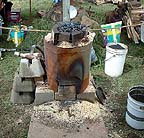
| Introduction to Smelting Iron is an intensive hands on program, roughly 18 hours in duration. Students will prepare materials, build a smelter, then fire it to produce a workable iron bloom. The 'Econo Norse' smelter that will be used was designed to be quickly constructed of easily obtained materials. It is fired with charcoal and uses an electric blower for air supply. A bloom weighing roughly 15 lbs is expected from use of about 40 lbs of ore. | 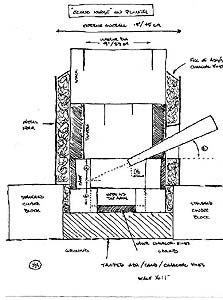 |
 |
| A number of video segments showing past smelts can be found on Darrell's YouTube channel |
Smelter Plan
|
Smelter Constructed
|
Friday Evening, the program starts with a background lecture covering the historical development and the practical elements of the small direct process bloomery furnace. (Typically 8 - 10 pm)
Saturday, the day will be spent constructing the 'Econo Norse' brick smelter itself. The smelt normally requires about 80 - 100 KG of charcoal to be smashed to size and sorted. Ore will be prepared, with various potential types being evaluated. At least some rock based ore will be roasted and crushed for the experience. Other furnace types will be examined (as part of ongoing experiments at Wareham). The working site will be prepared for the smelt the following day.
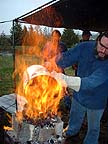
| A LONG day Sunday will start at 8 AM with the pre-heating the furnace. Any more charcoal required will be prepared. The now cool ore will be crushed (about 20 - 40 KG required) The initial charge of charcoal is scheduled for roughly 10 am. The actual process of the smelt takes roughly 6 - 7 more hours. Participants will learn the effective managing of an operating smelter, including adding fuel and ore, controlling air flow, and taping slags. Valuable experience will be gained in how to interpret the sounds of a correctly operating furnace. | 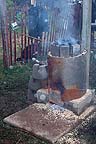 |
 |
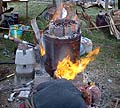 |
| Pre-heat Phase | Adding Charcoal | Tapping Slag |
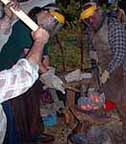
| After this, the resulting iron bloom will be extracted from the furnace - while the mass is still white hot!. It then is given a primary consolidation, compacting the surface using sledge hammers. The iron produced will be cut to sections and shared between the participants. | 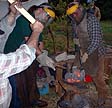 |
|
Cutting Bloom
|
A Finished Bloom
|
I am currently seeking additional students to round out this program. This is the ONLY course on these techniques AVAILABLE IN CANADA.
For more details, including registration, go to the full web site description.
Wednesday, March 27, 2013
How far we've come?
 |
| Paleolithic stone flake blades. Japan - 13,000 BC |
 |
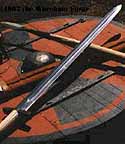
| Forged iron blades. England - c 900 AD |
 |
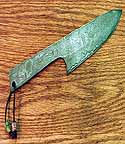
| 'Mosaic Damascus' by Conny Persson * |
The Cutting Edge : Considering Blades [Lecture - Rm 110 - 3:30 pm]As the presentation developed, it became more and more centred on the development of blade raw materials, and how they have influenced the basic possible shapes.
Cutting tools have been with us as long as we have been human. Stone, copper, bronze, iron - all these materials have determined the possibilities and influenced the shapes of blades. The bladesmith has long cloaked his craft in mystery, often to the confusion of the end user. This session will be a free wheeling look at both historic artifacts and a peek at techniques of the bladesmith. As well as attempting to suggest the correct common types for specific historical periods, consideration will be given on how to select and care for knives and other bladed tools.
Two things that always strikes me, when I look at the actual archaeological record:
1) The fundamental blade profiles are ancient in origin.
2) For almost all of Human History, working knives have been small - in the range of 7.5 - 10 cm blades (3 - 4 inches)
Although *modern* bladesmithing *art* is dominated by exotic alloys, elaborate processes, and complex ornimentation, this is very much different that the majority of cutting edges through history. Many of both the materials and methods seen in contemporary high end bladesmithing simply *did not exist* before the middle of the 20th Century.
* Hopefully this credit is correct. I scammed that image from a posting to a general discussion group, sourced out of Google Images. Nice work!
Subscribe to:
Posts (Atom)



 Posts
Posts