Monday, March 28, 2016

Into the 4th Millennium


Into the 4th Millennium

Hamilton Museum of Steam & Technology
 

April 1 - May 29

Demonstrations : Saturday April 2 

" The Museum will host a free event to open the exhibit on April 2, 2016 with an interactive forging demonstration 10 am to 12 pm and reception from 1 pm to 3 pm. "

www.hamilton.ca/attractions/hamilton-civic-museums/hamilton-museum-steam-technology-national-historic-site
Hamilton, Ontario L8H 7N2
Phone: 905-546-4797
Email: steammuseum@hamilton.ca
  • Tuesday to Sunday, 12 noon to 4 pm.

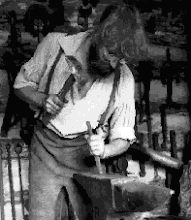
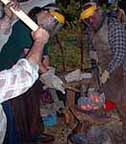
I was flattered by exhibit organizer Brad Allan to be selected as one of the artisans anchoring this presentation of the work of contemporary blacksmithing work.

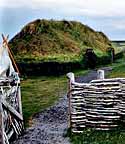
Along with contributing a number of objects, I will be undertaking a physical demonstration at the opening April 2. Here I will be using a Viking Age blacksmith's equipment (representing the first ironwork used in North America, circa 1000 AD in Vinland).

Other Ontario Artisan Blacksmiths participating:


Sunday, March 20, 2016

2 X short bits

Readers : You may have noticed a big gap in recent postings.
Life, the Universe, everything...

I * did * get that Ontario Arts Council Project Grant (!!!!)
This will put me in Belgium for the Ypres 16 event for the first week in September (see recent posts). Followed by four weeks at the Scottish Sculpture Workshop in Lumsden. First part is a continuation of the original Turf to Tools project, the second part my own investigations of the Scottish landscape through bronze and iron casting (and learning the techniques and equipment involved). Obviously much more on that to come.

The other things brewing here are seemingly endless work on travel arrangements, upcoming demonstrations / presentations and exhibit preparations. Again, expect to see some posts regarding those soon.

Here are a couple of short pieces pulled from recent e-mailed 'questions and answers'.*
Both relate to metal types, applications - and misconceptions :


Jeff wrote:
Hey, can you use wrought iron for a "flint and steel" or does it REALLY need steel? I would think any old iron bar would do, since the spark is going to spring from the oxidization of the iron.
A properly functioning 'steel' has to have both a higher carbon content - and just the right degree of hardness put into the metal after the finished forging.
What happens when you strike is that the flint tears out a small fragment of the metal.
The resistance to the tearing process is what accelerates the temperature, and the spark temperature and size is related to the hardness required to force the splinter off the surface. This in turn effectively pushes up the temperature of the splinter till it essentially burns - that is what the spark is (high temperature oxidation of the metal).

Too soft and the metal fragment does not get hot enough.
Too little carbon and there is not enough spark - or the resistance required to jump the temperature.

Honestly, This is one of those simple objects I have never had the best luck making - you have to establish and even process and the correct selection of metal to suit the best result.
Having good flint is also critical to consistent successful sparking as well. The black English is the best.

Like a lot of seemingly simple things, there is a lot of complexity behind this...

******

Alan wrote:
If I take a ball peen hammer and make a cross peen‎ or straight. Would I have to do a heat treat on it after I'm done my hamming?
Ideally - YES

Do remember that the base metal alloy in a hammer head should be higher carbon content than the mild steel you would be forging. These even despite that the metal being struck at forging temperature is significantly softer than any cold metal at the same alloy content.
Between these it tells you that you likely get away with just air cooling the re-forged hammer head, and using it in that state. You would eventually get some distortion / mushrooming of the striking surfaces.
But remember ancient hammers were just iron (not able to be hardened at all). These do show significant swelling at the striking faces - but did not effect the use of the tool.
Replica Norse blacksmith's tools (based on Mastermyr). Note swelling on the hammer face.
So the ideal is to harden and draw the temper back on your completed hammer head. This would produce the most durable tool.
Just how to best undertake this would depend entirely on the source alloy in the hammer head. Which is most likely completely unknown - right?

You might be better to leave your head a bit soft, and expect it to wear a bit faster. Getting the head *too* hard may lead to it cracking / even shattering  - at least potentially
Oil harden if you are going to attempt to harden at all would be my advise. Hammer heads I believe are tempered to a blue (but you should check that!)


* Readers Please Note : If you e-mail me and I follow up with a detailed response, I will often use those as the core of future blog postings. I will just use your first name and remove any other identity.

Saturday, March 05, 2016

Revised 2016 Schedule

Note Error : NO 'Layered Steel' program on August 27 & 28
I have received an Ontario Arts Council 'Project' Grant. 
This funds a one month of work at the Scottish Sculpture Workshop (Lumsden, outside Aberdeen, Scotland), related living costs and required transport. You can see the large block from September through early October for this project.

I have decided to extend this trip to participate in the Ypres 2016 event (Ypres Belgium) the first week of September.

I hope to attend the SCA 50th event in later June (Danville IN). This depends on my ability to mount an iron smelting demonstration / workshop at the event (still under discussion)

Obviously this all effects both the whole early Summer and especially the early Fall schedule.

Those wishing to book courses:
Should especially refer back to the main web site for the revised course dates. This especially applies to those considering Fall programs.
- At this point 'basic / introduction' courses are fully booked to the end of June.
- The normal early Fall / September basic course is cancelled
- The normal mid Fall / October basic course has been shifted to later in that month
 There are still spaces remaining in the 'special / advanced' level programs.

One major effect of the special projects I am undertaking this year is to heavily modify Iron Smelting events here at Wareham.
- The Spring Smelt has been pushed earlier to the Victoria Day long weekend.
- The normal Early Fall Smelt is in effect cancelled. 

Expect commentaries on all these special events as their dates approach...

Tuesday, February 02, 2016

'Barrel Turbine' : Elora Sculpture Project 2016

Not the strongest submission.
More of a concept rough - both the Ypres 16 and ESP 16 had the same submission deadlines (yesterday).
'Barrel Turbine' - Concept Rough
Elora Sculpture Project - 2016

‘Barrel Turbine’ - Concept

Elora has a history defined by its location on the Grand, the town developing around the various mills powered by its flow.

‘Barrel Turbine’ is intended to expand the primarily visual impact of the various entries into the Project by adding both motion and sound.
Visually, at least from a distance, the piece appears quite simple. The form is a representation of a large barrel, roughly five feet tall and three feet in maximum diameter. The shape is outlined by wide strips of steel, suggesting the wooden staves and metal bands of traditional cooperage. Between the strips, the spaces are filled with 1 inch square metal grid, which both protects and allows a view of the interior.
The barrel is topped with a ‘turbine’ shape, roughly 24 inches wide at the base and tapering slightly to 12 inches at the the top over its 18 inch height. The paddles of the turbine are formed of bright aluminum, a total of eight in all. The turbine is mounted on bearings that allow it to be rotated by the wind. This puts a larger motion to the piece, visible from a distance. Especially as the sun reflects off the rotating bright surfaces. This motion also provides the driving power for the internal mechanisms.

Inside the barrel are a series of moving parts, set along a central shaft that brings the motive power from the turbine above.
Some of these are rotating forms suggestive of gears and other machinery. These pieces will also be formed from light weight aluminum sheet. Bright paint will be used here and there to increase the impact of these moving parts.
There will also be a series of long rods with weighted ends which will serve as hammers. The rotating shaft will power the movement of the hammers. These will be linked and positioned to strike against hanging bars and strips. In total, this will create a random production of chime tones, shifting with the speed that the upper turbine is driven by the wind. The sound produced will be similar to that from a wind chime, and should have about the same ‘perception distance’.

Because the interior of the machine is visible through the protective grid work, a viewer peering closely will be able to see the various ‘machinery’ moving inside.
The large height of the overall piece is primarily to place the moving turbine high enough that small children can not access it. The height will also allow the turbine to catch more of the wind current needed to power it.
Overall, the piece should provide viewers with three different contact distances, with different impact at each. From across the street, the moving and light flashing turbine. From the side walk, the tones from the internal chimes. Up close the mystery of ‘how does this work’ and glimpses of working parts.


The illustration provided is more a concept rough than an actual clear illustration of the work. The approximate scale is 1: 8 (one square equals 2 inches). The left side approximates the exterior appearance. The right side gives some suggestion of the working / moving parts inside. It should be noted that at this point, there will need to be considerable experimentation / tinkering to determine the exact nature and placement of these interior parts.

The ideal placement is a location that naturally is exposed to as much wind as possible. The base mount situated at the south end of the bridge, across from the LCBO, may be most suitable.
Do note that ‘Barrel Turbine’ is a proposed work (rather than an existing piece).
 

February 15 - May 15, 2012 : Supported by a Crafts Projects - Creation and Development Grant

COPYRIGHT NOTICE - All posted text and images @ Darrell Markewitz.
No duplication, in whole or in part, is permitted without the author's expressed written permission.
For a detailed copyright statement : go HERE