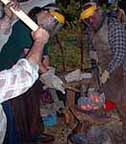
Arne Espelund can bear a certain 'responsibility' for getting me interested in the problem of researching working systems for Viking Age bloomery iron furnaces. I first met Arne at a Parks Canada workshop / research session in 2001. He has been a big help to me, and I have worked on a couple of experimental projects with him over the years since.
Arne was kind enough to send me an early copy of his latest book 'Evidence & Secrets'. I got about a third of the way into it, then got side tracked by other work (life...). My intent was to provide a personal review, then promote the volume as I could.
Wednesday, April 30, 2014
Wednesday, April 23, 2014
Elora Sculpture Competition - 2104...
... or, what else I am working on just this moment.
Proposal : Elora Sculpture Project / 2014
(below is a copy of my original submission description)
Artist's Description :
' Nature or Nurture? How closely are our objects inspired by nature, and that nature be found in even our most aggressive tools? Is it form or function that dictates?
The art of the ancient Celts was clearly influenced by the natural world. Are we looking here at a bundle of weapons, warped back to organic shapes? Or a grove of plants, frozen rigid? '
'Spears of Summer' is born of organic shapes I have been working with for some years now. Forged metals can shape and flex in a very organic way, and these processes have joined with my long immersion in the designs of the ancient Celts and Norse. Here individual shafts curve in an expanding helix from a circular base. Each ends in a flattened 'spear' shape. Individual blades are edge punched in the long strokes of Celtic Ogham runes. (The text I am leaning to is 'From the furry of the North, deliver us' *) These details are accented through the use of highlighting with contrasting coloured paint. The lower shafts and thick base are left untreated so to allow for natural oxidation with time.
This is intended as a tall sculpture, the scale an important aspect of the intended impact.
Technical Details :
There will be between 8 - 12 individual upright elements (determined by the visual impact at full scale). These are forged from 1 1/2 or 2 inch wide by 1/8 web angle steel. The spear shaped ends are each roughly 3 or 4 inches wide (as flattened), and roughly 18 inches long. The 'stem' is formed by collapsing the angle into a rough cylinder form.
The base will be an irregular circle, cut from 1/4 inch thick steel plate. Each of the stems will end in a threaded rod (welded into place). This will allow individual uprights to be simply bolted into place on installation. (This arrangement also permits a certain amount of modification of location and position of each element, allowing adjustment of the overall sculpture.)
The base plate will be prepared with holes allowing it to be easily mounted to the prepared support on site.
Asking price : $2500
Proposal : Elora Sculpture Project / 2014
Title : 'Spears of Summer'
![]() |
| 'Spears of Summer' overview |
![]() |
| Design details |
(below is a copy of my original submission description)
Artist's Description :
' Nature or Nurture? How closely are our objects inspired by nature, and that nature be found in even our most aggressive tools? Is it form or function that dictates?
The art of the ancient Celts was clearly influenced by the natural world. Are we looking here at a bundle of weapons, warped back to organic shapes? Or a grove of plants, frozen rigid? '
'Spears of Summer' is born of organic shapes I have been working with for some years now. Forged metals can shape and flex in a very organic way, and these processes have joined with my long immersion in the designs of the ancient Celts and Norse. Here individual shafts curve in an expanding helix from a circular base. Each ends in a flattened 'spear' shape. Individual blades are edge punched in the long strokes of Celtic Ogham runes. (The text I am leaning to is 'From the furry of the North, deliver us' *) These details are accented through the use of highlighting with contrasting coloured paint. The lower shafts and thick base are left untreated so to allow for natural oxidation with time.
This is intended as a tall sculpture, the scale an important aspect of the intended impact.
Technical Details :
There will be between 8 - 12 individual upright elements (determined by the visual impact at full scale). These are forged from 1 1/2 or 2 inch wide by 1/8 web angle steel. The spear shaped ends are each roughly 3 or 4 inches wide (as flattened), and roughly 18 inches long. The 'stem' is formed by collapsing the angle into a rough cylinder form.
The base will be an irregular circle, cut from 1/4 inch thick steel plate. Each of the stems will end in a threaded rod (welded into place). This will allow individual uprights to be simply bolted into place on installation. (This arrangement also permits a certain amount of modification of location and position of each element, allowing adjustment of the overall sculpture.)
The base plate will be prepared with holes allowing it to be easily mounted to the prepared support on site.
Asking price : $2500
Monday, April 21, 2014
'Viking Ireland' - as video
Archaeology blogs, Irish Archaeology Sites, News
April 8, 2014
Labels:
archaeology,
Viking Age
Tuesday, April 15, 2014
Replica - Meat Spit from Lund
A recent order was for a replica of a Viking Age Meat Spit, the original object found at Lund Sweden:
The starting stock for the shaft of the spit was 1/2 inch square mild steel. To duplicate the look of the original starting bar, this material was hammered to slightly reduce the 'industrial' dimension. This also creates a slightly irregular surface.
The artifact shaft is twisted along its length. To mimic the effect of the original use of a smaller heat zone (via a Norse type charcoal forge), individual segments were reduced to roughly 10 cm long. Each segment was given two complete rotations. With careful work, the result is a subtle shift in pitch over the smaller individual segments.
The 'spear' end started with a separate piece of 1/4 x 1 inch flat mild steel bar. The material was drawn to a tapered point (tapers in thickness as well as width) over about 30 cm. Then a diamond cross section was hammered, to create a double edged blade. This was intentionally left only 'hammer sharp' - in use, it is the sharp point that allows meat to be pierced.
The next major step was fitting the two main elements. The base of the spear was compressed between the points. The end of the shaft was slit open, then forged down to fit the spear.
here
The last steps were to create a round ring, then prepare the top end of the shaft for curving to a small loop to hold this ring. The material for the ring was forged round from 1/4 inch square stock - again to create the correct type of surface texture.
The finished meat spit was just slightly larger than the original artifact. Artifact at 110 cm / replica at 120. (This due to a simple math error on my part!)
Although not part of my standard 'inventory' of Viking Age replica cookware, I have in fact replicated this object a number of times in the past.
As detailed here, 2014 price would be $150 CDN.
![]() |
| Original notes - Spit on left |
![]() |
| Showing the profile hammering (change at hammer peen) |
![]() |
| Finished re-profile, first twist in place |
![]() |
| Twisting individual segments |
![]() |
| Blade portion rough forged |
![]() |
| Bar split to start drawing points |
![]() | |
| Points drawn to cylindrical points & curved forward |
here
![]() |
| Two elements fitted for welding |
![]() |
| Completed ring installed |
![]() |
| Finished replica |
Although not part of my standard 'inventory' of Viking Age replica cookware, I have in fact replicated this object a number of times in the past.
As detailed here, 2014 price would be $150 CDN.
Labels:
blacksmith,
cookware,
norse,
objects,
Viking Age
Subscribe to:
Posts (Atom)