I was a bit surprised that I have been asked to contribute to a very good series underway over on Don Fogg's Bladesmith Forum.
The series is entitled 'Knifemaker Interviews'. The idea was started by Christopher Price. Some of the best known and respected names have been included. The method is that Christopher asked a selected bladesmith (it was Allan Longmire) :
How this works: I will start by inviting a member here to an interview, where we'll discuss their history, views of the craft, their relevant background, and what makes them tick. They, then, will interview someone else, and so on as long as we have people willing to pour out their hearts and metalworking souls online for this community to share in.
Individuals have given intensely personal observations on their work and purposes, on the Arts and sometimes world view in general. This is inspiring stuff!
I was extremely flattered to be asked by Sheldon Browder (retired master smith from Colonial Williamsburg and fellow member of the Early Iron Group) to take part :
Posted Today, 08:57 AM
Quote
Darrell, i think that Some discussion of your connection with Viking
iron making a t L' Anse au Meadows might be a good place to start.
A fast start : I am especially honoured (and humbled) to be included in such august company. There are a great many names here from who's hands I have always seen spectacular work. (An awful lot of 'I wish *I* could have made that one'!) Some have come to be friends over the years, much to my surprise and gratification. I hope it proves I can add something to this quite wonderful (and informative) ongoing conversation.
At its best, this series reminds me a bit of an artist's round table at an extremely good conference...
To the Question:
You may personally find a curious circle here Sheldon.
(Cautionary note : This is how I remember this - maybe not the truth of what it really might have been!)
Second Cautionary note : I am not known for short answers!
I was working as the blacksmith / historic interpreter at Black Creek Pioneer Village (Toronto Ontario) in the mid to late 1980's. This is one of those synthetic historic villages, composed of buildings moved from their original locations and restored to the dates of construction. The span there is roughly 1816 - 1865. The blacksmith's shop was intended to be some vague 1850's time period. Individual interpreters came into the Village mostly self taught, and mostly spent their days working alone. (There was no internal training program such as exists at Colonial Williamsburg in Virginia.)
I had started my journey into living history through a deep interest in the Viking Age. I had literally fallen over the then fledgling Society for Creative Anachronism group at University of Toronto while a student at Ontario College of Art. (As many are sure to know, this is a very loosely Medieval themed organization.) As I was a young male, armoured combat (as it was developing in the SCA in those days) was something I was enthusiastically involved in. If you wanted armour back then (late 1970's) you pretty much had to build your own. A need for something at least vaguely approaching historic objects for costumes lead me to my first knives. (How I picked up a hammer for forging a longer tale!)
So that (roughly) sets the scene.
In general research, likely via the ALHFAM journal, I had seen an article describing a project undertaken by a team at Colonial Williamsburg. The name I * remember * is 'David Harvey'. (Shel, you might remember this - or have even been involved?) Anway, the project was an attempt to convert a local iron ore into a metallic mass. As I remember it, this was done using a deep built forge hearth, firing charcoal. The results were marginal, with enough metal produced to make a small chisel. (In retrospect, this all sounds like the variation on the Aristotle Furnace Tim Young had suggested to the Early Iron Group at Smeltfest a couple of years back, you certainly remember. Lee Sauder and Jesus Hernandez both took the lead on those experiments.)
Back to the thread - I had been 'offended' by the statement made in the published article : 'This process replicates the First Iron Production in North America.' Like all Canadians, this kind of thing gets the maple syrup in my veins just a boilin'. * We * all knew the very first iron produced in North America was at the hands of the Norse, at 'Leif's Houses' (northern Newfoundland) in Vinland - some time about 1000 AD.
So in the back of my head, as early as about 1990, was the idea of demonstrating the Viking Age iron smelting process.
Through a long chain of events (including a huge amount of mindless self promotion). I would develop a working relationship with Parks Canada, the L'Anse aux Meadows National Historic Site (LAM), and Dr Birgitta Wallace. This all over the 1990's, with many trips out to the site from my home base in central Ontario. (For those not familiar, that's a two and half day drive, an eight hour ferry, then another full day's drive.)
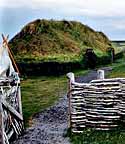
In 2001, Parks Canada received a corporate grant to re-create the small 'Furnace Hut' at LAM. The original was a roughly 3 x 3 metre structure, open on one side, dug into the bank of the Black Duck Brook. It appears to have been purpose built to contain a small clay walled iron smelting furnace. The furnace was either broken on bloom extraction (my best guess), or purposefully converted into a deep forge for the required compaction phase. The archaeology suggests only a single firing, a smaller furnace run with a fairly low yield. ( I can elaborate on all that if people ask about it.) I was part of small research group, intended to establish how best to equip the replica building and then interpret the historic event to the public. Dr Wallace represented the archaeological side. Archaeo-metallurgist Arne Esplund (from Norway) for Norse iron smelting. I was the interpretive / practical side. The working staff was represented by Mark Pilgram, one of the local people I had trained on a special six week program in 2000.
As part of the week long workshop, Marc and I, working from prototypes provided by Birgitta and Arne, * attempted * to smelt iron. Attempted being the key word here. As later experiments would prove, we did just about every single thing wrong!
I got back from that session determined to 'get this to work'. I wrangled (inspired / dragged kicking and screaming) my new group of Viking Age living history re-enactors, the Dark Ages Re-Creation Company (www.darkcompany.ca) into providing the required manpower.
Starting in 2002, we undertook a series of individual experimental iron smelts, concentrating on Norse type 'short shaft' bloomery furnaces. Our first attempts (also dismal failures) were using human powered Viking Age type blacksmith's bellows.
In 2003, a small group of us attended a demonstration by Lee and Skip Williams held at the American Museum of Frontier Culture in Staunton Virginia. Generous as always, Lee and Skip took us in and folded us into the demonstration. (Or at least let me badly explain what was going on to the general public - while they concentrated on the real work!) I certainly learned a huge amount that day.
Spring 2004 back at Wareham was another failure, but did gain us the friendship of Mike McCarthy. (Mike stopped by on his way back from a week with one of the Japanese iron masters.)
Fall of 2004 and a combination of pissy wet and cold weather, too late a start, beer for very late lunch - and a general WtF attitude... We not only stumbled on a easy and quick to build brick furnace design (what came to be known as the 'Econo-Norse') - we actually got iron!
By that point (what was my 5th / 6th iron smelt) I had realized that I had to pull back to basic principles. That *first* I had to learn how to effectively smelt iron, developing some standard methods and some kind of effective methods and base level understanding of the processes.
*Then* go back and attempt to remove individual modern elements, one by one, to work backwards towards a possible Viking Age method.
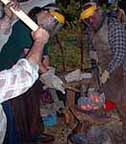
The direct process of this was a series of five experimental smelts DARC undertook from 2009 through 2010. This ended with a full scale re-creation of the historic smelt at Vinland, inside that same replica building at LAM. This public demonstration was undertaken using all Viking Age equipment (save modern safety gear). The end result was about the same as the archaeologists had estimated for the original event. About 20 kg of ore was converted to a roughly 3 kg iron bloom.
Dr Wallace was present for the demonstration, and confided to me after that she felt she would have to alter her earlier impressions of both Norse iron smelting, and more significantly, just what that ancient undertaking was really intended for. (I had always had big reservations about how the archaeologists had interpreted the artifact evidence - and its implications.)
I'm still wondering about the implications of air flow inside Norse type short shaft bloomery furnaces. More experiments to follow for sure. My team has also been working on a related system from Viking Age Iceland, working closely with Kevin Smith (Brown University).
The hard core knife makers here may notice this is straying a very far distance from bladesmithing.
Something Lee said once : 'You should kill what you eat'
The materials available to ancient blacksmiths are quite different compared to our modern metals. Further, how those materials were created in themselves alters the relationship ancient smiths had to their materials.
I will hardly claim to have that all figured out. But using historic methods to produce the source materials does alter my perceptions of the object itself...
(I think more than enough for one go round?)





 Posts
Posts