Monday, December 30, 2013

A Viking Age 'Folding' Knife?


Posted by Julia on 27 December 2013 - 02:42 PM (Bladesmith's Forum)
I am doing some research into folding knives from the early medieval period.

So far I have tracked down a few of examples:

York find 13816 - Folding knife from Fishergate, York. - Late 14th Century
London find 309 - Folding knife from London (currently held in Museum of London) - Late 13th Century.
London find 310 - 14th Century.

Does anybody now of any other examples of Folding Knife finds, ideally from the 11th-13th Centuries in the UK/Western Europe?


This is a 'folding' knife, but in this case more of a swivel to present one of two cutting edges. I have made replicas of this blade several times, and the combination of short straight and longer slightly curved has proved excellent for small scale wood or antler carving.

You suggested 'early medieval' - this knife is from the Viking Age in England.
I have a copy of the almost impossible to find 'Viking Artifacts' and have included a direct scan of the images and related text.

I have seen a couple of folding blades that have a long stem that extends the line of the back of the knife. There is a pivot at the base of the blade. This allows you to fold the blade out of the handle, holding down the stem with your thumb to hold it in the open position. One had a wood / antler handle, one had a folded metal handle. Not sure if I have images (or specific details).

Attached Images

  • folding-knife.jpg

Tuesday, December 24, 2013

Knifemaker Interview - Part 6


I'm trying to set up the next person in the series. Might be a bit delayed considering the time of year!

I really did not get much of a chance to wax poetic about bladesmithing, so in the mean time, I thought I would shove in some past pieces with short comments. Mainly trying to use work that illustrate specific concepts or lessons.


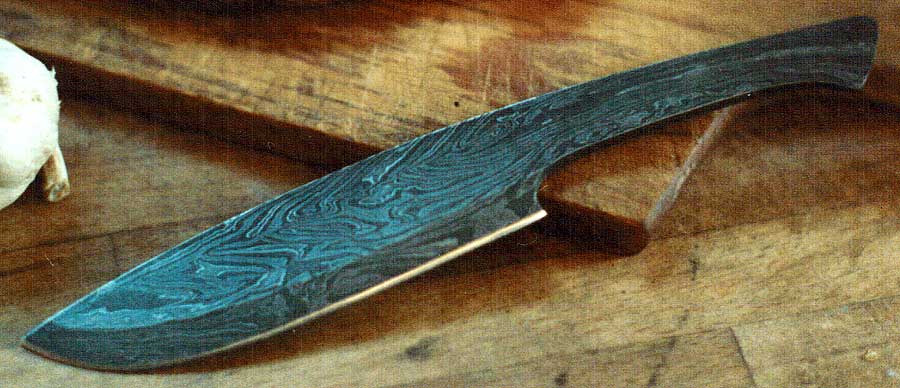
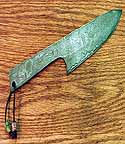
http://www.warehamforge.ca/KNIVES/kitchenknife1.jpg

Kitchen Knife - 1996 (about 11 inches overall)
About 225 layers, mild / wrought iron / 1095


I have always been most interested in the variations in patterning caused by the effect of the hand hammer on a layered steel billet. Creating random, rather than the regular and geometric, lines. My deep interest in Nordic artifact and design aside, the twisted diagonals of multiple core rods create lines that I find most desirable. (I certainly do appreciate the degree of control and precision required in Middle Eastern styles, they just do not appeal to me aesthetically.)

Years back, I had seen some artifact samples of one piece kitchen knives from Roman England in the collection of the Royal Ontario Museum in Toronto. Add to this that I am not that interested in the jewellery like work demanded by ornamental hilting. I consider a good functional knife should have a heavy weight tang, which means covering over a big chunk of layered materials.

Put all these design concepts together, and what resulted was a series of one piece knives, many intended as heavy kitchen knives.


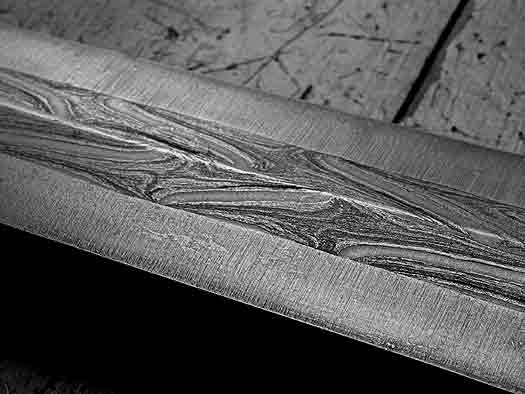
http://www.warehamforge.ca/KNIVES/SwordofHeroes/sword-close-2.jpg

'Sword of Heroes' - 2000 (22 inch blade)
Two nine layer cores with spring steel edges
Hilt is forged steel guard, moose antler, with cast in place pewter pommel weight.

(Yes, those are welding flaws to those looking closely!)

I had been making a lot of pattern welded knives into the 1980's and 90's - with good success with the welds. In arrogance, I thought I was able to move to sword sized lengths. To double the presumption, I accepted a commission for a 2/3 scale version of the Sutton Hoo sword. (eight *complex* twisted cores with 150 layer edges)
Wrong, wrong, and wrong.
Six weeks of work to the quench. A sharp crack.
I ended up with an eight inch knife.

Oh - by the way:
Don't attempt to do long complex welds in an unheated shop - in what turned out to be the coldest winter here in 150 years...


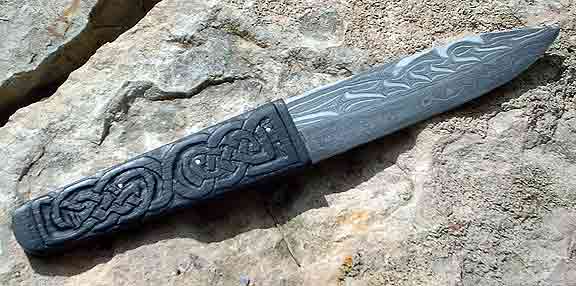
http://www.warehamforge.ca/KNIVES/knives07/ramsayR.jpg

'Wedding Sgin Dubh' - 2006 (5 1/2 inch blade)
About 260 layers of mild / L6 / wrought iron / 1095
Handle of bog oak (2000 year old Roman dock from London)


Layered steels certainly look great, but straight carbon steel will give a much better *working* edge. My personal approach is to make the back half of the blade of twisted rods, and the edge side of two layered slabs with a solid carbon steel core. The two separate pieces then are welded together to make the starting billet. This maybe adds an extra step, but I think gives a better *functioning* blade.


http://www.warehamforge.ca/temp/hectors-mark.jpg

'Hectors Bane' - 2012 (about 11 inches)
Bloom iron with spring steel core

I know I have been strongly influenced by the work and concepts of Lee Sauder. A bit of the similarity of approach may also lie with our shared feeling about to the whole 'art and mystery' of bloomery iron.
I also think that the raw and fractured edges of a parent bloom are an important part of the intrinsic nature of the material.
I have far more raw blooms than consolidated billets, fewer still are the billets that have been worked into objects. Most of the completed objects so far have been simple historic based pieces.

I am quite torn right now on this - how best to utilize my iron blooms. Refining this material, so massively difficult to create, down to perfectly consistent working bars, seems pointless to me (Sorry to some of my research partners and friends reading). The intrinsic quality of bloomery iron is hidden in that perfection.
Sad truth is that within blacksmithing overall, the single best way to turn the effort of all our work is through creating highly ornamented knives. I'm still struggling with all this - the best way to turn the unique qualities of bloomery iron into decorative objects that can both reflect their unique origin, but also command the $$ value that would attempt to provide for all that specialized work.


I hope everyone, with all our different personal paths, are able to finally put up the hammer for a couple of days, and sit back with a beverage of choice. Try to reflect on just how much you have actually *done*, not just the long list of what still remains to be tackled. (And boy, I wish I could be better at taking my *own* advice!)

Saturday, December 21, 2013

(Medieval +) Iron Production - Animated


 Passed along by Don Abott (via the Bladesmith Forum)


http://youtu.be/68xYjUvJjMs

One major point : this represents late Medieval iron production - the use of a large blast furnace to convert iron to a high carbon cast iron. This is a two set process (as illustrated), with the resulting ingots needing a second carbon *reduction* phase to convert the material to a lower carbon wrought iron which can be forged (hammered).

Thursday, December 19, 2013

Knifemaker Interview - Part 5


Shel, on 15 Dec 2013 - 13:17, said:So, one last question Darrell. Was all of this, in your thoughts, much as was the iron making efforts at Jamestown, an expedition looking for useful resources?

To keep to the question (at least to start...)

A larger consideration of just what Leif Eirikson was attempting with his voyage(s) is critical to placing the whole Vinland adventure into a meaningful context.
His father, Eirik the Red, was described in the Sagas as first exploring, then organizing and establishing the *successful* Greenland colony : 'So he could be chieftain, and then himself be the one who decided who would be banished or not'. Remember that Eirik was called 'the Red' for his considerable violent temper, which had lead to 'killings' in both Norway, then Iceland, resulting in banishment from both.
Leif would have been a younger man on both these moves (Norway / Iceland / Greenland), and certainly serving as a second in command for the Greenland exploration and later colony establishment. The Greenland Norse certainly knew that there was territory to the west, unexplored but certainly glimpsed by travelers storm tossed on Iceland to Greenland voyages. The Saga tales certainly paint a picture of a family well known for exaggerate, bold in action, and seeking to establish their fame (and power). It would be perfectly natural for Leif to want to explore and place his hand print on new lands - and perhaps be just a wee bit 'generous' in his descriptions.
First thing to remember is that 'Vinland' is a *region*  - not a single isolated place. When Leif speaks of his 'Land of Vines', he is in reality speaking of the entire modern Gulf of St Lawrence area of Canada. Newfoundland, the North Shore of Quebec, NE shore of New Brunswick. This last is proven by the find of three butternuts at LAM, a tree that has never grown further north than modern day New Brunswick. Significantly, wild grapes also are found in the same areas (grapes have never grown in Newfoundland).
The comparison here would be L'Anse aux Meadows is to Vinland as Jamestown would be to greater Virginia.

Unlike Jamestown, Leif never attempted to colonize Vinland, and 'Leif's Houses' at L'Anse aux Meadows is not a colony. The correct way to think of the place is as an outpost, a combination exploration base and lumber camp. Although there are hints in the Sagas that a farm settlement might have been attempted, the truth is that the young Greenland colony still had good land available, and itself was too small a population to support the effort needed.
Although the climate in Greenland (and throughout Northern Europe) was warmer in the Viking Age and Early Medieval periods, there was never any supply of timber on Greenland itself. Timber was needed to build houses in the Norse longhouse style, and also for ship construction.  It has been demonstrated via dendrochronology that many of the building timbers used in Greenland over its 400 year active Norse occupation were in fact cut in what was called Markland (modern day Labrador)
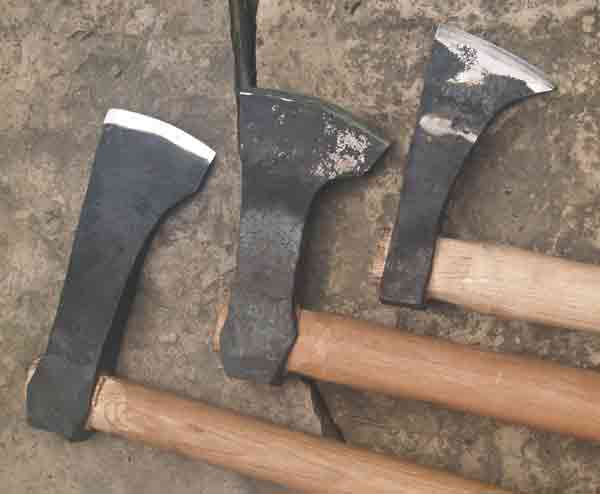

Part of the set of Norse shipbuilding tools I made for LAM in 2008 (Blog Posting)

Unlike Jamestown, Leif's Vinland explorations were never intended as a commercial venture. The mechanic is more likely that individuals would have taken part on the voyages, trading their labour against a share of the actual logs harvested. Back to Greenland, they would then be able to build houses on their own farm holdings for growing families.

As with Jamestown, it is most likely (and my opinion, now shared by Dr Wallace) that the single iron smelt at LAM represents a resource test. A factor to consider is that although there is primary bog iron ore on Greenland, there is no wood suitable to generate the large volumes of charcoal required for bloomery iron smelting . Iron objects would remain one of the primary imports into Greenland for the entire life of the settlement.
It would be natural for Leif, eager to brag about the excellent qualities of his discovered lands, would want to add 'everything to make good iron' to the list. The fact that iron was *not* included to the list of : timber, fish, grain, grapes may be more significant.
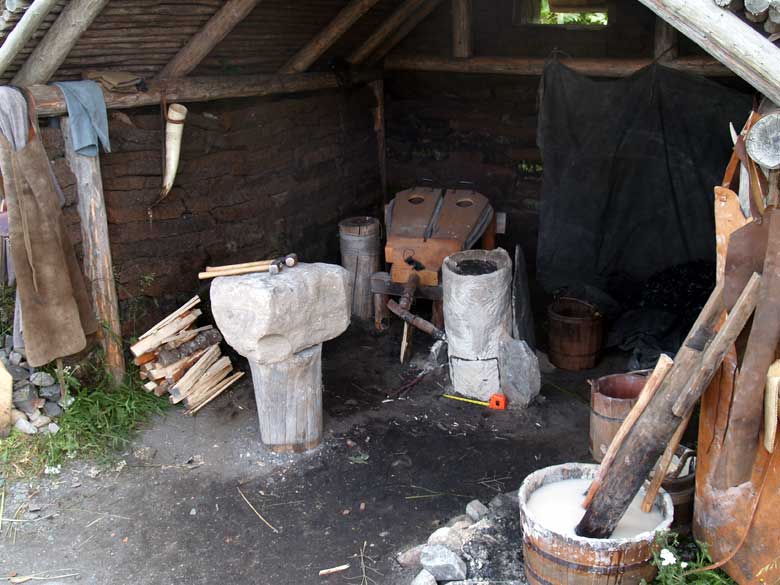

Before the 2010 demonstration smelt - inside the reconstruction of the 'Furnace Hut' at LAM

The Norse at Greenland did go to the (considerable) effort of building a dedicated structure to house the iron smelting effort. The archaeologists kind of glossed over this labour, with a kind of 'of course they would do so'. Truth is that the weather at LAM is not *that* foul, and our own experience has certainly proven you can build a small bloomery furnace one day, then fire it the next. Couple this with the small amount of physical remains certainly suggesting only one smelt attempt was undertaken. Perhaps they had fully intended more production, but that first attempt was so marginal that they never duplicated the effort? Some things we can never really know.
 

February 15 - May 15, 2012 : Supported by a Crafts Projects - Creation and Development Grant

COPYRIGHT NOTICE - All posted text and images @ Darrell Markewitz.
No duplication, in whole or in part, is permitted without the author's expressed written permission.
For a detailed copyright statement : go HERE