Thursday, June 25, 2009

Cold Forming Reversal Curves - on YouTube


Work on the Reade / Maxwell project continues...

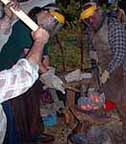
This sequence was shot as I made up the last of the 'undertow' elements.

Each of the curves is formed of a length of 1 1/2 x 3/16 inch flat bar. Depending on the element, the starting pieces range from 5 1/2 to as much as 15 feet long! For that reason alone, the sweeping curves are shaped COLD, using a metal bending machine (purchased specifically for this project).

The total elapsed time to form just the main body of one of the larger elements ranged from 45 to 30 minutes. For this video segment, I filmed the process as I worked, and then did some edit magic to speed up the film to about 2 x speed for the bulk of the process.

Saturday, June 20, 2009

Free Guide : 'The Art of Managing Your Career'

June 19, 2009
CHRC releases the second edition of
The Art of Managing Your Career

" The Art of Managing Your Career is a resource guide for self-employed artists and cultural workers in live performing arts; writing and publishing; visual arts and craft; film, television and broadcasting; digital media; music and sound recording, and heritage."

"The Art of Managing Your Career and its discipline enhancements were developed by artists and cultural workers to provide emerging self-employed artists and cultural workers with pertinent and practical information to better manage their careers."


http://www.culturalhrc.ca/amyc/index-e.asp

Cultural Human Resources Council (CHRC)
201-17 York Street, Ottawa, ON K1N 9J6
Tel. 613-562-1535 Fax 613-562-2982

The complete guide is available as six individual PDF files which can be downloaded from the web site above. (Each segment roughly 150 k, so a fast download even on rural dial up.) Individual chapter sections:
Chapter 1: The Culture Biz
Chapter 2: The Art of Self-Promotion
Chapter 3: The A to Z of Project Management
Chapter 4: Money – Keeping Track
Chapter 5: You and the Law
Discipline Enhancement: Crafts

The guide is free (for once an positive example of tax dollars at work). It will be especially useful for those considering developing a 'career' as an Artisan Blacksmith.
(This information passed along via the Metal Arts Guild)

Friday, June 19, 2009

"If only I could BOTTLE it..."

I love my friends (really). But sometimes they are so smart they are dumb. Clearing up after the iron smelt on May 30, one of the things left behind was a 4 litre container of 'bottled' water.


So look - we are on a well here in Wareham. Its a deep drilled well, something like 150 feet. This is important, as there is 30 - 40 foot thick clay layer down about 30 - 50 feet below ground level. A lot of older houses around Wareham use shallow dug or 'sand point' wells, which means they pull water off the top layer. This is of course most likely to also include agricultural by-products. Not to mention often means water is plentiful in spring, when the water table has risen as high as 6 inches below our ground level (!). Come August however, these shallow wells run dry.
Our well is down well beneath all that, into the limestone of the Niagara Escarpment. As far as I know, that water has been down there since the last ice age.

Now take a close look at that label. It says "Natural Spring Water", which I can tell you is a bald faced lie. That water is pumped out of a deep drilled well, not collected from a 'natural spring'. Look at the middle bottom - it says "Source at Feversham, Grey County, Ontario". The extraction and bottling plant is exactly 12 kilometers from my own well.

Get it? Its exactly the same water that comes out of my home taps. I guess it has been 'Ozonated' (what ever the hell that means). My home well water is not.

What did that bottle cost? Next time, just bring an empty container, fill it from my kitchen tap, and leave the two bucks on the counter....

Tuesday, June 16, 2009

What Six Hours gets you...


This is what I got done today in six hours of shop work.

The actual forged rush tips were completed late last week (as described in a couple of recent posts here). The steel stock for the first half of the project arrived mid Friday. So what I did today:

1) The shafts for the uprights were cut from 20 foot lengths of 3/8 and 1/2 round stock, to 48 inches. I could cut four pieces at a time, but with round stock I have to take care with the action of the band saw (can't leave it to cut on its own).

2) With the MIG welder, attached the prepared rush tips to their respective rods.

3) On the smaller tips (3/4 diameter on 3/8 rods), each piece was then ground to remove any large lumps or beads of weld.

4) Next these pieces were heated in the gas forge, and the area between rod and tip was forged to even out the shape. As well the tips were adjusted to that they were in a straight line with the shafts.

5) While still hot, most pieces got a second grinding to smooth off any bumps or uneven spaces.

In total, about 60 pieces were cut and welded. A little less than half that number undertook the full work up. (the bundle of smaller sized rushes to the left in the image).

So - what do you get paid for a full working day?
 

February 15 - May 15, 2012 : Supported by a Crafts Projects - Creation and Development Grant

COPYRIGHT NOTICE - All posted text and images @ Darrell Markewitz.
No duplication, in whole or in part, is permitted without the author's expressed written permission.
For a detailed copyright statement : go HERE